Hardline Conservative Jallili and 90,000 Vote Gap... Victory Prospects
The runoff vote for the Iranian presidential by-election has concluded, with centrist and reformist candidate Masoud Pezeshkian (70) reportedly holding a narrow lead in the early stages of vote counting, according to AP News and others on the 6th.
Iran's state TV reported early vote count results announced by the election commission in the early morning, stating that Pezeshkian is slightly ahead of hardline conservative candidate Saeed Jalili (59). According to the election commission, Pezeshkian received 2,904,227 votes, leading Jalili, who garnered 2,815,566 votes, by about 90,000 votes.
As a result, there are expectations within Iran that Pezeshkian may win the presidential election.
The runoff held the previous day was a direct contest between Pezeshkian and Jalili. The number of voters participating and the vote counting rate were not disclosed. Earlier, Iranian media reported that out of more than 61 million registered voters, over 30 million likely participated in the runoff.
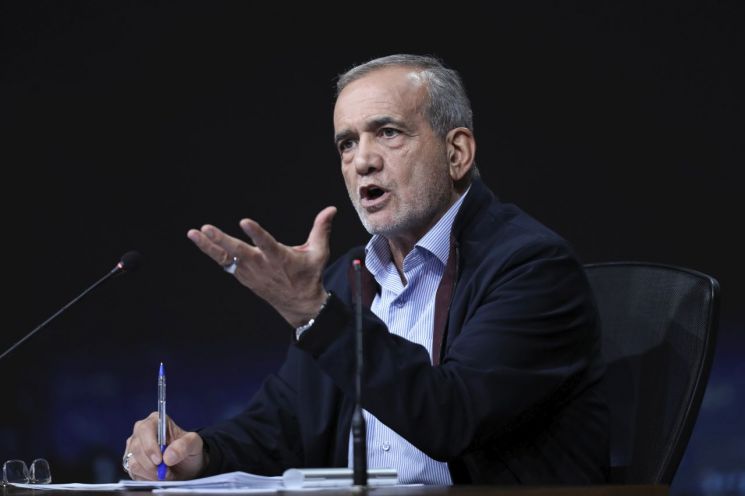 Masoud Pezeshkian, a presidential candidate in Iran, is speaking at a TV debate held at the IRIB TV studio, Iran's state broadcaster, in Tehran on the 1st (local time).
 [Image source=AP·Yonhap News]
Pezeshkian, a five-term member of the Majles (parliament), surprisingly secured first place in the first round of the presidential election held on the 28th of last month, with 44.4% of the vote. A cardiac surgeon by profession, he served as Minister of Health in the moderate administration of President Mohammad Khatami from 2001 to 2005. When he was the only reformist among the six candidates approved by the Guardian Council, he was initially regarded as a token candidate.
However, after the U.S. withdrawal from the Iran nuclear deal (JCPOA) in 2018 and the subsequent intensification of economic sanctions, he campaigned on improving relations with the West and easing hijab enforcement, appealing to reformist voters and younger demographics.
Jalili, a former diplomat, served as Iran's nuclear negotiation representative in 2007 and 2013. He defended Iran's nuclear program and confronted the West, and is considered a close aide to Supreme Leader Ayatollah Seyyed Ali Khamenei.
The Iranian presidential election was held unexpectedly following the death of President Ebrahim Raisi in a helicopter crash on May 19.
© The Asia Business Daily(www.asiae.co.kr). All rights reserved.
![Clutching a Stolen Dior Bag, Saying "I Hate Being Poor but Real"... The Grotesque Con of a "Human Knockoff" [Slate]](https://cwcontent.asiae.co.kr/asiaresize/183/2026021902243444107_1771435474.jpg)
















