'International Seminar on Gaming Disorder' Attended by Overseas Scholars
"No Clear Definition of Gaming Disorder Yet"
"Cautious Approach Needed for Disease Code Introduction"
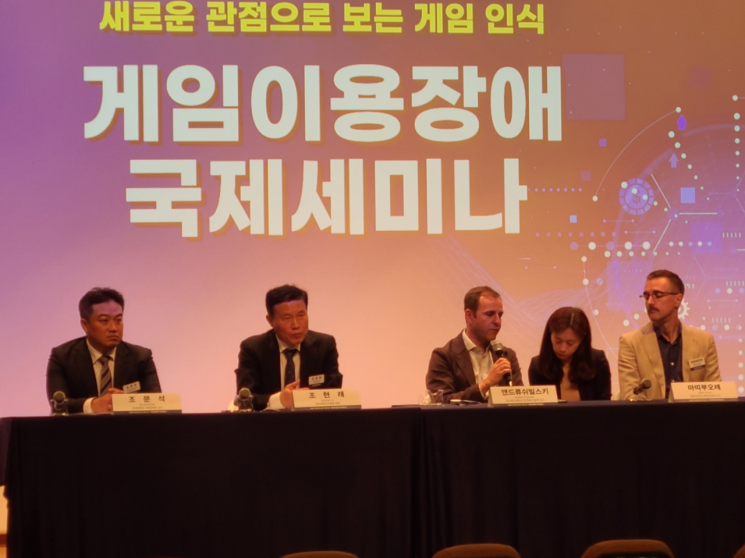
As the domestic introduction of the disease code for 'Gaming Disorder' defined by the World Health Organization (WHO) sparks divided opinions within the industry, overseas scholars expressed negative views on the adoption of the disease code, stating that "there is neither a clear definition nor consensus on the matter."
At the 'International Seminar on Gaming Disorder' hosted by the Korea Creative Content Agency and the Game Industry Association held on the 5th at the National Museum of Korea in Yongsan-gu, Seoul, Andrew Schivelsky, Professor of Human Behavior Technology at Oxford University, said, "Broadly speaking, more than half of adults are already addicted to technology, whether it be games, smartphones, or social media. However, diagnosing this as an addiction is another matter," adding, "In the UK, games are not considered addictive substances."
Professor Schivelsky stated, "From the perspective of a researcher and someone who has studied health and public policy, it took 20 years to adopt ICD-11 in the UK, which shows how long the process can be," and added, "I believe there is no clear definition of Gaming Disorder yet. More research and efforts are needed on how to study and treat it. Under the current circumstances, I do not view it positively."
Previously, WHO officially assigned a disease code to Gaming Disorder in the 11th revision of the International Classification of Diseases (ICD-11) in 2019. In South Korea, the current law mandates that the domestic standard classification must directly reflect the international standard classification. Therefore, it is highly likely that it will be directly incorporated into the 9th Korean Standard Classification of Diseases (KCD-9) to be applied next year. Both domestically and internationally, there is a conflict between the industry, which opposes defining games as a 'disease,' and the medical community, which argues that registering a disease code is necessary to address gaming addiction issues.
Matthijs Buure, Professor of Social Psychology at Tilburg University in the Netherlands, also expressed a negative stance on assigning a disease code. He said, "There are many conflicting opinions even among researchers. The assignment of a disease code is a controversial issue," and pointed out, "While individuals with problems can receive treatment, if a disease code is assigned, people who play games in daily life might be stigmatized as if they have a disability. It is a very complex issue, and there is no consensus among researchers."
Professor Buure also highlighted the limitations in information access for researchers and the general public. He said, "Researchers did not receive much information about how WHO's registration decision was made. The academic community was not provided with information on why this decision was taken," and added, "Open discussions need to continue."
Professor Jo Moon-seok of Hansung University’s Department of Social Sciences shared research results indicating that games cannot be seen as a direct cause of gaming disorder and emphasized the need for caution in adopting the gaming disease code. Professor Jo said, "After conducting research for four years, the research team did not find clear evidence that games are a direct cause of depression or anxiety," and added, "The results suggested that social, psychological, and environmental factors surrounding the user are more likely to act as preceding factors rather than Gaming Disorder being a direct cause."
Jo Hyun-rae, President of the Korea Creative Content Agency, also maintained a similar position to the professors. President Jo said, "Under the Prime Minister’s Office, the Ministry of Culture, Sports and Tourism and the Ministry of Health and Welfare are jointly discussing this through a public-private consultative body," and added, "If causes and effects are mixed, it can lead to problems where proper diagnosis is impossible. I believe we need to look objectively and derive results."
The government emphasized that it will support the positive value of the game industry, which accounts for 70% of Korea's content exports, through various policies. Yoo In-chon, Minister of Culture, Sports and Tourism, said in his congratulatory speech that "Despite the global status of K-Games, there still exists a negative public perception toward games. This is a misunderstanding stemming from incorrect prejudices about games and Gaming Disorder," and added, "We will support the spread of the positive value of games through various policies such as game literacy projects."
© The Asia Business Daily(www.asiae.co.kr). All rights reserved.

















