2nd Anniversary of PIM Design Research Center Opening
"Reducing Data Processing Time and Power Consumption"
Joint Research with Samsung and SK Hynix
"If semiconductors are developed well, it is no different from discovering oil fields. I believe that intelligent semiconductors (PIM) that save both energy and time are the answer for the future."
Yu Hoejun, Director of the KAIST PIM Semiconductor Design Research Center, is a leading figure in the research of PIM (Processing in Memory), emerging as the next-generation artificial intelligence (AI) semiconductor. Last month, at the semiconductor academic conference ‘VLSI Symposium’ held in Hawaii, USA, he attracted attention by presenting a method to apply PIM technology to DRAM together with Samsung Electronics. The VLSI Society is one of the world’s top three semiconductor societies, covering everything from process, devices, to circuit design.
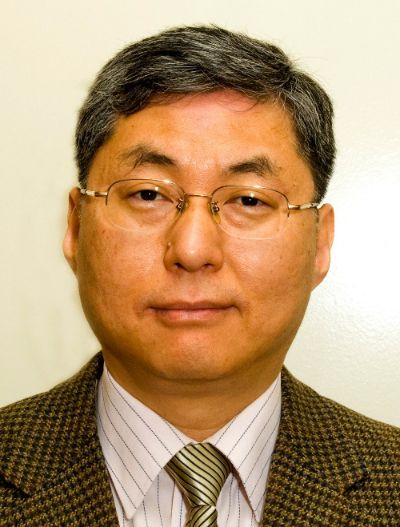
The PIM Semiconductor Design Research Center he established at KAIST recently celebrated its 2nd anniversary. This research center was selected as a national project and will lead PIM research until 2029. He is active across the semiconductor field in areas such as PIM-related human resource development, industry-academia joint technology development, and overseas networking. He also serves as the Dean of the KAIST Graduate School of AI Semiconductor and as President of the Semiconductor Engineering Society.
In a recent interview with Asia Economy, Director Yu emphasized several advantages of PIM. He said, "PIM is a semiconductor that performs computation in the memory where data was temporarily stored," and added, "Because it saves both time and energy simultaneously, it can greatly improve efficiency."
Currently, NVIDIA’s GPUs used in AI consume a lot of power, making sustainability a challenge. Director Yu stated, "According to energy statistics, the power consumption of data centers worldwide has reached a level comparable to that of the entire United Kingdom," and added, "Our government is also concerned about the concentration of ‘electricity-guzzling’ data centers in the metropolitan area." He further explained, "Since PIM performs computation where the data resides, it is faster and saves energy," predicting, "It will be about 900 times better than existing systems." He explained that the data transmission path can be improved by 30 times compared to existing systems, and power consumption can be reduced to one-thirtieth.
Director Yu has served as the lead designer for DRAM in the semiconductor industry. Starting with SK Hynix in the early 1990s, he researched game chips similar to PIM in 2000 before entering academia in 2006. He explained, "In October 2020, I presented PIM at a meeting attended by then-Prime Minister Chung Sye-kyun and ministers," and added, "The then Minister of Science and ICT, Choi Ki-young, recognized the importance of PIM after hearing the presentation, and it was adopted as a national project."
Director Yu’s goal for PIM development is early commercialization. The aim is to lower costs and increase efficiency to supply the market. He said, "We are developing PIM to be integrated into data centers and devices by combining technologies owned by Samsung Electronics and SK Hynix," and added, "We are also securing design IP and promoting productization through contract manufacturing by large companies."
He noted, "Looking at the number of papers presented at the VLSI Society and the nationalities of participants, Korea is performing on par with the United States." Korea had the highest number of registered participants at the symposium with 380, followed by the United States (316) and Japan (276). Samsung Electronics presented 16 papers in the technology field, and KAIST presented 12 papers in the circuit field, each recording the highest number worldwide.
Director Yu suggested, "It is time for Korea to attempt qualitative expansion beyond quantitative growth in the reality of its semiconductor industry, research, and education," and emphasized, "To lead the AI revolution, a pioneering spirit and Korea’s unique strategy are necessary."
He predicted that after PIM, neuromorphic (bio-inspired neural) semiconductors that operate similarly to the human brain will emerge. He said, "Just as our brain does not have separate memory and computation, the distinction between memory and non-memory semiconductors will also become blurred." Finally, he emphasized, "In terms of size, Korea’s semiconductor industry is recognized by all as an ‘adult,’" and added, "It is time to confidently lead the world with independent technologies that others cannot imitate."
© The Asia Business Daily(www.asiae.co.kr). All rights reserved.
![Clutching a Stolen Dior Bag, Saying "I Hate Being Poor but Real"... The Grotesque Con of a "Human Knockoff" [Slate]](https://cwcontent.asiae.co.kr/asiaresize/183/2026021902243444107_1771435474.jpg)
















