Supporting Commercialization of Promising Chip Startup Technologies
Trudeau Government Criticized for Passive Chip Industry Promotion
"Should Target Niche Markets Like Dutch ASML"
Canada's government, which had been passive in fostering the semiconductor industry, has started to revive the chip network by investing tens of millions of dollars, Bloomberg reported on the 5th (local time).
According to the report, Canada's Innovation, Science and Industry Department announced on the same day, "We plan to invest 120 million Canadian dollars (approximately 12 billion KRW) in CMC Microsystems to support the commercialization of startup technologies," adding, "This investment, made through Canada's Strategic Innovation Fund (SIF), will help build a pan-Canadian network that brings together stakeholders from a wide range of fields to support the development of semiconductor design, manufacturing, commercialization, and cutting-edge intelligent sensor technologies."
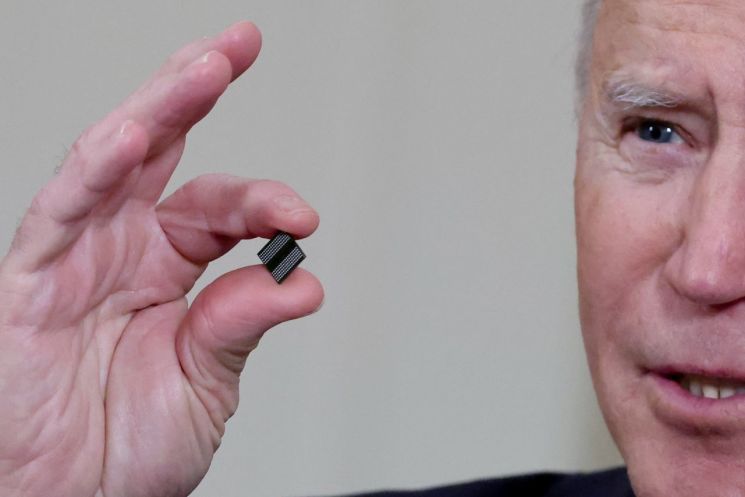
CMC Microsystems, which received funding from the Canadian government this time, is a nonprofit research accelerator established through the collaboration of 69 universities across Canada. Through the 'Fabric' project, valued at 220 million Canadian dollars, it supports research in advanced technology fields such as semiconductors, superconductors, artificial intelligence (AI), and the Internet of Things (IoT), as well as prototype production for startups.
Fran?ois-Philippe Champagne, Canada's Minister of Innovation, Science and Industry, said, "Semiconductors are at the heart of Canadians' daily lives and the economy," adding, "This investment will support Canadian technology innovators, create good jobs, and promote the sustainability of the semiconductor industry." Gordon Halling, President of CMC, responded in a statement, "Support for the Fabric project will ensure the future of Canada's semiconductor and advanced manufacturing sectors."
The Trudeau government in Canada has been criticized for not actively keeping pace with global semiconductor competition, such as the U.S. 'CHIPS Act,' despite having promising AI chip startups like Tenstorrent. The U.S. enacted the 'CHIPS Act' in August 2022, providing $39 billion in subsidies and $75 billion in loans and loan guarantees, focusing all efforts on expanding domestic semiconductor production.
Paul Slaby, Director of the Canadian Semiconductor Council (CSC), pointed out, "Canada lacks an industrial strategy for the chip sector," and added, "The Trudeau government has only recently started forming a dedicated team to foster the semiconductor industry." He emphasized, "Since Canada is a latecomer in this field, to establish a foothold in international trade, it should target niche markets in the semiconductor supply chain, similar to the Dutch government's support for ASML."
Meanwhile, Tenstorrent, which is challenging Nvidia's dominance in the AI chip market, is expected to raise $300 million (approximately 410 billion KRW) in a funding round led by Samsung Electronics. Tenstorrent is a Canada-based fabless company developing AI processors. Its CEO, Jim Keller, is known as a 'semiconductor legend' for designing Apple's iPhone 'A chip,' AMD's CPU 'Ryzen,' and leading Tesla's autonomous driving engineering.
© The Asia Business Daily(www.asiae.co.kr). All rights reserved.
![Clutching a Stolen Dior Bag, Saying "I Hate Being Poor but Real"... The Grotesque Con of a "Human Knockoff" [Slate]](https://cwcontent.asiae.co.kr/asiaresize/183/2026021902243444107_1771435474.jpg)
















