This Year 9,296 Lovebug Complaints... About 3,700 More Than Last Year
Main Cause of Climate Crisis... "Ecological Characteristic Analysis Needed"
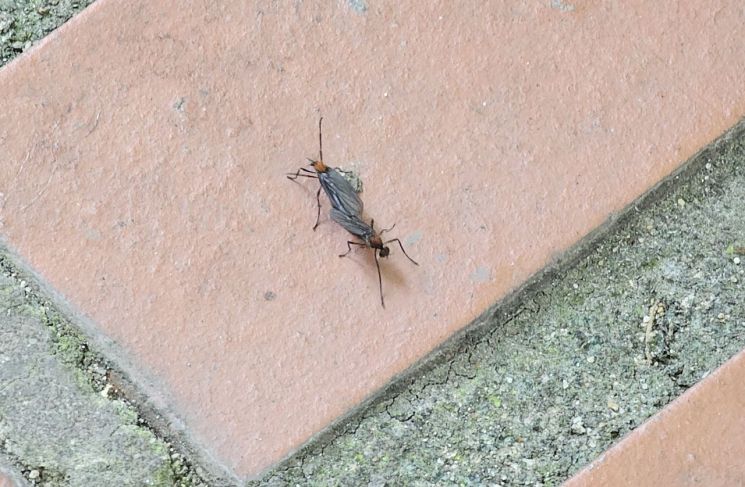
Lovebugs (Pyrrhocoris apterus), which had been concentrated in Eunpyeong-gu, Seoul, are now spreading across the entire city, leading to a surge in complaints. The climate crisis is being pointed out as the main cause of the lovebug outbreak, prompting calls for fundamental solutions rather than indiscriminate use of chemical agents.
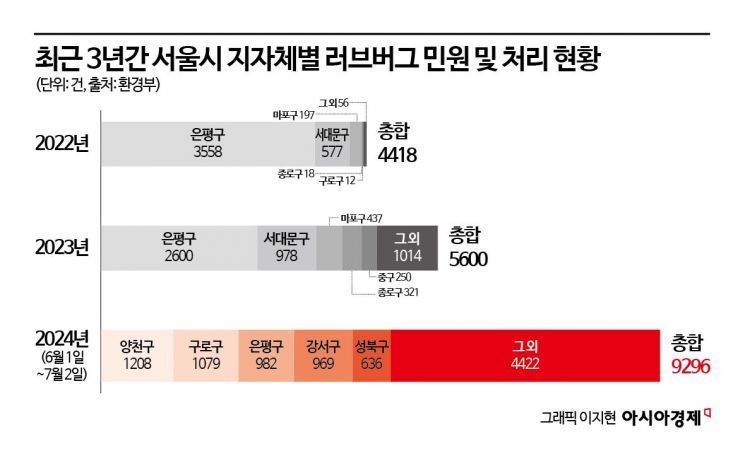
According to data received by the office of Kim Tae-seon, a member of the Democratic Party of Korea, from the Ministry of Environment on the 5th, Seoul City handled 9,296 lovebug-related complaints from the 1st of last month to the 2nd of this month. In 2022, there were 4,418 cases, and in 2023, 5,600 cases. The number is increasing every year.
Lovebugs, which mainly appeared in the northwestern part of Seoul, have spread throughout the city this year. Among Seoul's local governments, Yangcheon-gu handled the most lovebug-related complaints this year, receiving 1,208 cases. This was followed by Guro-gu with 1,079 cases, Eunpyeong-gu with 982 cases, Gangseo-gu with 969 cases, and Seongbuk-gu with 636 cases. Last year, Eunpyeong-gu handled the most lovebug-related complaints, recording 2,600 cases, which accounted for nearly half of all complaints that year. In 2022, out of a total of 4,418 complaints, Eunpyeong-gu handled 3,558 cases.
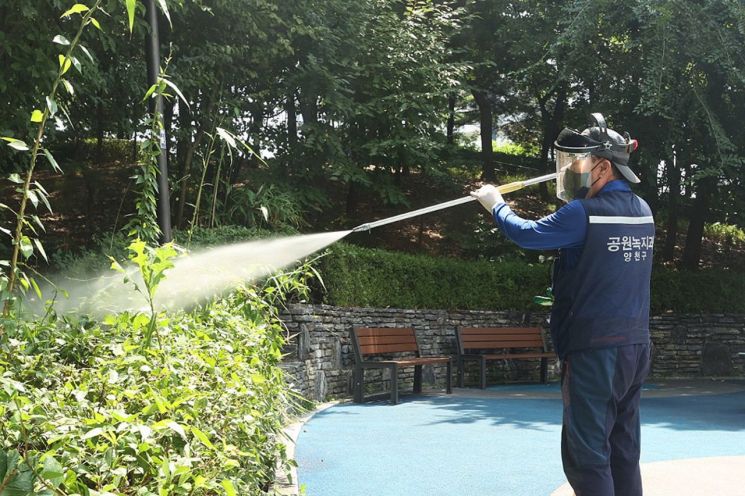 Seoul Yangcheon-gu (District Mayor Lee Gi-jae) announced on the 21st that it will conduct intensive pest control to eradicate 'Lovebug'. Accordingly, Yangcheon-gu deployed 15 pest control vehicles including high-pressure water trucks, ultrafine particle sprayers, and rechargeable and compressed sprayers to carry out pest control operations in residential areas, multi-use facilities, and green spaces. The photo shows the pest control operation against Lovebugs. [Image source=Yonhap News]
The reason lovebugs have spread across Seoul is presumed to be the climate crisis. The average temperature in the Seoul area was 10.8 degrees Celsius in 1980, but it rose to 13.4 degrees in 2014 and reached 14.1 degrees last year. Lovebugs prefer warm places and can spread to other areas by attaching themselves to cars emitting exhaust gases.
Lovebugs are classified as beneficial insects as they are neither toxic nor aggressive. In May, the Ministry of Environment announced through promotional materials that adult lovebugs act as pollinators, and lovebug larvae decompose organic matter in the soil, enriching it. Representative Kim emphasized, "Instead of indiscriminate chemical control, it is urgent to establish personnel and related infrastructure that can quickly analyze ecological characteristics and prepare effective response measures."
© The Asia Business Daily(www.asiae.co.kr). All rights reserved.



















