Excessive Delivery Fees Are the Core Issue
Questions Raised Over Cash Support Policies
Experts Say "Not a Fundamental Solution"
The government is pushing to support delivery fees for small restaurants, but criticism is emerging that the policy is absurd and ineffective. Self-employed business owners point out that "only the delivery platforms will benefit," while consumers are protesting, saying, "Why use taxes to solve the delivery fee issue?"
On the 5th, Jo (38), who runs a hamburger shop in Nam-gu, Gwangju, said, "Why should the government support the free delivery fees of Baemin and Coupang?" and criticized, "Supporting delivery fees is a policy that only helps delivery platforms."
Lee Ung-gu (47), who operates a fast-food restaurant in Jung-gu, Ulsan, said, "Autonomous competition should be a structure where self-employed people can choose platform policies according to their own circumstances and needs, but now self-employed people have to follow platform policies as they are to survive, which is a distorted state," and added sharply, "Structural problems must be solved first; cash support does not help at all."
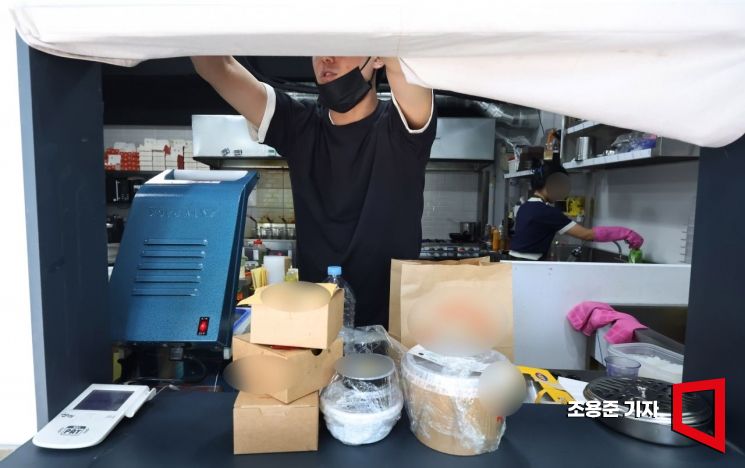 Delivery App Planning - A self-employed person running a delivery restaurant is packing food. Photo by Yongjun Cho jun21@
Consumers are equally baffled. Yoo (27), an office worker, said, "I doubt whether delivery fee support will significantly increase the sales of small businesses," and added, "As someone who does not order delivery often, I feel resistant to using taxes in this way." Im (36) criticized, "I heard for the first time that the government is going to support delivery fees, and I am speechless," "Is it okay to waste taxes like this?"
This year, as delivery platforms have successively started free delivery, self-employed business owners are complaining about excessive commissions and delivery fee burdens. In the case of Baemin, unlike the existing plan (Ultracall) where 88,000 KRW was paid monthly, to receive free delivery, store owners must subscribe to the flat-rate plan 'Baemin1Plus.' With a brokerage commission of 6.8%, card fees, and additional delivery fees (3,300 KRW in Seoul) that the store owner must bear, criticism arises among self-employed people that it is a "structure where the more you work, the more you lose."
In the case of Coupang Eats, store owners must bear a brokerage commission of 9.8%, card fees, and a delivery fee of 2,900 KRW. On the 3rd, the government announced plans to support delivery fees for small restaurants to reduce the burden caused by delivery commissions. A Ministry of SMEs and Startups official explained, "The purpose is to help because many difficulties related to delivery fees for small business owners have been detected," and added, "We plan to discuss specific matters such as budget and targets with the Ministry of Economy and Finance."
Experts unanimously said it is a premature policy. Professor Ha Jun-kyung of the Department of Economics at Hanyang University said, "It is difficult to be a fundamental measure for the delivery fee burden issue when there is a large power gap between platforms and small business owners," and added, "As much as the government supports, platforms may increase the actual burden of delivery fees, and there is room to create burdens under various names."
Professor Lee Bong-ui of Seoul National University Law School said, "It may be a benefit that helps small business owners immediately, but since delivery fees cannot be supported forever, it is not a fundamental solution to the current situation."
© The Asia Business Daily(www.asiae.co.kr). All rights reserved.
![Clutching a Stolen Dior Bag, Saying "I Hate Being Poor but Real"... The Grotesque Con of a "Human Knockoff" [Slate]](https://cwcontent.asiae.co.kr/asiaresize/183/2026021902243444107_1771435474.jpg)
















