3:45 PM Vote to End Debate
Increased Possibility of Special Prosecutor Law Vote and Approval
Concessions on Prosecutor Recommendations and Mention of Third-Party Special Prosecutor
The opposition parties, including the Democratic Party of Korea, plan to proceed with a vote on the 'Chae Sang-byeong Special Prosecutor Act' immediately after the filibuster (unlimited debate) ends on the afternoon of the 4th. It is highly likely that the opposition will pass it on their own. Although the ruling party has launched protests such as sit-ins to condemn the opposition, their only option is to exercise the presidential veto power. The key issue arises after the Special Prosecutor Act returns to the National Assembly. Since the possibility of rejection is high if a re-vote is initiated, it is expected that the political calculations of gains and losses will intensify.
According to political circles, the vote to agree to end the filibuster conducted by the People Power Party is expected to take place around 3:45 p.m. that day. On the previous day, Speaker Woo Wan-sik of the National Assembly submitted the Chae Sang-byeong Special Prosecutor Act as the first agenda item, and at 3:39 p.m. on the same day, Rep. Yoo Sang-beom of the People Power Party became the first to start the filibuster. Six minutes later, at 3:45 p.m., the Democratic Party submitted a motion to end the filibuster to the Speaker. According to Article 106 of the National Assembly Act, a motion to end debate is decided by a secret ballot vote after 24 hours have passed. If three-fifths (180 members) of the total members present vote in favor, the debate can be ended. The opposition's 192 seats are sufficient.
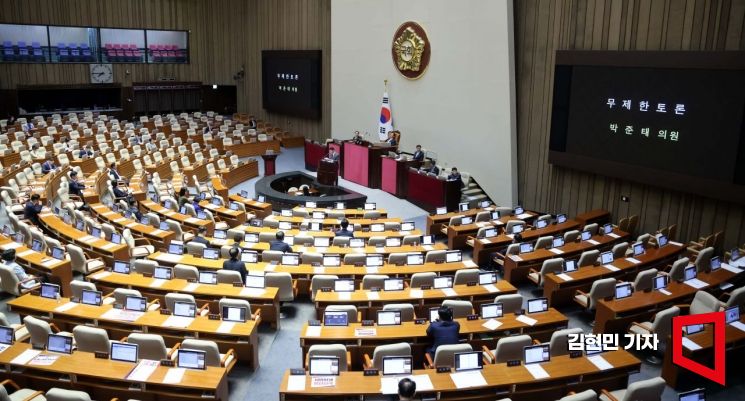 Park Joon-tae, a member of the People Power Party, is conducting an unlimited debate (filibuster) opposing the 'Chae Sang-byeong Special Prosecutor Bill' at the National Assembly plenary session on the 4th. Photo by Kim Hyun-min kimhyun81@
The Special Prosecutor Act is expected to pass the plenary session of the National Assembly smoothly. It requires a majority of the total members' votes, and the Democratic Party alone, with 171 seats out of 300, can approve it. Once passed by the National Assembly, the bill is sent to the government. President Yoon Seok-yeol is highly likely to exercise his veto power within 15 days. If the veto is exercised, the Special Prosecutor Act returns to the National Assembly for a re-vote.
The critical point begins when the Special Prosecutor Act returns to the National Assembly. First, the possibility of rejection during the re-vote is high because the approval criteria are stricter than during the plenary session. For a re-vote on a vetoed bill, a majority of the total members must be present, and two-thirds (200 members) of those present must vote in favor. Even combining all opposition votes, there are only 192 seats, falling short by 8 votes. This means the 22nd National Assembly is repeating the scenario of 'opposition-only approval → presidential veto → National Assembly re-vote → rejection.'
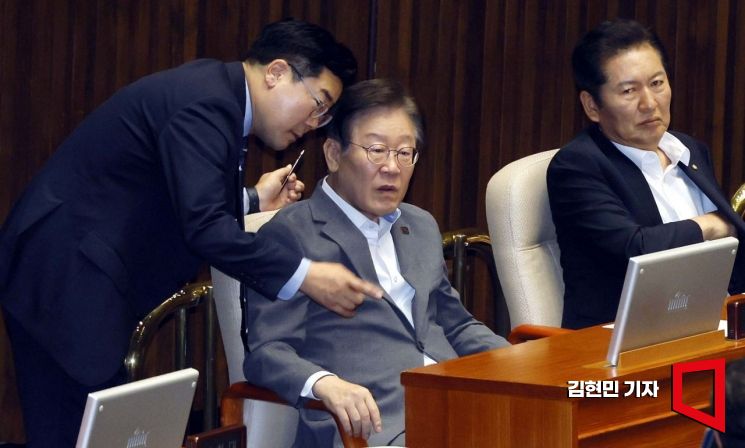 Lee Jae-myung, former leader of the Democratic Party of Korea, and Park Chan-dae, floor leader, are talking during the plenary session held at the National Assembly on the 3rd. Photo by Hyunmin Kim kimhyun81@
Various opinions have emerged from both ruling and opposition parties regarding the re-vote. The Party for People's Innovation proposed a compromise to pass the Special Prosecutor Act. They suggested conceding one special prosecutor candidate nomination from the non-negotiating group to a level acceptable to the ruling party. In this case, figures such as the Chief Justice of the Supreme Court or the Korean Bar Association are being mentioned. Han Dong-hoon, former emergency committee chairman of the People Power Party, proposed a 'third-party recommended special prosecutor.' This is an intention to overcome the crisis by appointing a special prosecutor from a neutral third party with no vested interests. Meanwhile, the Democratic Party insists on passing the Special Prosecutor Act according to the National Assembly Act procedures. A Democratic Party official only stated, "We are considering extraordinary measures to prevent the rejection of the Special Prosecutor Act." Within the party, there is a plan to escalate pressure on the ruling party by consecutively submitting the 'Broadcasting 3 Acts' and the 'Broadcasting and Communications Commission Act Amendment' following the Chae Sang-byeong Special Prosecutor Act.
© The Asia Business Daily(www.asiae.co.kr). All rights reserved.
![Clutching a Stolen Dior Bag, Saying "I Hate Being Poor but Real"... The Grotesque Con of a "Human Knockoff" [Slate]](https://cwcontent.asiae.co.kr/asiaresize/183/2026021902243444107_1771435474.jpg)

















