Dreaming of Breaking a World Record, Counting Leaves for Over an Hour
"It Takes 1 Hour Just to Count the Number of Leaves"
Japan's 'luckiest man in the world' set a new Guinness World Record by cultivating a clover with 63 leaves.
Bringing clovers with four or more leaves found in parks home for pollination... Dreaming of breaking the world record
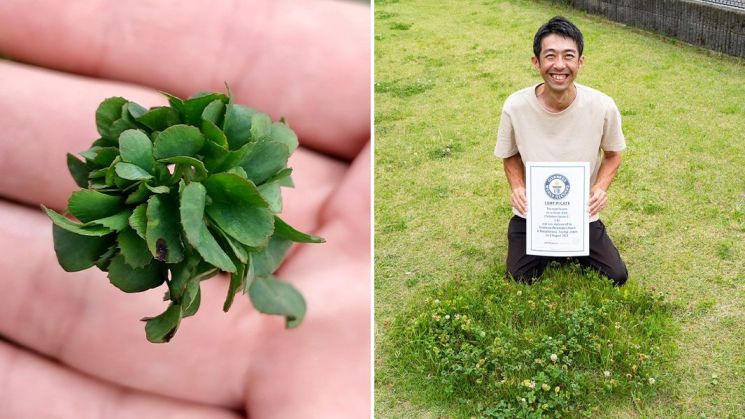 The Guinness World Records recently reported that Yoshiharu Watanabe (45) from Nasushiobara City, Tochigi Prefecture, Japan, cultivated a '63-leaf clover,' breaking the Guinness World Record.
 [Image source=Guinness World Records]
Guinness World Records recently reported that Yoshiharu Watanabe (45) from Nasushiobara City, Tochigi Prefecture, Japan, broke the world record by cultivating a '63-leaf clover.' Since 2012, Watanabe has been cross-pollinating clovers in his home garden. Watching the number of clover leaves increase each year through cross-pollination, he set his sights on the Guinness World Record. After 12 years, on the 20th of last month, he succeeded in obtaining a clover with 63 leaves. The previous world record was a 56-leaf clover set in 2009 by Shigeo Obara from Hanamaki City, Iwate Prefecture, Japan.
Watanabe has a clover field in his garden, and whenever he found clovers with four or more leaves near rice paddies or parks, he brought them home. After discovering a 20-leaf clover in his garden, he felt the possibility of achieving the world record. However, to break the record at that time, he needed to triple the number of leaves, so he manually pollinated some clovers that were otherwise left to pollinate naturally. Although this process was not easy, the number of leaves gradually increased as a reward for his efforts. In 2020, he grew a clover with 49 leaves, and in 2021, one with 55 leaves, approaching the world record.
"Counting the leaves took an hour... hoping to bring surprise and joy to people"
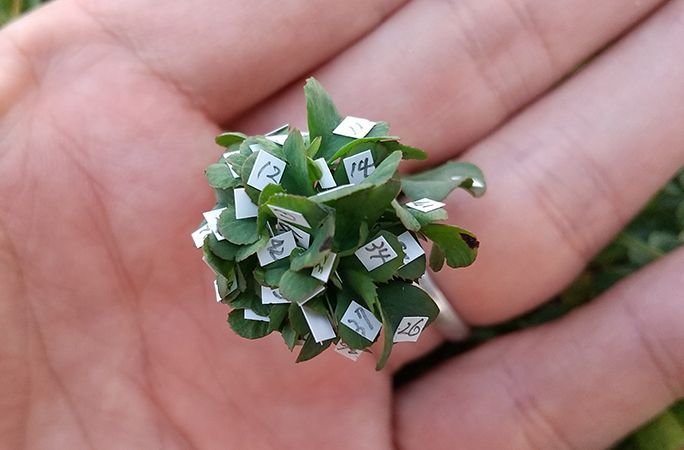 Attaching labels to the 63-leaf clover that set a Guinness World Record and counting the number of leaves. [Image source=Guinness World Records]
However, for a while, the number of leaves did not increase and even decreased at times. Therefore, when Watanabe first discovered the clover that set the record, he estimated it had 56 leaves. Then he was surprised to find that it actually had more than 60 leaves. To accurately count the number of leaves, he attached small labels to each leaf and counted them carefully. Watanabe said, "This clover's leaves are smaller than those of ordinary clovers, so counting the leaves was very difficult," adding, "It took more than an hour to count the clover leaves." He expressed, "I am very happy to finally achieve the world record," and said, "Just as four-leaf clovers are said to bring luck, I hope this 63-leaf clover brings surprise and joy to people."
Four-leaf clovers, a mutation of three-leaf clovers, became a 'symbol of luck' thanks to Napoleon
Four-leaf clovers are a mutation of the three-leaf clover. The flower language of the three-leaf clover is known as 'promise and peace,' while the four-leaf clover is said to represent 'luck.' There are various stories behind the four-leaf clover becoming a symbol of luck, but the most famous is an anecdote related to Napoleon. While riding his horse on the battlefield, Napoleon spotted a four-leaf clover he had never seen before and bent down to pick it. Thanks to this, he narrowly escaped a bullet fired by the enemy, which led to the four-leaf clover becoming a symbol of 'luck, health, and love.'
Five-leaf clovers, which are even rarer than four-leaf clovers, are said to symbolize 'financial luck and greater fortune,' while six-leaf clovers are known to represent 'health luck.' According to a 2017 BBC survey, one in 5,000 clovers is a four-leaf clover, and the probability of finding a five-leaf clover is only one in 24,000.
© The Asia Business Daily(www.asiae.co.kr). All rights reserved.
![Clutching a Stolen Dior Bag, Saying "I Hate Being Poor but Real"... The Grotesque Con of a "Human Knockoff" [Slate]](https://cwcontent.asiae.co.kr/asiaresize/183/2026021902243444107_1771435474.jpg)

















