NPEs Targeting Korean Companies
No Immediate Way to Prevent Lawsuits
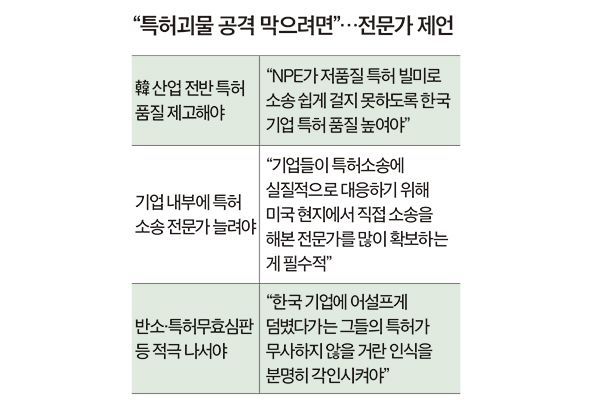
Industry-Academia Collaboration to Improve Patent Quality
Must Defend Against Weak Attacks with Legitimate Strategies
Major Korean export companies such as Samsung, LG, and Hyundai Motor are facing hundreds of patent infringement lawsuits filed by NPEs (Non-Practicing Entities, patent assertion entities) in courts including the U.S. Federal District Court for Texas. To overcome this situation, experts point out that the overall quality of patents in the Korean industry must be improved to prevent NPEs from making infringement claims based on low-quality patents. There are also suggestions that companies should continuously increase the number of in-house patent litigation experts to respond more effectively to lawsuits.
According to a review by Law Times through LexisNexis’ CourtLink, Samsung Electronics, LG Electronics, Hyundai Motor, and SK Hynix are currently involved in over 110 patent infringement lawsuits filed in the U.S. Federal District Courts for the Eastern and Western Districts of Texas. Since the first lawsuit was filed against these companies in Texas courts in 1997, they have faced more than 780 patent lawsuits.
Companies are required to spend tens of billions of won in litigation costs per patent lawsuit. According to statistics from the American Intellectual Property Law Association (AIPLA), the median cost of defending a patent lawsuit involving risks exceeding $25 million (approximately 34.7 billion won), which is the amount demanded by NPEs, reached $3.875 million (about 5.4 billion won).
Experts agree that “it is difficult to find a way to completely block lawsuits immediately.” Korean companies are prime targets for NPEs because they have excellent technological capabilities, large sales volumes, and inevitably build factories or expand sales offices in the U.S., the world’s largest market. Nam Hyung-doo (60, Judicial Research and Training Institute class 18), a professor at Yonsei University Law School, said, “This ultimately proves that our companies’ technology is world-class,” adding, “If they lacked technology or had not entered the U.S. market, they would not have been sued.”
An Seong-tak, a patent attorney at Gwangjang Rian & Go, explained, “The reason NPEs file patent lawsuits against Korean companies is because it is ‘business.’ Not only Korean companies that can pay high litigation costs but also large U.S. corporations become targets of NPEs.”
To prevent indiscriminate lawsuits by NPEs, efforts from both industry and academia to improve patent quality are essential. NPEs do not produce products but seek profits through lawsuits and licensing based on patents they have acquired from various companies.
They also purchase large numbers of patents from university research labs or buy low-quality patents mass-produced in a factory-like manner at low prices, then file comprehensive patent infringement lawsuits against companies using related patented technologies to gain profits through royalty negotiations. To make it difficult for NPEs to file lawsuits so easily in this way, it is pointed out that the overall level of technological patents in the Korean industry must be raised.
There are also calls for Korean companies to expand their internal pool of patent litigation experts. This would strengthen preemptive investigations to reduce the risk of lawsuits from the product development stage.
Attorney An said, “For companies to effectively respond to patent lawsuits, it is essential to have many experts who have direct experience with U.S. litigation,” adding, “Companies need to secure personnel experienced in U.S. patent litigation through various methods such as increasing training opportunities for patent experts within the company and increasing internal experts who can collaborate with U.S. law firms on litigation work.”
Choi Seung-jae (53, class 29), an attorney at Law Firm Class Hangyeol, said, “Thieves do not break into every wealthy house. Thieves do not enter houses with thorough security,” emphasizing, “Korean companies need to check whether they have secured enough internal experts to prepare for NPE attacks.”
Recently, cases of Korean companies taking a ‘direct approach’ by filing counterclaims or patent invalidation trials against NPEs’ patent lawsuits have also emerged. A representative example is LG Electronics, which is involved in a patent lawsuit with the domestic-based NPE Pantech Corporation in the Eastern District of Texas, filing a petition for invalidation of Pantech’s patent at the U.S. Patent Trial and Appeal Board (PTAB) last year. Samsung Electronics filed a counterclaim against Secure Wi-Fi in a patent infringement lawsuit in May. Industry insiders expect this trend to become more pronounced.
An official in charge of patent management at a large corporation said, “Although it may seem that Korean companies quickly settle disputes when sued, they are actually fighting fiercely beneath the surface,” adding, “They negotiate to gain a favorable position, reduce prices, and fight until they can fight to the end before settling, and they will continue to actively respond to lawsuits.” He emphasized, “It is necessary to firmly instill the perception that if NPEs recklessly challenge Korean companies, their patents will not remain safe.”
Hong Yoon-ji, Lee Soon-gyu, Ahn Hyun, Lee Jin-young, Law Times reporters
※This article is based on content supplied by Law Times.
© The Asia Business Daily(www.asiae.co.kr). All rights reserved.

















