Greenhouse Gas Emissions Increased to 29.27 Million Tons Last Year
Emission Intensity per Production Also Rose
Impact of Reduced Electric Furnace Operation Due to Real Estate Market Slump
POSCO Holdings and Hyundai Steel, which have declared a transition to a 'low-carbon production system,' still have not reduced the proportion of blast furnace operations that emit a large amount of carbon. As blast furnace production increased, greenhouse gas emissions last year were found to have increased compared to the previous year. The steel industry is the largest carbon emitter sector in South Korea.
According to the recently published 'Sustainability Reports' by POSCO and Hyundai Steel on the 5th, both companies saw an increase in direct and indirect greenhouse gas emissions last year. POSCO's direct and indirect emissions last year were 71.97 million tons, up from 70.18 million tons the previous year. Hyundai Steel's emissions also increased for three consecutive years, from 28.49 million tons in 2021 to 28.50 million tons in 2022, and 29.27 million tons last year.
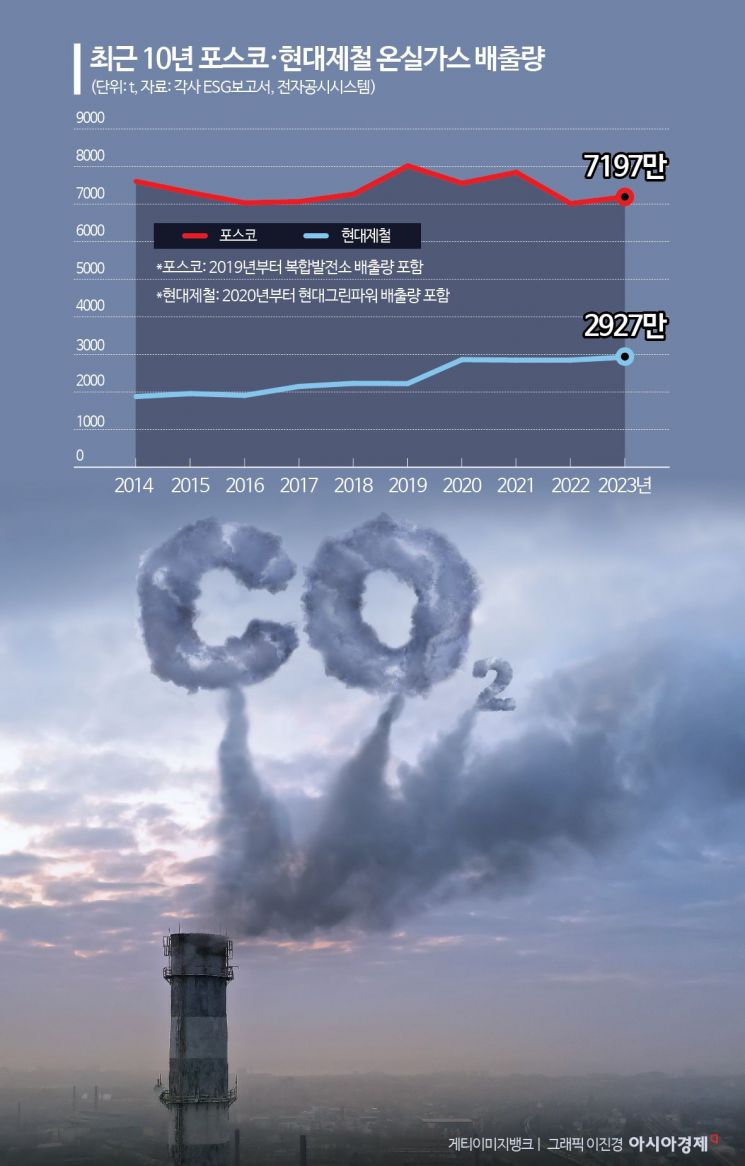
The steelmakers explained that greenhouse gas emissions increased in line with the rise in product output. In 2022, greenhouse gas emissions temporarily decreased due to the suspension of operations at the Pohang plant caused by Typhoon Hinnamnor, but emissions increased again last year as production returned to normal. In fact, POSCO's crude steel production last year was 35.68 million tons, a 4.2% increase from 34.22 million tons the previous year. During the same period, Hyundai Steel's crude steel and product output rose from 19.57 million tons to 20.50 million tons.
The steel industry views reducing greenhouse gas intensity as crucial to achieving carbon neutrality. Greenhouse gas intensity refers to the amount of greenhouse gas emissions per ton of crude steel produced, reflecting the steelmakers' efforts to reduce carbon emissions.
POSCO's greenhouse gas intensity was 2.02 last year, slightly down from 2.05 during 2021?2022. In contrast, Hyundai Steel's intensity has been increasing since 2018 when it was 0.95, reaching 1.43 last year. Although it slightly decreased compared to the previous year (1.44), it remains at a high level. This is because Hyundai Steel's blast furnace usage ratio increased while electric furnace usage actually decreased. Blast furnaces use coal to produce molten iron, resulting in high greenhouse gas emissions, whereas electric furnaces use steel scrap and electricity, producing fewer emissions.
Hyundai Steel's blast furnace usage ratio last year was 65.4%, up from 61.7% in 2021 and 63.8% in 2022. Conversely, the electric furnace usage ratio decreased from 38.3% to 34.6%. POSCO, which started construction of a large electric furnace plant at its Gwangyang Steelworks in February this year, has maintained a blast furnace usage ratio of 94% for two consecutive years.
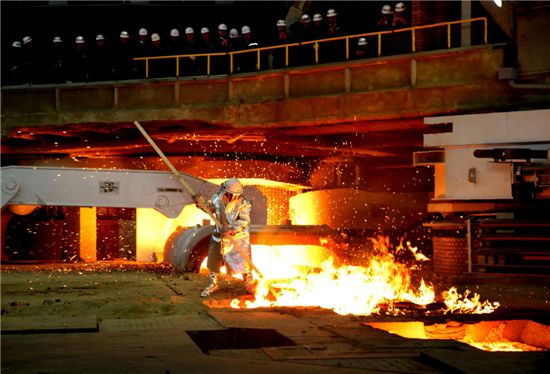 An employee of Hyundai Steel Dangjin Steelworks is inspecting the condition of molten iron coming from the blast furnace.
 [Photo by Asia Economy DB]
The reason Hyundai Steel reduced electric furnace operations is due to sluggish sales of rebar and shaped steel produced in electric furnaces amid the real estate market downturn. A steel industry insider analyzed, "Blast furnaces must operate 24 hours a day, but electric furnaces can adjust production according to demand, making it easier to halt production when product demand is low."
On the other hand, POSCO mainly produces stainless steel in electric furnaces. Since it is less affected by the decline in construction demand, its greenhouse gas intensity did not increase.
The steel industry accounts for 15% of South Korea's total carbon emissions and 40% of emissions in the industrial sector. It is classified as one of the most challenging industries to achieve the 2050 'Net Zero' target.
Steelmakers have devised strategies to increase the use of electric furnaces aiming for an eco-friendly transition. POSCO plans to reduce carbon emissions in the blast furnace production process by using low-carbon fuels and raw materials, and complete the development of hydrogen reduction steelmaking technology by 2030. Hyundai Steel is producing low-carbon products by introducing a 'combined electric furnace-blast furnace process.' Ultimately, it plans to adopt a new electric furnace process utilizing hydrogen. A Hyundai Steel official stated, "We plan to reduce carbon emissions through various methods, including increasing the use of low-carbon raw materials such as direct reduced iron."
© The Asia Business Daily(www.asiae.co.kr). All rights reserved.

















