Kim Woo-jung, the general director of the Daejong Film Awards who was accused of inflating the production costs of the Justice Party's promotional video by tens of millions of won during the 21st general election, has been sentenced to a suspended prison term.
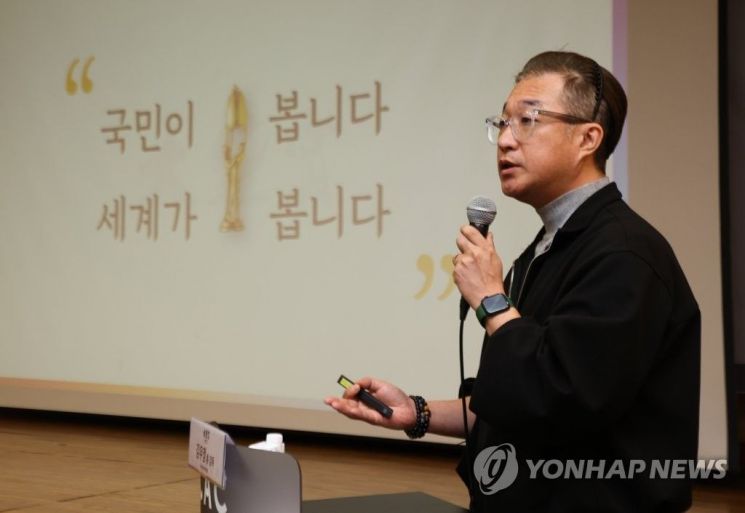
According to the legal community on the 3rd, the Supreme Court's First Division (Presiding Justice Kim Seon-su) upheld the original court ruling that sentenced Director Kim, who was indicted on charges including violation of the Political Funds Act, fraud, and attempted fraud, to six months in prison with a two-year suspension.
The court stated the reason for dismissing Kim's appeal was that "there was no error in the original court's judgment that violated the rules of logic and experience, exceeded the limits of free evaluation of evidence, or misinterpreted the legal principles regarding the establishment of the crimes of violation of the Political Funds Act, fraud, and attempted fraud."
The Supreme Court also upheld the original ruling that sentenced Cho Mo, former deputy secretary-general of the Justice Party and head of the election countermeasures situation room, who was indicted as an accomplice alongside Kim, to six months in prison with a two-year suspension.
The court explained the reason for dismissing Cho's appeal was that "there was no error in the original court's judgment that failed to conduct necessary hearings, violated the rules of logic and experience, exceeded the limits of free evaluation of evidence, or misinterpreted the legal principles regarding the specification of charges, intent for fraud, and joint principal offender."
Kim, who oversaw the Justice Party's general election and advertising promotion agency work, was tried on charges of fraudulently applying for 75 million won in election expense reimbursement to the National Election Commission in April 2020 by submitting false electronic tax invoices, embezzling 40 million won from the commission, and failing to receive 35 million won.
Investigations revealed that Kim created some promotional videos by adding subtitles or shortening the length of existing TV commercials produced between 2019 and 2020, then falsely reported them as newly planned and filmed, inflating the total amount to 75 million won.
The prosecution applied charges of violating the Political Funds Act, stating that Kim fabricated false contracts with video production companies, disguised payments as subcontracting fees, transferred money, immediately received it back, and submitted falsified supporting documents to the National Election Commission claiming actual expenses were incurred.
Additionally, fraud charges were applied for inflating advertising and promotional production costs to cover expenses for items not reimbursed as election expenses, such as internet homepage and TV commercial video production, and submitting reimbursement claims with false supporting documents to the National Election Commission at the Justice Party's request.
Cho was charged with submitting the reimbursement claim to the National Election Commission with false supporting documents, knowing that Kim would inflate the costs in this manner.
Of the inflated 75 million won in promotional expenses conspired by Kim and Cho, 40 million won was paid to the consortium formed by Kim, while the remaining 35 million won was rejected by the National Election Commission during the audit process after discovering the false claim, resulting in non-payment.
The first trial accepted Kim's claim that the videos in question were newly planned and produced, acquitting both defendants.
However, the second trial recognized that the two had falsified documents to embezzle money and sentenced both to six months in prison with a two-year suspension.
The court stated, "It can be acknowledged that under the conspiracy of the defendants, defendant Cho submitted the election expense reimbursement claim with false supporting documents, embezzling 40 million won from the National Election Commission, while 35 million won was not paid due to claim rejection," and added, "The original ruling acquitting defendant Kim of the charges was based on factual errors or legal misinterpretations that affected the judgment," thus overturning the first trial's decision.
Regarding Cho, the court concluded, "Defendant Cho at least tacitly permitted defendant Kim to falsify supporting documents to obtain payment for work not covered by election expense reimbursement and attached these documents when submitting the reimbursement claim," and "the defendants can be seen as conspirators in fraud or attempted fraud related to false election expense reimbursement claims."
Although both defendants appealed, the Supreme Court found no issues with the second trial's judgment.
© The Asia Business Daily(www.asiae.co.kr). All rights reserved.

















