Ministry of Agriculture, Food and Rural Affairs Achieves $6.2 Billion in Exports in First Half of the Year
Exports of K-Food Plus, including agricultural and food products, smart farms, and agricultural machinery, are showing strong growth. Supported by increases in ramen, snacks, and kimchi, export value in the first half of this year rose by more than 5% compared to last year.
The Ministry of Agriculture, Food and Rural Affairs announced on the 3rd that the cumulative export value of K-Food+ in the first half of 2024 (provisional) reached $6.21 billion, an increase of 5.2% from last year. In particular, agricultural and food products amounted to $4.77 billion, up 6.7% year-on-year.
The top export destinations for agricultural and food products are the United States, China, and Japan. Exports to the U.S. increased by 17% due to stable labor markets and easing inflation trends supporting steady consumer spending. In China, with the activation of online platforms, efforts have focused on entering online channels and influencer marketing, and as consumer sentiment slowly recovered, exports turned to an upward trend starting in May. Japan, which was the largest export market last year, saw a 7.0% decrease year-on-year due to the continued weak yen, high inflation, and declining real wages, reducing its share as the third-largest export market. Other regions such as Europe, Latin America, the Middle East, and Oceania showed overall growth, with growth rates exceeding 10% compared to the previous year.
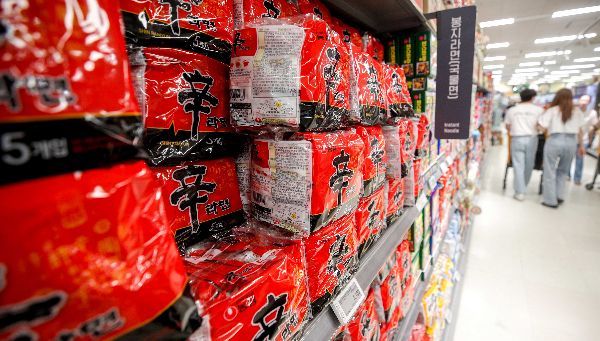
The most exported item was ramen, recording exports of $590.2 million, a 32.3% increase from the previous year. The spicy ramen challenge gained popularity and word of mouth spread, while various new products tailored to local consumers’ tastes were launched, accelerating exports, according to the Ministry of Agriculture, Food and Rural Affairs. Especially, China and the U.S., the largest markets for K-ramen, each surpassed $100 million in cumulative exports by the end of June through expanded entry into online channels and large supermarkets. Exports to Europe also steadily increased, exceeding $100 million for the first time in the first half of the year.
The item with the highest growth rate was rice-processed foods. Including frozen gimbap, fried rice, tteokbokki, rice beverages, and Makgeolli, rice-processed foods recorded exports of $136.9 million in the first half, a 41.4% increase year-on-year. Processed rice products such as frozen gimbap gained popularity as gluten-free health and convenience foods, and exports have continued to increase as entry into large U.S. retail stores like Costco expanded.
Exports of kimchi, a representative K-Food, reached $83.8 million in the first half, a 4.0% increase from the previous year. In particular, in the U.S., growing consumer interest and demand for fermented and vegan foods led to record-high export performance. In Europe, kimchi that can be stored and distributed at room temperature was introduced and promoted in connection with Korean cultural events, resulting in exports increasing by more than 40% year-on-year.
Pet food exports increased by 10.3% year-on-year, reaching a record high of $79.8 million, mainly to Japan, Taiwan, and Vietnam. The Ministry of Agriculture, Food and Rural Affairs expects the upward trend to continue in the second half of the year through active marketing and the Korean Wave, as well as new market development in countries such as Malaysia and Indonesia.
The Ministry of Agriculture, Food and Rural Affairs is actively promoting inter-ministerial collaboration and win-win cooperation between large and small-to-medium enterprises to expand K-Food+ exports. As a result of the inter-ministerial consultative body operation in the first half, the Ministry of Land, Infrastructure and Transport will support the preparation for safe operation of a new cargo-only airline at Gimhae Airport to improve fresh agricultural product logistics; the Ministry of Oceans and Fisheries will expand the supply of temporary storage near the Busan Port terminal to reduce logistics costs; and the Ministry of Trade, Industry and Energy will cooperate in discovering buyers to develop new markets in Latin America and India, aiming to resolve difficulties faced by export companies.
Following the preferential collaboration on smart farm and agricultural machinery trade insurance (short-term export insurance) with the Ministry of Trade, Industry and Energy in the first half, the Ministry of Agriculture, Food and Rural Affairs plans to collaborate with the Ministry of SMEs and Startups in the second half. Leveraging the 'Memorandum of Understanding (MOU) for Strengthening Global Competitiveness of SMEs in the Agricultural Industry' scheduled to be signed at the end of July, the ministry will promote linkage of export support policies such as export vouchers and explore new collaboration methods. Additionally, in cooperation with the Ministry of Land, Infrastructure and Transport, it plans to develop collaboration models enabling the smart farm industry to enter overseas markets jointly with experienced overseas construction companies.
Kwon Jae-han, Director of Agricultural Innovation Policy at the Ministry of Agriculture, Food and Rural Affairs, said, "The diversification of products and marketing efforts tailored to local export markets by our farmers and exporters are meeting the global Korean Wave fever, continuously breaking export records." He added, "In the second half, we will actively support exporters by resolving their difficulties, supporting participation in exhibitions, discovering influential overseas buyers, pioneering new markets, and expanding inter-ministerial cooperation to ensure K-Food+ exports continue to grow and achieve the best results this year."
© The Asia Business Daily(www.asiae.co.kr). All rights reserved.
![Clutching a Stolen Dior Bag, Saying "I Hate Being Poor but Real"... The Grotesque Con of a "Human Knockoff" [Slate]](https://cwcontent.asiae.co.kr/asiaresize/183/2026021902243444107_1771435474.jpg)











