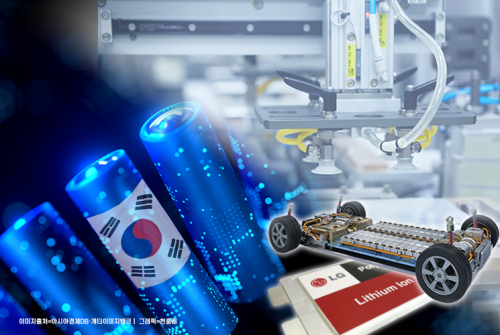
From January to May, the global electric vehicle battery market grew by 23%. Amid a slowdown in electric vehicle growth, concerns about oversupply have emerged in North America, the main market for Korean companies.
According to market research firm SNE Research on the 3rd, the battery usage installed in electric vehicles (including pure electric vehicles, plug-in hybrid vehicles, and hybrid vehicles) registered worldwide from January to May reached 285 gigawatt-hours (GWh), marking a 23.0% increase compared to the same period last year.
During the same period, the market share of the three domestic battery companies?LG Energy Solution, Samsung SDI, and SK On?was 22.3%, down 2.8% from the previous year. While Samsung SDI recorded a growth rate of 26.8%, LG Energy Solution and SK On showed lower growth rates of 5.6% and 4.2%, respectively.
Samsung SDI's strong growth was attributed to solid sales of the BMW i4/X/5 and Audi Q8 e-tron in Europe, as well as positive reception of the Rivian R1T/R1S in North America.
LG Energy Solution is increasing production at Ultium Cells 2, a joint factory with GM, and with GM's new vehicles equipped with the Ultium platform scheduled for release, further sales expansion is expected.
SK On plans to convert its second plant in Georgia, USA, dedicated to Ford, to a Hyundai line within the year and will operate its third plant in Hungary with a capacity of 30 GWh in the second quarter.
Among Japanese companies, Panasonic was the only one to make the top 10, ranking 6th, but experienced a 26.8% decline compared to the same period last year.
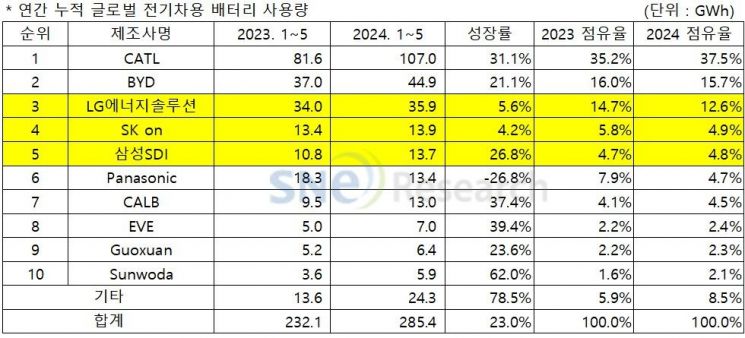
China's CATL firmly maintained its global number one position with a 31.1% growth rate compared to the previous year. BYD recorded a 21.1% growth rate, ranking second globally, maintaining steady sales after a decline due to the Lunar New Year.
SNE Research explained that while electric vehicle growth is slowing outside China, uncertainties are increasing in major regions such as Europe and the United States.
In Europe, countervailing duties are planned to be imposed on Chinese automakers, and in the U.S., the presidential election remains a variable. Following the U.S., Europe has also begun to actively check China, which is expected to hinder Chinese companies' overseas expansion.
The growing uncertainty in the North American market, which is a key market for Korean companies, is a concerning point. In June, Panasonic cited the Boston Consulting Group to lower its forecast for North American electric vehicle penetration in 2030 from 50% to 30%, announcing a business restructuring to strengthen both the North American and Japanese markets instead of focusing solely on North America. Regarding this, SNE Research stated, "There are also voices expressing concerns about oversupply from Korean battery companies, which account for most of the local expansion plans in North America."
© The Asia Business Daily(www.asiae.co.kr). All rights reserved.
![Clutching a Stolen Dior Bag, Saying "I Hate Being Poor but Real"... The Grotesque Con of a "Human Knockoff" [Slate]](https://cwcontent.asiae.co.kr/asiaresize/183/2026021902243444107_1771435474.jpg)












