Real GDP Decline in Q1
Private Consumption Drops, Exceeding Expectations
Toyota Production Halt Also Hits
Reversing Previous Growth Forecasts
Japan's GDP Growth Rate Expected to Decrease This Year
Complicated Bank of Japan Calculations
Raising Rates Risks Recession Acceleration
Staying Put Risks Yen Weakness
Japan's economic growth rate for this year is projected to be negative for the first time in four years since the first year of the COVID-19 pandemic in 2020. As the Japanese economy is expected to enter a recession again, the Bank of Japan (BOJ), which is weighing the timing of additional interest rate hikes, is facing a dilemma. Taking an aggressive tightening stance could deepen the recession, while not doing so raises concerns about continued yen depreciation.
Japan's Economic Growth Rate Expected to Contract for the First Time in Four Years
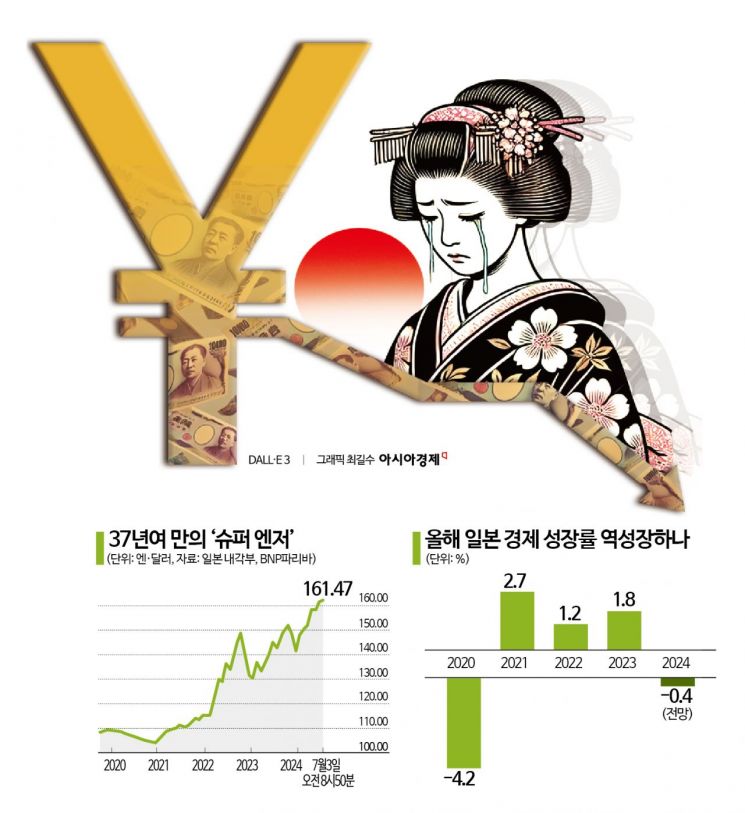
On the 2nd (local time), BNP Paribas and SMBC Nikko Securities forecast that Japan's gross domestic product (GDP) growth rate will decrease by 0.4% and 0.3%, respectively, compared to the previous year. They reversed earlier predictions that Japan's GDP would show slight growth this year. If Japan's GDP contraction materializes this year, it would mark a recession for the first time in four years since 2020 (-4.2%).
The reason for the forecast of a negative economic growth rate this year is that Japan's first-quarter real GDP decline exceeded expectations. According to Nihon Keizai Shimbun (Nikkei), the Cabinet Office announced on the 1st that Japan's first-quarter real GDP decreased by an annualized 2.9%. This is a downward revision from the previously announced estimate of -1.8% last month. Japan's real GDP growth rate has shown negative figures for two consecutive quarters, following the third quarter of last year (-0.9%).
Sluggish Recovery and Contraction in Private Consumption
The main factor is the contraction in private consumption, which accounts for more than half of GDP. Although import prices have been rising due to the prolonged weak yen, wage increases have not kept pace, reducing consumers' spending power. Additionally, net exports have decreased. This is due to the suspension of production and shipments following the discovery of quality certification fraud at Toyota, the world's largest automaker. The Japanese government's suspension of production for three Toyota models, initially scheduled to end last month, has been extended until the end of this month.
Bloomberg reported that expectations for a significant rebound in Japan's second-quarter GDP are fading among experts. Personal consumption in Japan has been declining for four consecutive quarters, and the recent dollar-yen exchange rate exceeding 161 yen has led to a 'super weak yen' not seen in over 37 years. The general consensus is that the virtuous cycle effect of consumption driven by wage increases, which is key to economic growth, will not materialize.
Complicated Calculations for the Bank of Japan
The downward revision of Japan's economic growth forecast is expected to complicate the Bank of Japan's calculations. At the monetary policy meeting scheduled for the 31st of this month, the BOJ plans to announce whether it will raise interest rates again following March or reduce the scale of its monthly 6 trillion yen government bond purchases to some extent. Some in the market believe the BOJ needs to implement effective tightening measures to respond to the record yen depreciation.
However, tightening measures risk accelerating the recession, presenting a dilemma. Japan, boasting the world's highest aging rate, has an economic structure that makes recovery difficult once economic damage occurs. This is a major reason behind Japan's 'Lost 30 Years' of prolonged stagnation.
Nikkei explained, "It may be premature for the BOJ to rush into raising interest rates without confirming a positive turnaround in real wages." Yoshiki Shinke, chief economist at Dai-ichi Life Research Institute, said, "While the BOJ may implement additional tightening measures, given Japan's GDP growth rate, such moves may appear awkward."
If the BOJ does not propose additional tightening measures, the yen's depreciation is expected to continue. Ales Kutny, Head of International Rates at Vanguard, predicted, "If the BOJ announces a slight reduction in government bond purchases (not meeting market expectations), market disappointment could cause the yen to fall rapidly," adding, "In that case, the dollar-yen exchange rate could rise to 170 yen."
© The Asia Business Daily(www.asiae.co.kr). All rights reserved.

















