‘Major Transformation of Healthcare Industry Triggered by AI’ Report Published
“Domestic AI Healthcare Market to Reach $6.672 Billion by 2030”
Domestic AI Healthcare Industry Gains Attention for Growth Potential Due to IT Advances and Aging Population
As the integration of artificial intelligence (AI) technology rapidly advances in the healthcare industry, the current status of the rapidly growing domestic AI healthcare industry and business strategies for market dominance have been presented.
On the 3rd, Samjong KPMG published a report titled "The Great Transformation of the Healthcare Industry Triggered by AI," introducing the current status and outlook of the AI healthcare market, the competitive landscape within the domestic and international AI healthcare industries, and strategies for market dominance.
AI healthcare is a medical service that collects and integrates not only existing medical data such as insurance claim information and academic papers but also new data that was difficult to obtain, such as biometric data, lifelog, and genomic information, and analyzes them through AI technology to provide patients with appropriate diagnosis and treatment.
Market research firm MarketsandMarkets forecasted that the global AI healthcare market size will explosively grow from $15.83 billion last year to $181.79 billion by 2030.
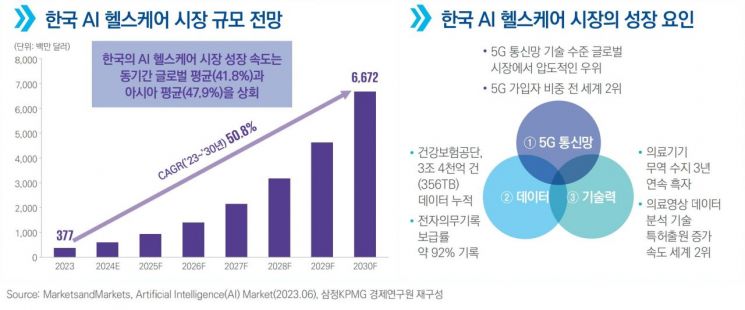
The domestic AI healthcare market is also expected to grow at an average annual rate of 50.8%, increasing from $377 million last year to $6.672 billion by 2030. The growth rate of Korea's AI healthcare market surpasses the global average (41.8%) and the Asian average (47.9%) during the same period.
The growth factors of Korea's AI healthcare market include its excellent 5G communication network. It shows overwhelming technological superiority and ranks second worldwide in subscriber share. Korea's electronic medical record (EMR) adoption rate exceeds 90%, and the entire population is covered by a single national health insurance system, which is advantageous for securing medical big data. The increased technological capabilities of Korean medical device companies are also a significant factor.
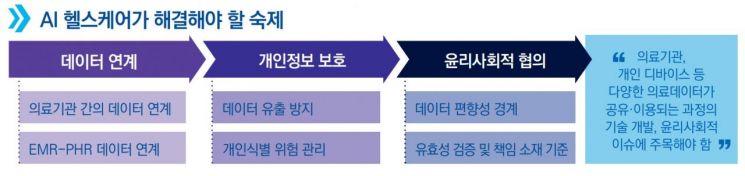
To secure a leading position in the future AI healthcare market, it is necessary to establish an interoperability strategy that encompasses not only data linkage between medical institutions but also linkage between EMR and personal health data (PHR).
Ensuring security to prevent the leakage of sensitive personal information is also essential. A cybersecurity system for network security, cloud security, and data security across interconnected collaborative structures must be established first.
Furthermore, clear ethical and social consensus on potential future incidents is required for the industry's development. Stakeholders must reach agreements on ethical and social issues such as bias in training data, transparency and accountability in decision-making processes, patient safety guarantees, and social impact.
Kyungsoo Park, Partner in charge of the healthcare industry at Samjong KPMG, stated, "Domestic AI healthcare companies are seeking to secure overseas market entry through partnerships with foreign medical device companies that have a high global market share, and are actively pursuing mergers and acquisitions (M&A) across different industries to create synergy," adding, "It is necessary to establish concrete business models considering the needs, regulations, and technical aspects of the AI healthcare market."
© The Asia Business Daily(www.asiae.co.kr). All rights reserved.


















