Powell Evaluates "Disinflation Entry"
Needs "Greater Conviction" to Cut Rates
Job Openings per Unemployed Lowest Since 2021
"Fed Overly Dependent on Data"...Concerns Over Rising Unemployment Rate
Jerome Powell, Chairman of the U.S. Federal Reserve (Fed), recently reiterated a cautious stance, stating that while the U.S. has entered a 'disinflation' path (a slowdown in the inflation rate), greater confidence is needed before cutting interest rates. He avoided commenting on the possibility of a rate cut in September, saying, "I will not set a specific date." Some voices warn that if the Fed, amid signs of cooling in the U.S. labor market, relies too heavily on data and delays the timing of rate cuts, it could lead to rising unemployment and an economic recession.
Powell: "Entered Disinflation... Need Greater Confidence in Inflation Slowdown"
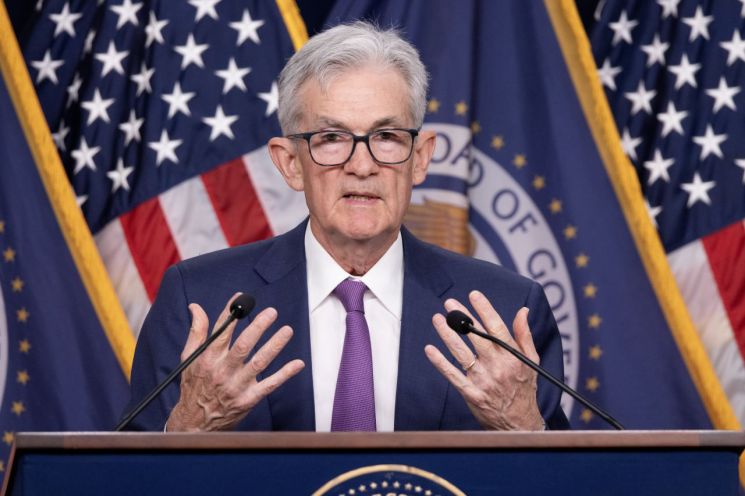
On the 2nd (local time), Powell attended a panel discussion at the European Central Bank (ECB) Annual Forum held in Sintra, Portugal, and stated, "We have made significant progress in bringing inflation down to our target."
Regarding recent inflation indicators, he said, "They suggest we are returning to a disinflation path," but added, "Before embarking on a more accommodative policy, we want greater confidence that inflation is moving sustainably toward the 2% target."
The core Personal Consumption Expenditures (PCE) price index, which the Fed mainly references for monetary policy, rose 2.6% year-on-year in May. This was in line with market expectations and down from the previous month's increase of 2.8%. Powell forecasted that inflation would fall to the low-to-mid 2% range within a year.
However, he expressed concern that rushing rate cuts could cause inflation, which has recently eased, to rebound, warning against both excessive tightening and easing risks.
Powell said, "We know well that if we move too early, we could undo the good work we've done," and "If we move too late, we could unnecessarily damage economic recovery and expansion." He assessed that the Fed's two mandates?full employment and price stability?have "returned to a much more balanced state."
When asked about the possibility of a rate cut in September, he replied, "I will not specify a concrete date here today." Earlier, the Fed reduced its forecast for the number of rate cuts this year from three to one at last month's Federal Open Market Committee (FOMC) meeting.
The market interpreted Powell's remarks as dovish (favoring monetary easing), calming the bond yields that had surged the previous day. The U.S. 10-year Treasury yield, a global benchmark for bond yields, fell 4 basis points (bp) from the previous trading day to 4.43%, while the 2-year Treasury yield, sensitive to monetary policy, dropped 3 bp to 4.73%.
U.S. Labor Market at a 'Turning Point'... Concerns Rise Over Unemployment Increase and Recession
While Powell emphasizes a cautious approach regarding rate cuts, some in the market warn that if the pivot (policy shift) is delayed, the cooling U.S. labor market could sharply slow down, leading to rising unemployment and a recession. The U.S. unemployment rate was 4% in May. It had fallen to a 50-year low of 3.4% a year ago but has gradually risen, surpassing 4% for the first time since January 2022. An unemployment rate of 4% is considered full employment, but experts are divided on whether it will stabilize around 4% or continue to rise. Investment bank Goldman Sachs expects a significant rise in unemployment due to slowing growth.
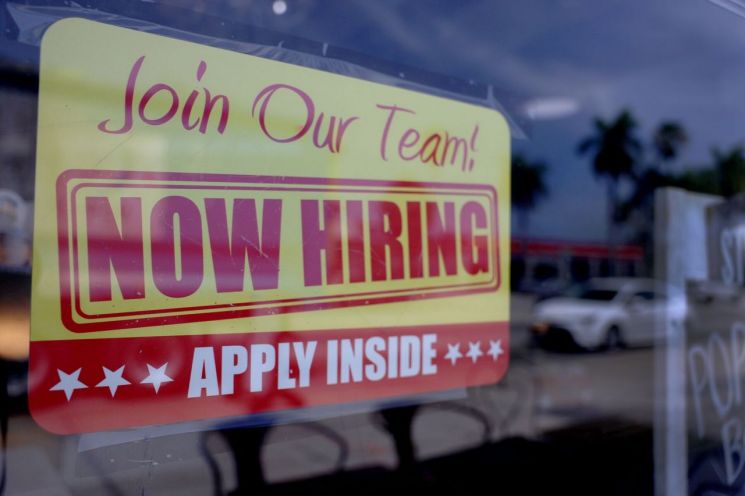
The May Job Openings and Labor Turnover Survey (JOLTs) released by the Department of Labor also confirmed a slowdown in the labor market. In May, job openings totaled 8.14 million, exceeding both the forecast (7.96 million) and the previous month's figure (7.919 million), but the number of job openings per unemployed person was 1.22, the lowest since 2021. This was slightly down from April's 1.24 and similar to the pre-pandemic 2019 average of 1.19. Additionally, there is speculation that weak consumer spending, which accounts for two-thirds of the U.S. economy, could lead to rising unemployment. According to the Commerce Department, retail sales in May increased by only 0.1% month-on-month, falling short of the forecasted 0.3%. April retail sales were revised down to a 0.2% decrease month-on-month.
Concerns about labor market slowdown are growing within the Fed as well. Mary Daly, President of the Federal Reserve Bank of San Francisco, warned last week that the U.S. labor market is nearing a turning point and that further slowing could raise unemployment. She said, "So far, the labor market has adjusted slowly and unemployment has risen slightly, but we are now approaching a point where positive outcomes are less likely," adding, "The future labor market could lead to higher unemployment. The risks we face now are not only about inflation."
Mohamed El-Erian, Chief Economic Advisor at Allianz and former CEO of PIMCO, the world's largest bond manager, warned, "There is no buffer in the U.S. labor market," and "The Fed is overly reliant on data. If rate cuts are delayed too long, it could lead to a recession."
© The Asia Business Daily(www.asiae.co.kr). All rights reserved.


















