Receiving Medical Fees in Virtual Assets
Money Laundering Through Nominee Accounts
Diverse Methods of Offshore Tax Evasion
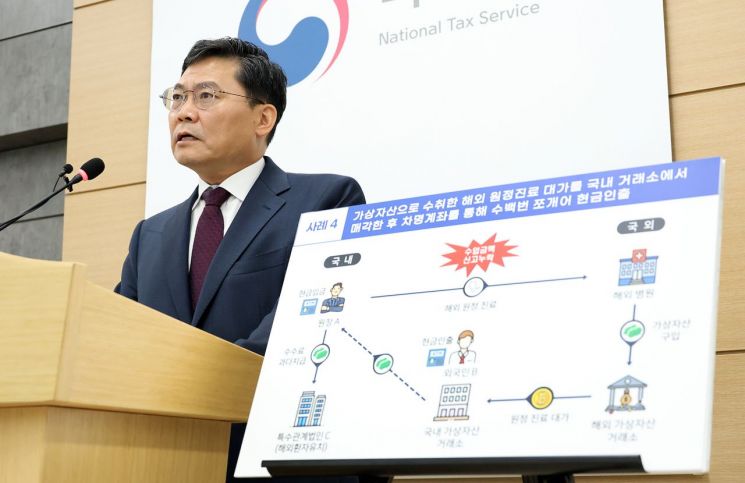 Jung Jae-su, Director of the National Tax Service Investigation Bureau, is holding a briefing on the 2nd regarding the commencement of tax investigations into 41 offshore tax evasion suspects, including doctors.
The National Tax Service (NTS) has launched a tax investigation into doctors who disguised Southeast Asia medical tourism as seminars to conceal related revenues. The NTS believes some doctors received payments for medical tourism in virtual assets, which are difficult to trace, and then brought the funds into the country through nominee accounts.
On the 2nd, Jeong Jae-su, Director of the NTS Investigation Bureau, stated, "Following the end of COVID-19, the number of foreigners visiting domestic hospitals and clinics such as plastic surgery and dermatology has increased again. We have confirmed allegations that 4 to 5 doctors concealed earnings from medical tourism in Southeast Asia and other locations," adding, "We have initiated tax investigations on a total of 41 offshore tax evasion suspects, including these individuals."
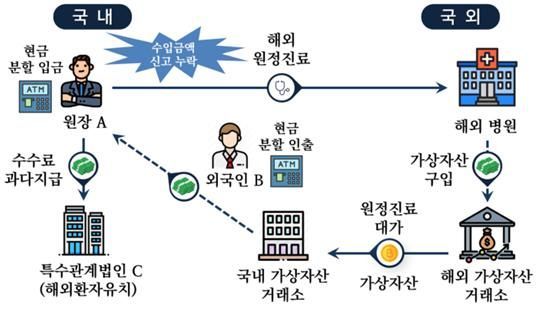
According to the NTS, individual A, who operates a plastic surgery clinic in Korea, received payments in virtual assets for medical tourism conducted at a local hospital in Southeast Asia. To evade tax authorities' tracking, A sold the virtual assets received as payment on domestic exchanges, then laundered the funds by withdrawing cash hundreds of times via ATMs using a nominee account of foreigner B, and subsequently depositing the cash back into an account under A’s name through other ATMs hundreds of times. Furthermore, Director A received foreign patient referral services from a special-related corporation C under his control and is suspected by the NTS of evading income tax by excessively overpaying commissions beyond the appropriate amount. Through the tax investigation, the NTS plans to impose income tax on tens of billions of won received as payment for medical tourism in virtual assets and tens of billions of won in excessive commission payments.
Tax evaders who erased traces such as names and resident registration numbers and changed their nationality to foreign to evade the NTS’s tracking of unreported overseas income are also subject to this tax investigation. Director Jeong said, "They cunningly exploited the difficulty the NTS faces in identifying overseas assets and income status through international information exchange when ownership of overseas assets and accounts changes to foreign names due to nationality changes," adding, "Some suspects obtained the nationality of tax havens by using golden visas that grant citizenship on the condition of investing a certain amount locally, then re-entered Korea and lived luxuriously with hidden assets."
The investigation also includes companies that issued virtual assets through overseas paper companies to conceal profits and companies that provided overseas technical services and received payments in virtual assets while omitting sales. These companies not only omitted sales but also doubly concealed capital gains earned from selling the virtual assets later. The NTS believes some company owners accumulated wealth solely through virtual assets and offshore funds, avoiding domestic assets such as real estate to evade tax authorities’ scrutiny.
Additionally, the NTS plans to investigate some multinational corporations that transferred corporate funds to overseas local subsidiaries for the benefit of the owner’s family, as well as those that sold or transferred core assets of domestic subsidiaries?grown based on domestic human resources, infrastructure, and market demand?to foreign special-related parties without paying fair compensation.
© The Asia Business Daily(www.asiae.co.kr). All rights reserved.
![Clutching a Stolen Dior Bag, Saying "I Hate Being Poor but Real"... The Grotesque Con of a "Human Knockoff" [Slate]](https://cwcontent.asiae.co.kr/asiaresize/183/2026021902243444107_1771435474.jpg)

















