June Consumer Price Inflation Rate 2.4%
Three Consecutive Months of Slowdown, Possibility of Base Interest Rate Cut Increases
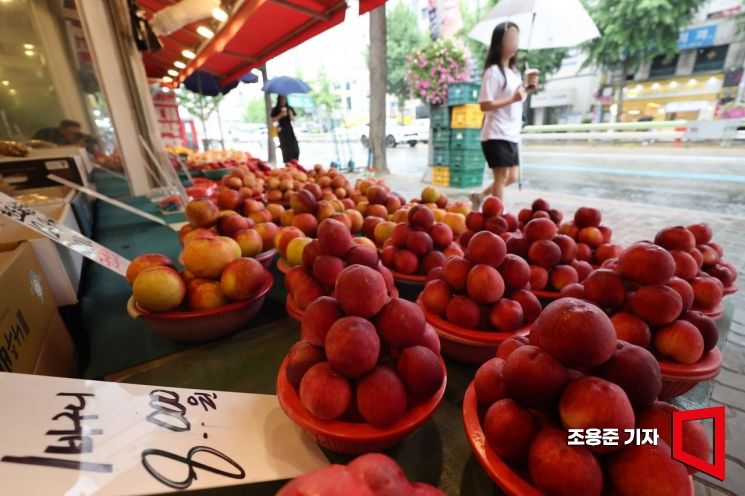 On the 2nd, when the consumer price inflation rate recorded 2% for three consecutive months, fruits were displayed at the Cheonggwa Market in Yeongdeungpo-gu, Seoul. Photo by Jo Yongjun jun21@
As the rate of consumer price inflation continues to clearly slow down, claims that the Bank of Korea's timing for lowering the base interest rate is approaching are gaining strength. The market predicts that the Bank of Korea may cut the base interest rate as early as next month.
On the 2nd, Statistics Korea announced that the consumer price index last month rose by 2.4% compared to the same month last year. This is the lowest inflation rate in 11 months since July last year (2.4%).
The consumer price inflation rate dropped to 2.8% in January this year, then rose again to 3.1% in February and March, and has shown a declining trend for three consecutive months from April (2.9%) through May (2.7%) to June.
The core inflation index, which shows the underlying trend of prices, has slowed its rise to the low 2% range. The June index excluding agricultural products and petroleum rose 2.0% compared to the same month last year. The OECD-style core inflation index excluding food and energy increased by 2.2%.
On the same day, the Bank of Korea held a 'Price Situation Review Meeting' chaired by Deputy Governor Kim Woong and stated that the consumer price index inflation rate last month showed a downward trend as expected and forecasted that the slowing trend would continue.
Deputy Governor Kim said, "The core inflation rate maintained a stable trend at the low 2% level," adding, "It is positive that the consumer price inflation rate also showed a downward trend as expected, falling to the mid-2% range."
He continued, "The consumer price inflation rate may temporarily pause its slowing trend due to recent oil price increases," but "considering the downward stabilization of core inflation and other underlying prices, as well as the base effects from last August's sharp rise in oil and agricultural product prices, the overall slowing trend is expected to continue."
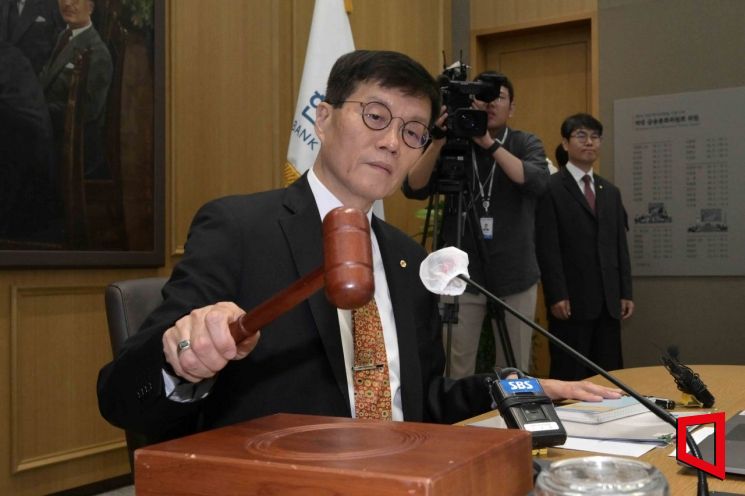 Lee Chang-yong, Governor of the Bank of Korea, is striking the gavel at the Monetary Policy Committee meeting held at the Bank of Korea headquarters in Jung-gu, Seoul, on May 23. Photo by Joint Press Corps
As the downward stabilization of prices becomes more evident, expectations for the Bank of Korea to lower the base interest rate are expected to grow. Bank of Korea Governor Lee Chang-yong said at a meeting held after deciding to keep the base rate unchanged on May 23, "If the inflation rate in the second half of the year is confirmed to be declining to 2.3?2.4%, we can consider lowering the interest rate." Previously, at a meeting in April, Governor Lee dismissed the possibility of a rate cut, saying that no signals for a rate cut had been given.
With the June inflation rate falling to the 2.4% level mentioned by Governor Lee, it is evaluated that conditions have been set for the Bank of Korea to seriously discuss lowering the base interest rate. In the market, views are increasing that the Bank of Korea will cut the base rate at the Monetary Policy Board meeting scheduled as early as next month.
Kang Seung-won, a researcher at NH Investment & Securities, said, "Considering the slowing inflation rate and sluggish domestic demand, there may be minority opinions for a rate cut at this month's Monetary Policy Board meeting, and the base rate may be lowered next month."
Baek Yoon-min, senior researcher at Kyobo Securities, said, "We expect the Bank of Korea to lower the base interest rate next month," emphasizing, "Uncertainty about growth remains high, and the need for policy responses to ease financial stability risks such as real estate project financing is increasing."
© The Asia Business Daily(www.asiae.co.kr). All rights reserved.
![Clutching a Stolen Dior Bag, Saying "I Hate Being Poor but Real"... The Grotesque Con of a "Human Knockoff" [Slate]](https://cwcontent.asiae.co.kr/asiaresize/183/2026021902243444107_1771435474.jpg)

















