Highest Level in 2 Months
Concerns Over Full-Scale War Between Israel and Hezbollah
There is a forecast that oil prices could soar to $90 per barrel if geopolitical tensions in the Middle East escalate.
On the 1st (local time) at the New York Mercantile Exchange, West Texas Intermediate (WTI) crude oil closed at $83.38 per barrel, up $1.84 (2.26%) from the previous trading day, while Brent crude, the global oil price benchmark, rose $1.60 (1.9%) to close at $86.60.
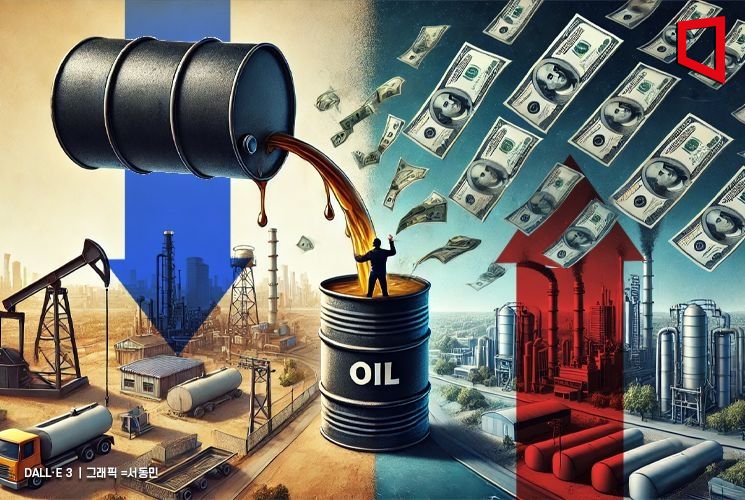
For WTI, this is the highest level since April 26, and for Brent crude, the highest since April 30.
The market attributes the rise in oil prices to heightened geopolitical tensions in the Middle East. Recently, conflicts between Israel and the Lebanon-based armed faction Hezbollah, supported by Iran, have intensified, raising concerns that Iran might become fully involved. The day before, Hezbollah's armed drone exploded, injuring 18 Israeli soldiers. Israel had previously conducted airstrikes on Hezbollah facilities in southern Lebanon. Iran produces about 3 million barrels of oil per day, accounting for approximately 3% of global production.
Andy Lipow, Chairman of Lipow Oil Associates, stated, "The biggest fear in the market is geopolitical tension in the Middle East," adding, "because it could spread to a complete supply disruption in the Persian Gulf region." He further added, "With demand increasing until the end of this year, Brent crude prices are expected to rise to around $90 per barrel."
TD Securities commodity analysts also pointed to the tensions between Israel and Hezbollah as the recent driver of price fluctuations. However, they believe that this increase in risk premium is more likely to support prices rather than trigger a new rally.
Due to rising demand, oil prices have been on an upward trend in recent weeks. Dennis Kissler, Senior Vice President at BOK Financial, said, "The recent price strength stems from declining oil inventories, increased road traffic demand, and more air travel," adding, "Sustained high temperatures across most parts of the U.S. have also increased demand for power generation."
Wall Street forecasts that oil prices will decline next year as supply increases and demand decreases. JP Morgan analysts predict Brent crude prices will drop significantly from an average of $83 this year to $75 next year. Goldman Sachs maintained its forecast for next year at an average of $82 per barrel.
© The Asia Business Daily(www.asiae.co.kr). All rights reserved.
![Clutching a Stolen Dior Bag, Saying "I Hate Being Poor but Real"... The Grotesque Con of a "Human Knockoff" [Slate]](https://cwcontent.asiae.co.kr/asiaresize/183/2026021902243444107_1771435474.jpg)











