KAIST Wins Grand Prize at Idea Contest
Recommended for Inclusion in National R&D
"To solve the low birthrate problem, we need to pay close attention not only to the birthrate but also to the miscarriage rate."
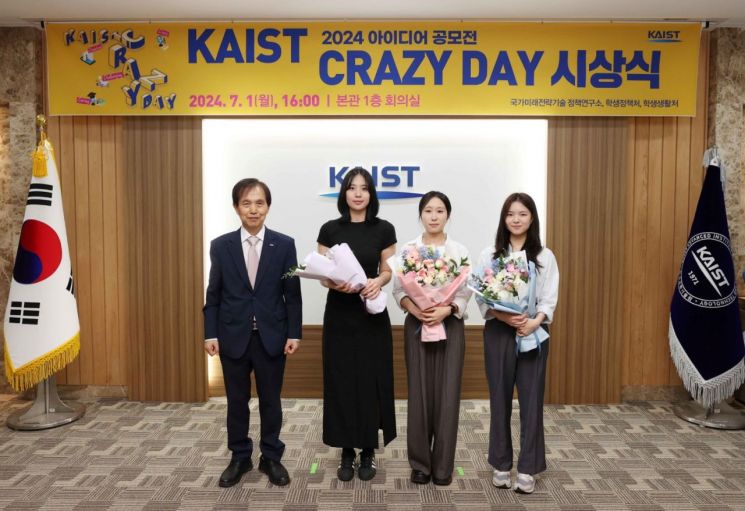 Lee Da-eun, Park In-ah, and Heo Hanna, winners of the KAIST Crazy Day Idea Contest Grand Prize, are taking a commemorative photo with KAIST President Lee Kwang-hyung. Photo by KAIST
Park In-ah, Lee Da-eun, and Ha Han-na, all born in 2002 and currently studying law at Dongguk University, proposed preventing miscarriages as a solution to overcome the population crisis.
The three won the grand prize at the 'KAIST Crazy Day Idea Contest' award ceremony held on the 1st at KAIST's Daejeon headquarters with their project titled "Development of a Portable AI Fetal Monitor to Reduce Miscarriage Rates." This contest was a nationwide public competition conducted by KAIST since March to find scientific and technological ideas to overcome the population crisis.
According to statistics from the National Health Insurance Service, from 2013 to 2022, over 1.46 million fetuses were miscarried over ten years. During the same period, the number of births was approximately 3.48 million. The miscarriage-to-birth ratio has steadily increased, soaring from 37.5% in 2013 to 49.4% in 2022.
Under the premise that protecting conceived life healthily is as important a solution to increasing birthrates as encouraging pregnancy and childbirth, they proposed an ultra-thin device capable of monitoring the fetus's condition 24 hours a day.
The method involves attaching an ultra-thin patch, made thinner than the widely used adhesive patches for blood sugar measurement, to the mother and using deep learning AI technology to observe the fetus's stability.
The measured results can be checked anytime via a mobile phone application, and if abnormal signals are detected, the device notifies the mother and medical institutions in real time to prepare for crisis situations in advance.
In her acceptance speech, Park In-ah said, "The population issue is a complex and difficult challenge, but I hope more people will take an interest in this problem and work together to solve it."
Seo Yong-seok, director of the KAIST National Future Strategy Technology Policy Research Institute, who oversaw the contest, added, "We plan to propose these ideas to the Ministry of Science and ICT and the Ministry of Health and Welfare so that they can be promoted as actual R&D projects."
© The Asia Business Daily(www.asiae.co.kr). All rights reserved.
![Clutching a Stolen Dior Bag, Saying "I Hate Being Poor but Real"... The Grotesque Con of a "Human Knockoff" [Slate]](https://cwcontent.asiae.co.kr/asiaresize/183/2026021902243444107_1771435474.jpg)
















