Professor Lim Jungho's Team at UNIST Accurately Predicts Typhoons by Combining Cheollian Satellite Data and AI
AI Quickly Analyzes New Typhoon Data... Applicable to Operational Forecast Systems
As climate change makes typhoon prediction increasingly difficult, a new technology has been developed that combines real-time satellite data and deep learning to predict typhoons with greater precision.
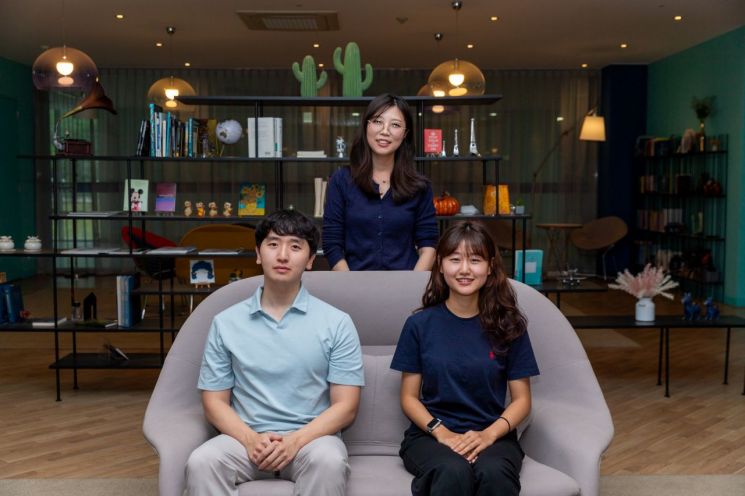 (From the top center clockwise) Researcher Joo Hyun Lee, integrated master's and doctoral course student Yejin Kim, integrated master's and doctoral course student Minki Chu (all first authors).
The research team led by Professor Lim Jungho of the Department of Urban and Environmental Engineering at UNIST (President Lee Yonghoon) has developed a deep learning-based prediction model that accurately analyzes typhoon information. By integrating geostationary meteorological satellite data with numerical model data, the model predicts typhoon intensity in real time.
The Hybrid-Convolutional Neural Networks (Hybrid-CNN) model developed by the team objectively and accurately predicts typhoon intensity over 24, 48, and 72 hours. The results showed approximately 50% improvement over previous predictions and demonstrated excellent performance even during rapid typhoon intensification.
Traditional typhoon observation methods mainly relied on geostationary satellite data, which forecasters analyzed manually. This process was time-consuming and depended on the uncertainties of numerical models. However, the Hybrid-CNN model significantly increases analysis speed, reducing the uncertainty of numerical models and enabling more accurate typhoon forecasts.
The team estimated typhoon intensity using transfer learning based on data from Cheollian 1 and Cheollian 2A satellites. By visualizing and quantitatively analyzing the AI-driven automatic typhoon intensity estimation process, they improved the accuracy of typhoon forecasts. The AI, trained on existing meteorological data, analyzed new typhoon data quickly and accurately.
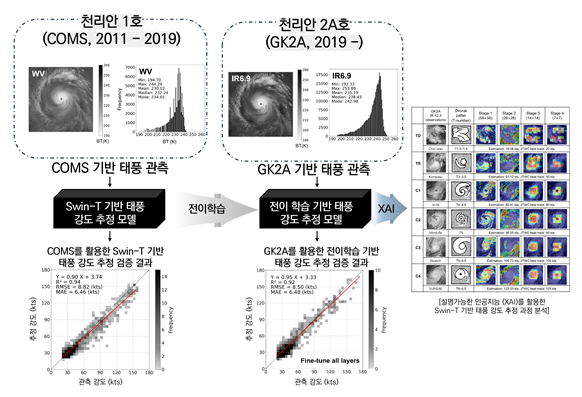 Overview of Transfer Learning-Based Typhoon Intensity Estimation Framework Using Cheollian 1 and Cheollian 2A Satellites.
Environmental factors affecting changes in typhoon intensity can be objectively extracted and applied to operational forecasting systems. This is expected to provide forecasters with rapid and accurate typhoon information, greatly aiding disaster preparedness and damage prevention.
Professor Lim Jungho explained, "The deep learning-based typhoon prediction framework will provide forecasters with more accurate prediction information, enabling them to establish swift and effective countermeasures."
 Professor Jeongho Lim
This research was supported by the Ministry of Oceans and Fisheries, the Ministry of Science and ICT, and the Institute for Information & Communications Technology Planning & Evaluation. The results were published in GIscience & Remote Sensing in March 2024 and in the iScience journal by CellPress in May 2024.
© The Asia Business Daily(www.asiae.co.kr). All rights reserved.
![Clutching a Stolen Dior Bag, Saying "I Hate Being Poor but Real"... The Grotesque Con of a "Human Knockoff" [Slate]](https://cwcontent.asiae.co.kr/asiaresize/183/2026021902243444107_1771435474.jpg)

















