Long-term Bond Yields Rise After Presidential TV Debate
Fiscal Deficit Expected to Widen Due to Trump Tax Cuts
Tariffs and Immigration Policies Also Expected to Fuel Inflation
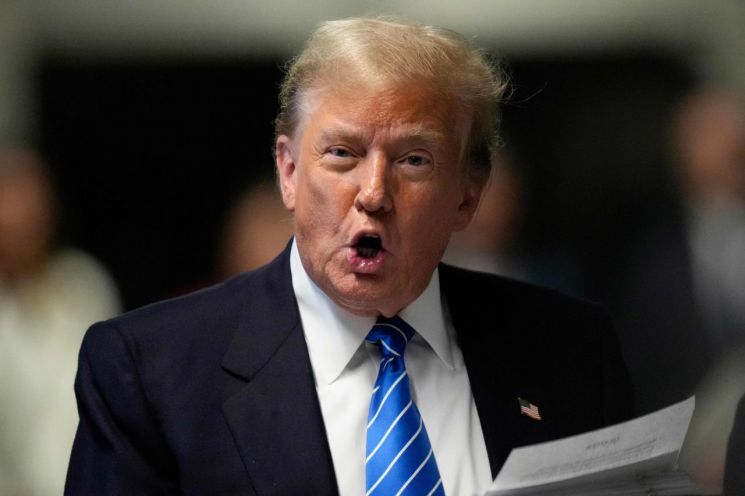
With the U.S. presidential election approaching this November, U.S. Treasury yields are surging, particularly in long-term bonds. Following the first presidential debate held last week, the bond market is reacting to analyses suggesting an increased likelihood of former President Donald Trump's victory. If Trump succeeds in returning to the White House, it is expected that his signature tax cut policies will expand the fiscal deficit, while tariff hikes and immigration restrictions could fuel inflation, leading to sustained high interest rates.
On November 1 (local time), in the global bond market, the benchmark 10-year U.S. Treasury yield rose 15 basis points (1bp = 0.01 percentage point) from the previous trading day to 4.49%. The 30-year Treasury yield increased by 14 basis points to 4.65%. Both the 10-year and 30-year Treasury yields are at their highest levels since May 31.
The sudden surge in long-term U.S. Treasury yields is attributed to the first presidential debate held on October 27. As President Joe Biden appeared frail?stammering and staring into space?the market perceived a higher chance of former President Trump winning, prompting economic impact analyses. Indeed, since the debate on October 27, U.S. Treasury yields have risen for three consecutive trading days through today.
Wall Street expects that if former President Trump returns to the White House and the Republican Party controls both the House and Senate, inflation will rebound. Tariff hikes could increase import prices, and immigration restrictions could reduce labor supply, pushing up labor costs and causing inflation to surge again. Global credit rating agency Moody's projected that if Trump wins the election and Republicans control Congress, U.S. inflation would rise from 3% in 2024 to 3.6% in 2025. In contrast, under a Biden victory scenario, inflation is expected to remain at 2.4% in 2025. Should inflation accelerate again, the Federal Reserve (Fed) may hesitate to cut interest rates, prolonging the period of high rates.
Corporate and income tax cuts are also identified as short-term factors pushing up Treasury yields. Former President Trump argues that tax cuts increase corporate investment and household consumption capacity, leading to economic growth and higher tax revenues. However, in the short term, reduced government revenue may lead to increased Treasury issuance to cover the deficit, driving yields higher.
Morgan Stanley noted in an investment memo immediately after the debate, "There has been a clear shift in the probability of former President Trump defeating President Biden," adding, "Markets now must respond to the increased likelihood of changes in immigration and tariff policies in an economy already cooling." The memo further stated, "With growing concerns over the fiscal deficit and a higher chance of a Republican victory, upward pressure on long-term yields could intensify."
Nomura Securities also stated in an investment memo released that day, "The Trump administration is likely to issue additional Treasury bonds as tariff increases alone will not suffice to finance expanded fiscal spending," and "If inflation rises again and the Fed maintains high interest rates, government fiscal deficits will widen further due to increased interest costs."
On the same day, the U.S. Supreme Court granted former President Trump partial immunity related to allegations of "overturning the election results," increasing his chances of returning to the White House. Local media outlets such as The New York Times (NYT) forecast that it is virtually unlikely that Trump's criminal trial related to this matter will take place before the November election. Thus, following his decisive victory over President Biden in the first TV presidential debate and the partial alleviation of "judicial risks," Trump’s path to the presidency has been given a green light.
The market is also placing a high probability on former President Trump's election. According to New Zealand-based betting site PredictIt, traders estimate Trump's chances of winning the election at 58%, while President Biden's chances stand at 30%. A poll also revealed that 7 out of 10 Americans want President Biden to withdraw from the race. According to a survey conducted by CBS News and polling firm YouGov immediately after the TV debate, 72% of voters said President Biden should not run for re-election. Only 28% responded that Biden should run.
© The Asia Business Daily(www.asiae.co.kr). All rights reserved.

















