Before the Final on the 7th, Candidates with Low Chances Attempt to Withdraw
87% of Contests Still Undecided... Effectiveness Remains 'Questionable'
In France, following the first round of the early general election held on the 30th of last month (local time), the far-right party Rassemblement National (RN) secured first place with 33% of the vote, prompting the second-place left-wing coalition and the third-place pro-government bloc (Ensemble) to urgently form an 'anti-RN alliance.' With the second round of voting scheduled for the 7th, this move reflects their determination to block the surging far-right forces and is expected to be a key variable in the election outcome.
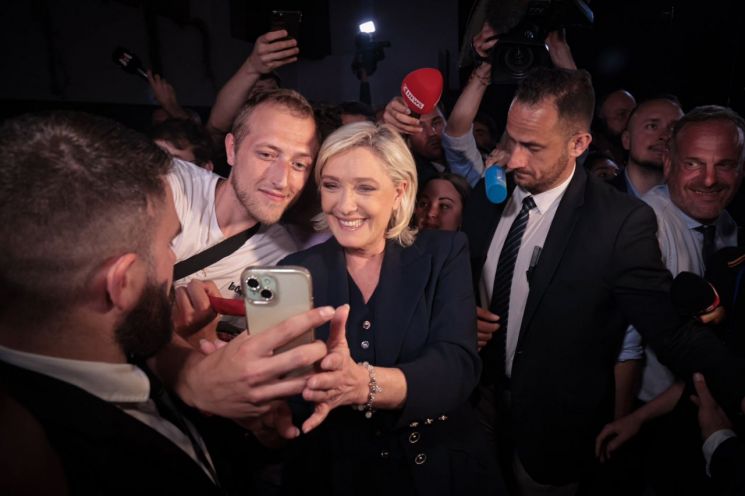 Marine Le Pen, the de facto leader of the French far-right party National Rally (RN), is seen taking a selfie with supporters on the 1st (local time).
 [Image source=EPA Yonhap News]
According to foreign media including France24, Gabriel Attal, Prime Minister of France and leader of the pro-government bloc which ranked third with 20.04% of the vote, stated immediately after the first round, "The lesson tonight is that the far-right is at the threshold of power," emphasizing, "We must not allow votes to go to the RN." He added, "We have made decisions regarding more than 60 constituencies. This means our candidates will withdraw," warning, "If they come in third, RN could win by defeating candidates from other parties that share our and the Republic's values."
The left-wing coalition, New Popular Front (NFP), which came in second with 28% of the vote, also promised to withdraw candidates who placed third in the first round, CNN reported. Jean-Luc M?lenchon, leader of La France Insoumise (LFI), which leads the NFP, told supporters that day, "Our instruction is clear: do not give a single vote or seat more to the RN," adding, "A long week awaits us, and everyone will make decisions according to their conscience."
These two political forces' decision to withdraw their lower-ranking candidates aims to block the far-right. If votes are split between the second and third-place candidates, RN candidates could win by default, so they intend to prevent this. It is interpreted as a show of will to support the candidate with the highest chance of winning among the two forces to stop RN's expansion and prevent them from securing a majority of seats.
Under French election law, to win outright in the first round, a candidate must secure more than 25% of registered voters in the constituency and more than 50% of the total votes cast that day. The second round, held on the 7th, will take place in constituencies where no candidate was elected. Candidates who receive more than 12.5% of the vote in each constituency advance to the runoff. The U.S. political media outlet Politico predicted that, given the historically high turnout in this election, three-way runoffs could occur in hundreds of constituencies.
Out of the total 577 seats, 76 candidates (13.2%) secured a majority in the first round (39 from the far-right camp including RN, 32 from NFP, 2 from the pro-government bloc, 1 from the Republicans, and 2 from other right-wing parties). The contest for the remaining 501 seats (86.8%) has been postponed to the second round.
Foreign media described this candidate withdrawal strategy as the so-called 'cordon sanitaire' strategy, which has been used for decades to contain extremist forces. This strategy was also mobilized when Jean-Marie Le Pen, the father of Marine Le Pen?the de facto leader of RN?and founder of the RN's predecessor, the National Front (NF), ran in the 2002 presidential election. When Jean-Marie Le Pen unexpectedly advanced to the runoff by placing second in the first round, the left-leaning Socialist Party, which failed to advance, supported the center-right Union for the Republic (RPR) candidate to block him.
First, the NFP and the pro-government bloc are expected to engage in a week-long political negotiation to decide whether to withdraw candidates in individual constituencies to block nationalist and anti-immigration forces. However, there is analysis that it is uncertain whether the cordon sanitaire strategy will yield meaningful results this time as well. The Guardian noted, "Voters are increasingly reluctant to vote for parties that do not fully align with their political preferences," pointing out that this has steadily shaken the united front of mainstream parties.
© The Asia Business Daily(www.asiae.co.kr). All rights reserved.

















