Jongno-gu Designated as Nation's First 'Special Management Area'
'Red Zone' Bukchon-ro 11-gil Tourist Access Limited to 7 Hours During Daytime
Serious Illegal Parking... Charter Bus Traffic Restriction Zone Also Enforced
Jongno-gu Mayor: "Protecting Residents While Coexisting with Local Economy"
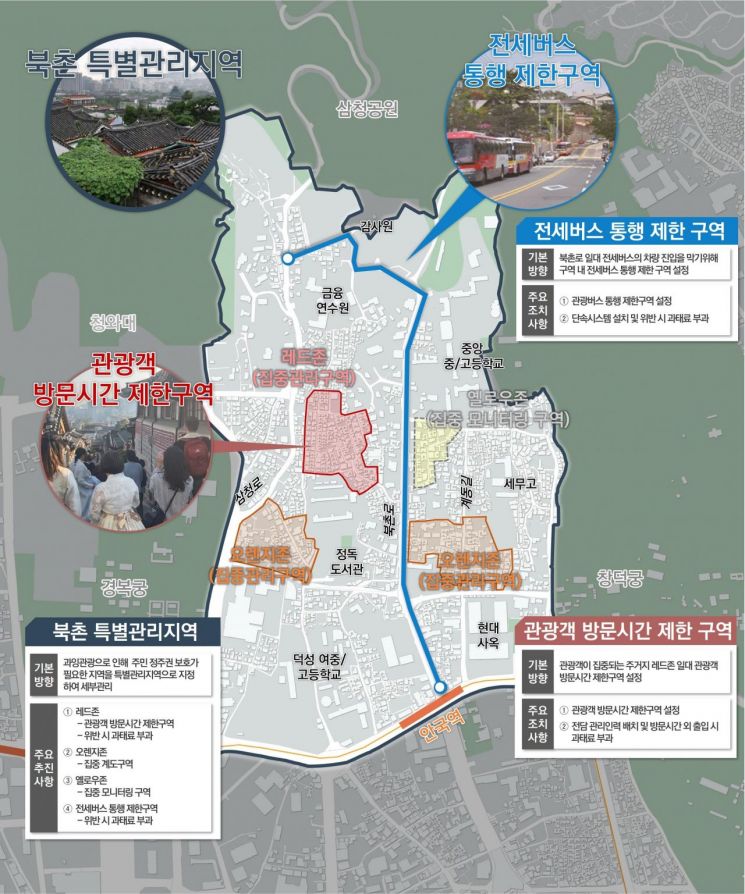
Jongno-gu, Seoul (District Mayor Jeong Munheon) announced that starting from the 1st, it will designate the popular tourist destination ‘Bukchon Hanok Village’ as a ‘Special Management Area,’ imposing restrictions on visiting hours and preventing illegal parking of charter buses.
The target area includes the entire Bukchon district unit planning zone (1,128,372.7㎡), which covers parts of Samcheong-dong and Gahoe-dong, and is divided into four zones: ‘Red Zone,’ ‘Orange Zone,’ ‘Yellow Zone,’ and ‘Charter Bus Traffic Restriction Zone,’ each with different implementation times and traffic hours.
The district designated the Special Management Area due to concerns that the natural environment was being damaged and residents’ peaceful living conditions were being disturbed by tourist visits exceeding the area’s capacity. Designation as a Special Management Area under the Tourism Promotion Act allows for restrictions on tourist visiting hours and vehicle and tourist traffic, with fines imposed for violations.
Bukchon-ro 11-gil (34,000㎡), which receives the highest influx of visitors, has been designated as the ‘Red Zone,’ limiting tourist visiting hours from 10 a.m. to 5 p.m. (a total of 7 hours). After revising the ordinance in the second half of this year, a guidance period will be held starting in October, with full enforcement beginning in March next year.
Bukchon-ro 5-ga-gil (26,400㎡) and the Gye-dong-gil area (34,000㎡) have been set as the ‘Orange Zone.’ Considering the high floating population and the mixed residential and commercial areas, visiting hours will not be restricted, but guidance activities will be intensified.
Bukchon-ro 12-gil (11,700㎡), where resident complaints have started to increase, is designated as the ‘Yellow Zone,’ a focused monitoring area. Through monitoring, the actual status of visitors will be identified, and if necessary, guidance will be strengthened by deploying Bukchon Village Keepers and installing signboards to ensure basic order compliance.
The 1.5 km section of Bukchon-ro from Anguk Station Intersection to the entrance of Samcheong Park (27,500㎡), where illegal parking of charter buses is frequent, has been designated as the Charter Bus Traffic Restriction Zone. Through traffic regulation review, installation of traffic safety facilities, and implementation of a vehicle traffic management system, charter bus traffic in this area will be restricted starting July next year, followed by about a six-month guidance period, with full enforcement beginning in January 2026.
Since most charter buses carrying group tourists illegally park at the village entrance, the district expects this to be the strongest policy to ensure smooth traffic flow and capacity control. In line with the charter bus traffic restrictions, charter bus pick-up and drop-off zones will be established within a maximum radius of 1.5 km around Bukchon to encourage a shift from vehicle-centered to pedestrian-centered travel patterns.
Jongno-gu conducted a ‘Study on Designation and Management Measures for Special Management Areas’ targeting the Bukchon influence area from November 2022 to December last year, and submitted a proposal for designation as a Special Management Area to the Ministry of Culture, Sports and Tourism and Seoul City in February this year.
The Special Management Area boundaries were finalized after review by a designation review committee composed of experts and a residents’ public hearing.
District Mayor Jeong Munheon stated, “The success of this project depends on the active participation of tourists and the travel industry, and above all, requires strong support from the Ministry of Culture, Sports and Tourism and Seoul City.” He added, “We plan to have a sufficient guidance period to minimize confusion among tourists and the industry, and we hope that the Special Management Area policy will become a cornerstone of ‘sustainable tourism’ that protects residents’ right to live while coexisting with the local economy.”
© The Asia Business Daily(www.asiae.co.kr). All rights reserved.

















