Extended Forex Market Trading Hours Until 2 AM from the 1st
Trading Hours Extended from 9 AM to 2 AM Next Day
Expected to Enhance Exchange Rate Stability and Reduce Transaction Costs
Inclusion in World Government Bond Index (WGBI) Also Anticipated
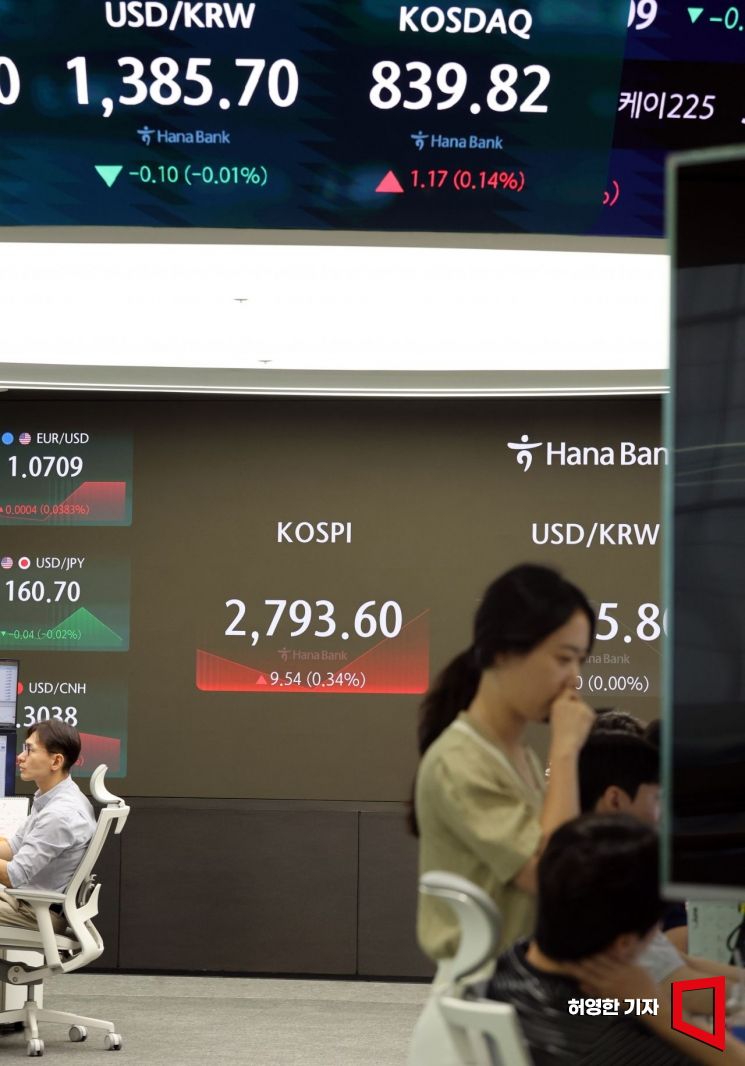 Various indices such as stock prices and exchange rates are displayed on the electronic board in the dealing room of the Seoul Hana Bank headquarters. Photo by Younghan Heo younghan@
Starting from the 1st, the trading hours of the domestic foreign exchange market will be significantly extended. With the extension of foreign exchange trading hours, it is expected that market stability will improve and transaction costs will be reduced, thereby enhancing the benefits for investors. As the foreign exchange market develops, expectations for inclusion in advanced country indices such as the World Government Bond Index (WGBI) are also expected to increase. However, there are concerns that exchange rate volatility may actually increase during economic crises, and that foreign exchange trading may not become as active as anticipated.
Foreign Exchange Market Closing Time Extended from 3:30 PM to 2 AM
According to the Ministry of Economy and Finance and the Bank of Korea, the domestic foreign exchange market will operate from 9 AM to 2 AM the following day starting from this day. Previously, it operated from 9 AM to 3:30 PM, so the trading hours will increase by 10 hours and 30 minutes.
The authorities expect that the increase in foreign exchange trading hours will enhance the stability of the won-dollar exchange rate market. Until now, since the foreign exchange market closed at 3:30 PM, various events occurring domestically and internationally until the next market opening could not be reflected in the exchange rate in real time.
While the domestic foreign exchange market was closed, overseas investors traded the won through offshore Non-Deliverable Forward (NDF) contracts, causing the offshore trading market to grow abnormally. NDF is a forward contract settled in dollars for the difference between the contract rate and the spot rate (fixing rate) at maturity, used by foreigners for currency hedging and foreign exchange investment.
Volatility in NDF was reflected all at once in the next day’s domestic exchange rate, frequently causing a "wag the dog" phenomenon where the domestic foreign exchange market was excessively influenced. The government and market experts expect that with improved domestic market accessibility due to this system change, the influence of NDF will decrease, and in the long term, NDF trading will be absorbed into domestic foreign exchange market trading.
Kim Chan-hee, an economist at Shinhan Investment Corp., said, "With the extension of foreign exchange market trading hours, we expect the volatility of the won-dollar exchange rate to decrease," adding, "In the long term, NDF trading will also be absorbed."
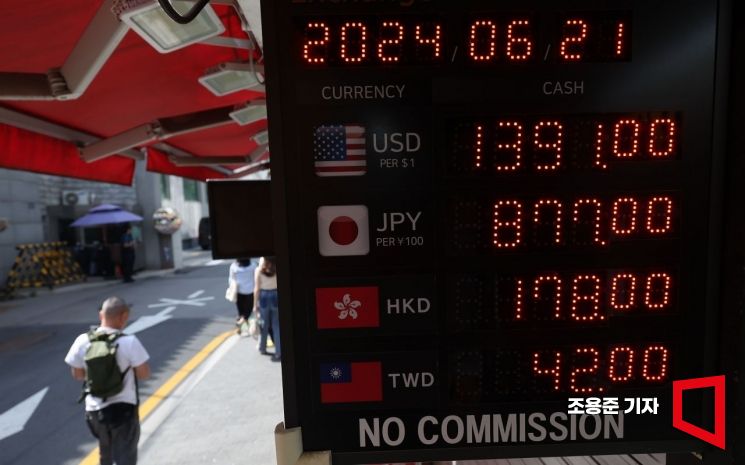
Increased Currency Exchange Benefits and Greater Possibility of Inclusion in the World Government Bond Index
Investors’ currency exchange benefits will also increase. Until now, domestic investors purchasing U.S. stocks and bonds after market hours exchanged dollars at a provisional exchange rate called the 'interim rate,' but from now on, they will be able to exchange at real-time rates. The interim rate generally involved higher exchange costs than real-time rates, so this is expected to reduce such costs.
Export-import companies operating domestically or expanding overseas will also be able to exchange currency at real-time rates during nighttime, enabling them to manage the risk of losses due to exchange rate fluctuations.
As the foreign exchange market becomes more advanced, expectations for inclusion in advanced country indices are also expected to rise. Improved accessibility to the foreign exchange market is analyzed to increase the possibility of Korea’s government bonds being included in the World Government Bond Index (WGBI).
The WGBI is a bond index managed by the FTSE Russell Group of the Financial Times Stock Exchange (FTSE) in the UK and is known as an advanced country government bond index. If Korean government bonds are included in the WGBI, foreign investment in domestic bonds is expected to increase significantly. The foreign exchange authorities are anticipating inclusion in the WGBI in September.
Park Sang-hyun, a senior researcher at Hi Investment & Securities, said, "With the opening of the domestic foreign exchange market, foreign investors’ accessibility will greatly improve," adding, "The possibility of inclusion in the WGBI will also increase."
However, there are concerns that even with extended foreign exchange trading hours, nighttime trading may not become active. Even currencies like the Swiss franc or Chinese yuan, which can be traded 24 hours, tend to see decreased trading volume during nighttime hours. Without proper response capabilities, the domestic foreign exchange market could become more vulnerable to external shocks such as a global financial crisis, and exchange rate volatility could increase.
The authorities stated that they will strengthen institutional support, such as enhancing the role of domestic banks as market makers, to maintain appropriate market liquidity and stability. A foreign exchange authority official emphasized, "We plan to actively support creating an environment where domestic and international market participants can trade in our foreign exchange market without major difficulties," adding, "If exchange rate volatility excessively expands during nighttime hours, we will respond appropriately by implementing market stabilization measures in a timely manner."
© The Asia Business Daily(www.asiae.co.kr). All rights reserved.


















