In the first round of the early general election held in France on the 30th (local time), exit polls indicated that the far-right party Rassemblement National (RN) is expected to win. French President Emmanuel Macron's decision to dissolve the National Assembly and call for early elections, aimed at curbing the rise of far-right forces, has ultimately backfired. Cornered, President Macron urged support, stating that "democratic and republican unity is needed in the second round of voting (July 7)."
 Marine Le Pen, the de facto leader of the French far-right party National Rally (RN)
 [Photo by Reuters]
Far-right expected to lead in first round... Macron's centrist coalition ranks third
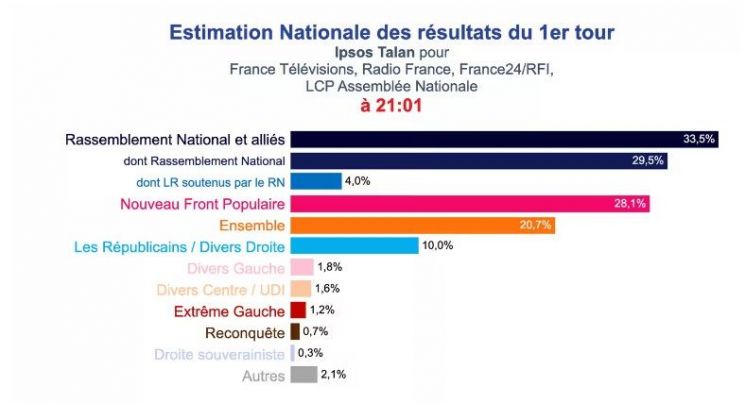
According to exit polls by the polling agency Ipsos, RN is estimated to secure 33.5% of the vote in the first round. Following are the left-wing coalition New Popular Front (NFP) with 28.1%, and the ruling party Renaissance led by President Macron’s Ensemble coalition with 20.7%. Exit polls released by BFM TV also showed RN leading with 33%, ahead of NFP at 28.5% and Renaissance Ensemble at 22%.
Although the second round remains, if the current exit polls hold, RN could secure a majority. ELABE, citing BFM TV results, projected RN to win between 255 and 295 seats. NFP is expected to gain 120 to 140 seats, and Renaissance Ensemble 90 to 125 seats. The French National Assembly has 577 seats, requiring at least 289 for a majority. However, Ipsos’s seat analysis forecasts RN to win 230 to 280 seats, falling short of a majority.
Marine Le Pen, the de facto leader of RN, welcomed the exit poll results at a press conference immediately after their release, calling it "a clear vote showing the will of the French people." She urged consolidation to enable President Macron to appoint RN leader Jordan Bardella as Prime Minister, stating, "An absolute majority is necessary for the reforms this country needs."
Ipsos predicted that 65 to 85 candidates would be elected outright in the first round. In the 2022 general election, only five candidates surpassed the first-round election criteria of over 25% of registered voters in the district and more than 50% of total votes cast on the day. The remaining districts will hold a second round on July 7. The number of constituencies advancing to the second round is forecasted as RN 390 to 430, NFP 370 to 410, and Renaissance Ensemble 290 to 330. In the second round, candidates who receive at least 12.5% of registered voters’ support in the first round or the top two vote-getters compete, with the highest vote-getter winning. Major foreign media reported that each party must finalize their second-round candidate lists within 48 hours, and intense negotiations between the left-wing coalition and centrist coalition are expected to block the far-right RN from taking power.
High voter turnout... Macron cornered after early election gamble
Following the confirmation of a far-right surge in this general election, as in the European Parliament elections, President Macron, who took the bold step of dissolving the National Assembly and calling early elections, has become increasingly politically cornered. Macron’s announcement of early elections was intended to highlight the risk of a far-right government and curb RN’s momentum confirmed in the European Parliament elections, but it has instead strengthened the far-right.

The provisional turnout for the first round was 67%, 19.5 percentage points higher than the 47.5% turnout in the first round of the 2022 general election. Major foreign media analyzed that this high turnout reflects voters’ perception of the sudden early election as highly important. France24 reported, "Although the final outcome remains uncertain ahead of the second round, President Macron’s decision is having the opposite effect and will be another blow." Politico Europe stated, "What was once considered an unimaginable nightmare in France?the far-right party taking power?has come one step closer. His (early election) gamble appears to be failing."
If RN or NFP becomes the largest party in the National Assembly after the second round, France will see a far-right or left-wing coalition Prime Minister. This would result in a so-called 'cohabitation' government, where the President and Prime Minister belong to different parties. There have only been three such cohabitation governments in the history of France’s Fifth Republic. Consequently, President Macron’s position is expected to become even more constrained. Although he has stated that he will not resign from the presidency even if he loses the general election until the 2027 election, a cohabitation government could lead to the cancellation or significant revision of Macron’s reform agenda, including pension reform and pro-business policies. Centrist lawmakers who lose their seats and other existing supporters may also turn their backs on President Macron.
In a statement, President Macron said, "The high turnout proves the political significance of this vote," and appealed, "It is time for broad and clear democratic and republican unity against RN in the second round." ?douard Philippe, former Prime Minister and member of the Horizons party within Ensemble, also argued, "We must not vote for the far-right or far-left in the second round." Jean-Luc M?lenchon, leader of La France Insoumise (LFI) within the left-wing coalition NFP, declared, "This election is a clear defeat for President Macron," emphasizing that NFP is the only alternative to RN in the second round.
© The Asia Business Daily(www.asiae.co.kr). All rights reserved.



















