Biden Suffers Major Defeat in First Presidential TV Debate
Trump Announces Tariff Hikes, Tax Cuts, and Anti-Immigration Policies
Tax Foundation: "GDP Down 0.8%"... Moody's Predicts "Recession Next Year"
With the first TV debate resulting in a crushing defeat for President Joe Biden ahead of the U.S. presidential election this November, the 'Trump risk' is becoming more apparent. As the possibility of former President Donald Trump's return to the White House increases, with promises such as tariff hikes, tax cuts, and banning illegal immigration, attention is focused on the impact this could have on the U.S. economy and major countries. Some voices warn that if former President Trump is elected, inflation driven by tariff increases could surge, leading to a decline in growth rates, and a delay in interest rate cuts could push the U.S. economy into a recession.
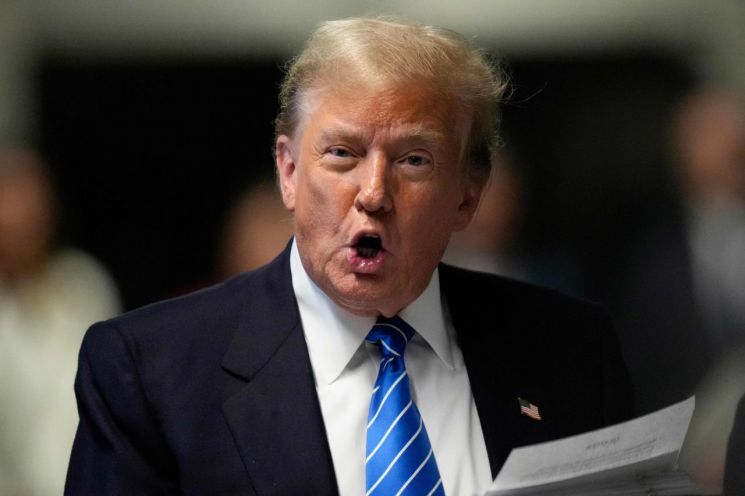
According to an analysis by global credit rating agency Moody's on the 30th of last month (local time), if former President Trump wins the election and the Republican Party controls Congress, U.S. inflation is estimated to rise from 3% in 2024 to 3.6% in 2025.
Moody's expects that while tax cut policies such as reductions in corporate and income taxes will stimulate the economy, tariff increases and anti-immigration policies will drive inflation. If tariffs rise, import prices will increase, and if immigration inflows decrease, mismatches in the labor market and rising labor costs could cause inflation to rebound. Moody's also foresees a significant possibility of a recession occurring in mid-2025 if the Federal Reserve (Fed) hesitates to cut interest rates amid a resurgence of inflation.
In the scenario where President Biden is re-elected, the inflation rate is expected to record 2.4% in 2025.
Moody's warned, "The Fed, focusing on labor costs and inflation, may resume raising interest rates or at least feel the need to wait longer before cutting rates," adding, "A recession could once again become a serious threat."
If former President Trump, who has announced 'bombshell tariffs,' is elected, an increase in inflation is inevitable. Previously, former President Trump declared that he would impose a universal tariff increase of 10 percentage points on all imported goods worldwide and apply ultra-high tariffs exceeding 60% uniformly on Chinese imports. As import prices rise and household burdens increase, this could lead to reduced consumption, decreased production, investment, and employment, and a decline in growth rates.
According to a recent report by the Tax Foundation titled 'Tracking the Economic Impact of Trump and Biden Tariffs,' if former President Trump's tariff increase pledges are realized, the U.S. Gross Domestic Product (GDP) is expected to decrease by at least 0.8%, and employment is projected to decline by 684,000 full-time jobs. Americans' taxes are also expected to increase by $524 billion. The Peterson Institute for International Economics (PIIE) similarly analyzed that Trump's tariff policies would impose an annual tax burden of up to $1,700 on middle-income American households. In fact, a University of Chicago study found that when former President Trump raised tariffs on washing machines in 2018, the purchase prices for washing machines and dryers increased by $86 and $92, respectively.
The Tax Foundation pointed out, "Many economists have found through research that since the trade war began in 2018, tariffs have only caused prices to rise and production and employment to decline, negatively impacting the U.S. economy."
Not only the U.S. but also major countries worldwide are expected to find it difficult to avoid the Trump risk. If the U.S. tariff hikes lead to an expansion of the global trade war and contraction of trade, it is highly likely to adversely affect global economic growth. If inflation surges sharply in the U.S., sustaining a strong dollar and delaying interest rate cuts, other countries may face significant difficulties in shifting to accommodative monetary policies, increasing downward pressure on their economies.
© The Asia Business Daily(www.asiae.co.kr). All rights reserved.

















