Bank of Korea Economic Research Institute 'Economic Analysis' Paper
10,000 KRW Childbirth Support Payment Increases Total Fertility Rate by 0.0003
10,000 KRW Increase in Infrastructure Budget Raises Total Fertility Rate by 0.00096
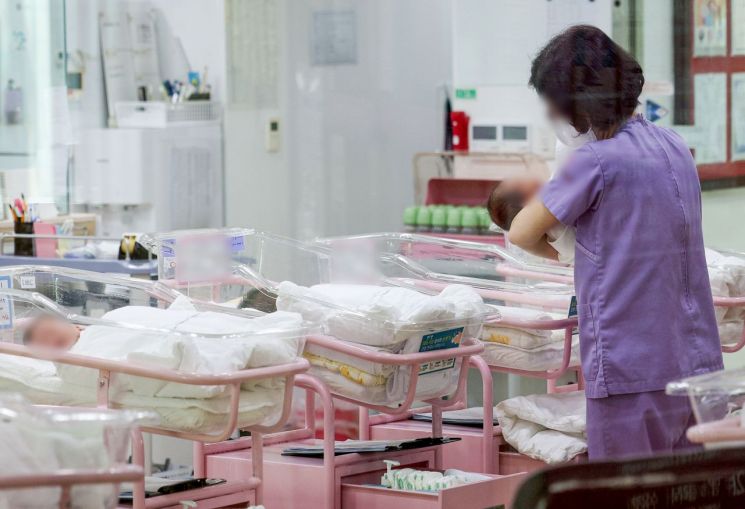
As the government and local governments introduce various measures to address the low birthrate issue, a study has found that both cash policies such as childbirth support payments and non-cash policies such as care centers among local governments' childbirth support policies help increase the birthrate.
According to the paper titled "Analysis of the Effectiveness of Local Government Childbirth Support Policies: Focusing on Cash and Non-Cash Policies," published in the economic analysis by the Bank of Korea Economic Research Institute on the 30th, the policy effects were measured through a unit-year and regional panel fixed effects model of 226 basic local governments from 2009 to 2021. The results showed that both childbirth support payments and the budget per child for infrastructure development within local governments had a significant impact on increasing the total fertility rate.
Cash policies include childbirth support payments, while non-cash policies refer to support for infrastructure-related policies such as care centers, children's halls, and community childcare sharing centers.
Both cash support and infrastructure expansion policies were found to increase the total fertility rate. It was analyzed that when a basic local government provides a childbirth support payment of 10,000 KRW, the total fertility rate increases by 0.0003. Additionally, when the infrastructure budget per child in the service sector increases by 10,000 KRW, the total fertility rate increases by 0.00096.
Hyerim Park, a senior research fellow at the Local Finance Office of the Korea Institute of Local Finance who authored the paper, explained, "In local governments' childbirth support policies, not only cash support policies that generally increase household income but also service and infrastructure expansion policies that directly reduce childcare costs can be interpreted as helpful in promoting childbirth."
Senior Research Fellow Park added, "The recent ultra-low birthrate phenomenon is caused by a complex interplay of socio-cultural and economic factors, so there are limitations to reversing the birthrate solely through local government childbirth support policies," and emphasized, "It is necessary to implement distinctive non-cash policies alongside local governments' cash support policies."
© The Asia Business Daily(www.asiae.co.kr). All rights reserved.
![Clutching a Stolen Dior Bag, Saying "I Hate Being Poor but Real"... The Grotesque Con of a "Human Knockoff" [Slate]](https://cwcontent.asiae.co.kr/asiaresize/183/2026021902243444107_1771435474.jpg)
















