Metropolitan Area Sales Up 0.01% · Jeonse Up 0.01%, Maintaining Similar Upward Trend
Number of Rising Areas in Both Sales and Jeonse Overwhelms Declining Areas
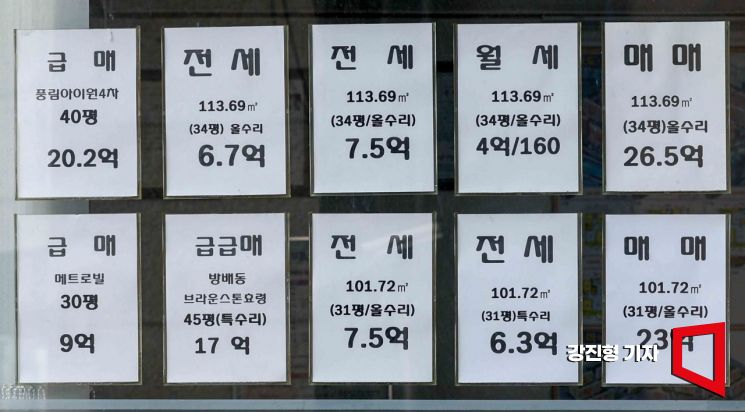 More than half of the jeonse prices for the 'standard apartment size' in Seoul this year have exceeded 600 million won. On the 5th, a jeonse and sale price list was posted at a real estate office in Seoul. Photo by Kang Jin-hyung aymsdream@
In the Seoul metropolitan area, including Seoul, Gyeonggi, and Incheon, sales prices have risen for three consecutive weeks, indicating that the upward trend is spreading to the outskirts. This is the first time in about two years and five months since January 2022 that the entire metropolitan area’s sales prices have risen together for three consecutive weeks.
According to the 'June Fourth Week Metropolitan Area Sales Price Change Rate' released by Real Estate R114 on the 29th, major areas have seen not only an increase in transaction volume but also a partial recovery to previous peak levels, gradually improving buyers' sentiment. The Housing Price Outlook Consumer Sentiment Index (CSI) announced by the Bank of Korea rose by 7 points from the previous month to around 108. This is the highest figure in eight months since October last year. An index above 100 indicates that more people expect housing prices to rise in the next year.
Seoul apartment sales prices have increased for three consecutive weeks recently (0.01% → 0.02% → 0.01%). While redevelopment projects remained flat (0.00%), general apartments rose by 0.01%. New towns also increased by 0.01%, and Gyeonggi and Incheon showed no change (0.00%).
Among the 25 districts in Seoul, only one area (Gangseo -0.01%) experienced a decline, while six areas saw increases. The number of declining areas has significantly decreased in May and June, suggesting that the upward trend starting in central areas is now affecting the outskirts of Seoul. Areas such as Mapo (0.04%), Songpa (0.03%), Gangdong (0.03%), Seongbuk (0.01%), Dongjak (0.01%), and Gangnam (0.01%) recorded increases.
The upward trend was also clear in individual new town areas. Although Sanbon fell by 0.03%, Pyeongchon (0.02%), Bundang (0.02%), and Paju Unjeong (0.01%) rose. In Gyeonggi and Incheon, Osan (0.04%), Uijeongbu (0.02%), and Incheon (0.01%) increased, while Icheon (-0.07%) and Guri (-0.01%) declined.
The jeonse (long-term lease) market has been rising for nearly a year, making declines in individual areas very rare. Seoul rose by 0.02%, maintaining a similar upward trend, new towns increased by 0.01%, and Gyeonggi and Incheon showed a pause with no change (0.00%).
In Seoul, areas such as Mapo (0.12%), Gwangjin (0.12%), Nowon (0.07%), Gangbuk (0.07%), Yangcheon (0.04%), and Dongjak (0.03%) saw increases, with larger gains in popular residential areas among demand groups. New towns like Bundang (0.04%) and Sanbon (0.02%) rose, but Dongtan fell by 0.01%. In Gyeonggi and Incheon, Icheon (0.07%), Suwon (0.04%), Hwaseong (0.02%), and Ansan (0.02%) increased, while Incheon experienced a slight adjustment (-0.01%).
A Real Estate R114 official said, "As concerns in the jeonse rental market persist, buyers' sentiment indicators are gradually improving," adding, "generally, since future price trends vary greatly depending on the influx of demand relative to supply, it is necessary to carefully monitor sentiment indicators and respond with appropriate policies."
He continued, "Among major demand indicators, not only the aforementioned Housing Price Outlook Consumer Sentiment Index (CSI) but also supply-demand trends surveyed by the Korea Real Estate Board, forecast indices from Kookmin Bank, price outlook surveys by Real Estate R114, and consumer sentiment indices from the Korea Research Institute for Human Settlements all show that buyer sentiment is reaching or surpassing the critical threshold (100). From the government's perspective, it is essential to improve market conditions and systems to ensure steady supply of both mid-to-long-term new constructions and existing properties," he concluded.
© The Asia Business Daily(www.asiae.co.kr). All rights reserved.
![Clutching a Stolen Dior Bag, Saying "I Hate Being Poor but Real"... The Grotesque Con of a "Human Knockoff" [Slate]](https://cwcontent.asiae.co.kr/asiaresize/183/2026021902243444107_1771435474.jpg)
















