Bank of Korea's 'May Weighted Average Interest Rate of Financial Institutions'
Savings Deposit Interest Rate at 3.55% per annum... Rising After 6 Months
Mortgage Loan Interest Rate at 3.91%, Declining for 7 Consecutive Months
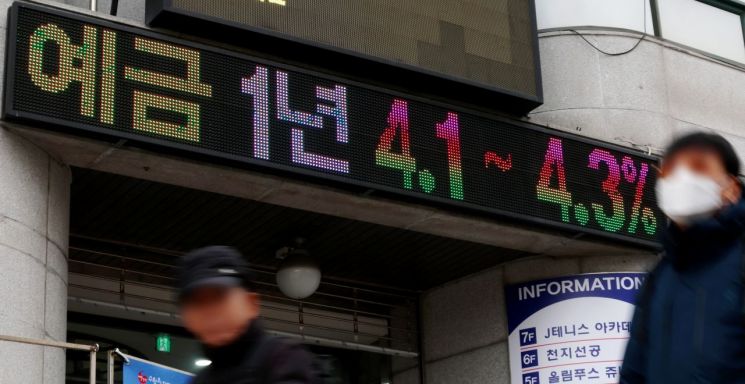
Due to the rise in market interest rates, bank deposit interest rates have turned upward for the first time in six months. Mortgage loan interest rates have declined for seven consecutive months.
According to the "Weighted Average Interest Rates of Financial Institutions for May 2024" released by the Bank of Korea on the 28th, the interest rate on new savings deposits at deposit banks last month was 3.55% per annum, up 0.02 percentage points from the previous month. This marks an upward reversal after six months since recording 3.85% in December last year. Pure savings deposits rose 0.03 percentage points to 3.53%, and market-type financial products increased 0.02 percentage points to 3.64% compared to the previous month.
Seo Jeong-seok, head of the Financial Statistics Team at the Bank of Korea’s Economic Statistics Bureau, explained, "Savings deposit interest rates rose due to the increase in market interest rates," adding, "Pure savings deposits increased mainly in time deposits, while market-type financial products rose centered on financial bonds and negotiable certificates of deposit (CDs)."
The loan interest rate in May was 4.78% per annum, rising 0.01 percentage points from the previous month as both corporate and household loans increased. The corporate loan interest rate rose 0.02 percentage points to 4.9%, marking an upward reversal after six months since December last year (5.29%). Both large enterprises (+0.02 percentage points) and small and medium enterprises (+0.04 percentage points) saw increases. This was influenced by the rise in key benchmark interest rates.
For household loans, mortgage loan rates declined while general credit loan rates increased. The mortgage loan rate was 3.91%, continuing a downward trend for seven consecutive months since November last year (4.48%). General credit loan rates rose 0.09 percentage points to 6.11% compared to the previous month. The proportion of fixed-rate loans among household loans fell 3.9 percentage points to 58.6% from the previous month. This is because fixed-rate mortgage loans remained high at 93.4%, while the share of general credit loans, mostly variable-rate, expanded.
Seo said, "Mortgage loan rates fell as the 5-year bank bond, a key benchmark rate, declined," and added, "General credit loan rates rose due to increases in short-term benchmark rates and the growing share of low- to mid-credit borrowers."
The interest rate spread between deposits and loans narrowed slightly from 1.24 percentage points to 1.23 percentage points as deposit rates rose more than loan rates.
For non-bank financial institutions, both deposit rates (based on 1-year fixed-term deposits) and loan rates (based on general loans) fell except for savings banks and Saemaeul Geumgo. Deposit rates declined by 0.03 percentage points at savings banks, 0.08 percentage points at credit unions, 0.07 percentage points at mutual finance, and 0.07 percentage points at Saemaeul Geumgo. Loan rates rose by 0.02 percentage points at savings banks and 0.26 percentage points at Saemaeul Geumgo, while falling 0.14 percentage points at credit unions and 0.06 percentage points at mutual finance.
Meanwhile, starting this month, the Bank of Korea has restructured the proportions of fixed and variable rate loans for household loans and mortgage loans, as well as the fixed and variable rates for mortgage loans. Loans with interest rate adjustment cycles of five years or more among periodic loans are now classified as fixed-rate loans rather than variable-rate loans. This change was made as the supervisory authorities reclassified periodic loans as fixed-rate loans due to an increase in periodic mortgage loan issuance this year.
© The Asia Business Daily(www.asiae.co.kr). All rights reserved.

















