Jeon Jun-wi Decides Party Leader Election Method on This Day
Reduced Convention Effect for 2nd Term Leadership if Endorsed
One-Shot Primary and Regional Tour Burden in Approval Voting
The Democratic Party of Korea will decide on the new leadership election method to be applied at the August 18 party convention on the 28th. With the possibility of former leader Lee Jae-myung running unopposed becoming more certain, it is expected that the party will decide whether to endorse him or hold a yes-or-no vote.
The Democratic Party Convention Preparation Committee (Jeonjunwi) will hold a closed meeting at the National Assembly in the morning to determine the election rules when there is only one candidate for party leader. The party's constitution and regulations do not clearly specify the election method if there is only one candidate. If former leader Lee runs unopposed, it has the advantage of solidly uniting nationwide support. However, there is a concern that the expansion of opposition due to the consolidation of a 'single-pole system' could become an obstacle to expanding the centrist base.
In the case of a yes-or-no vote, a one-shot primary is highly likely. A one-shot primary refers to a method where the party tours regions but does not conduct separate voting and counting by region, instead holding it all at once.
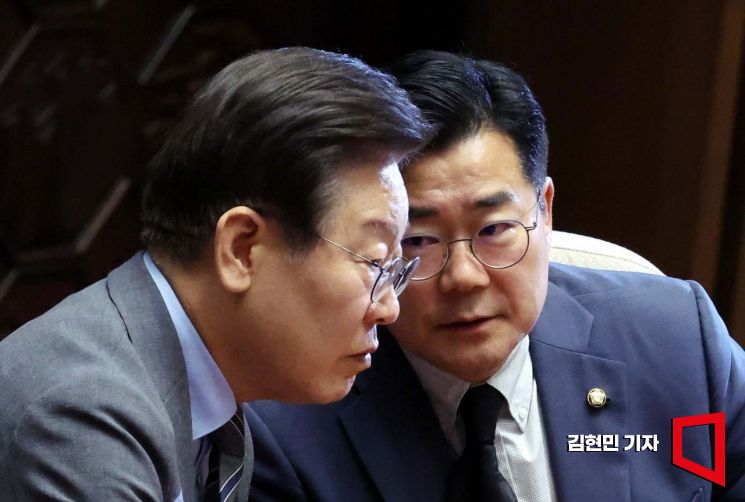 Former Democratic Party leader Lee Jae-myung and floor leader and acting party leader Park Chan-dae are talking at the plenary session held at the National Assembly on the 27th. Photo by Hyunmin Kim kimhyun81@
In the case of endorsement, the party can skip regional tours and directly appoint the party leader. This minimizes the burden of factionalization due to frequent exposure. However, the stronger the 'Eodaemyeong (Anyway, the leader is Lee Jae-myung)' trend becomes, the more the party convention may fail to attract interest. Unlike the People Power Party, where four candidates compete for party leadership, if the convention ends as a 'Lee Jae-myung coronation,' it may be difficult to enjoy the convention effect.
Jeonjunwi also feels a greater burden regarding endorsement. Lee Chun-seok, chairman of Jeonjunwi, said on the radio that day, "It is desirable to secure procedural legitimacy even through a yes-or-no vote when electing the party leader, and there will be controversy over whether it is appropriate to just applaud and end with an endorsement."
Meanwhile, Jeonjunwi plans to finalize the ratio of votes reflected from delegates and party members with voting rights at the meeting. The current party constitution and regulations stipulate that the ratio of votes reflected from delegates to party members with voting rights in the election of the leader and supreme council members should be 'less than 20 to 1.' The Democratic Party previously amended party regulations to adjust the ratio of votes reflected from delegates and party members with voting rights in the election of provincial party chairpersons. Until now, the party has used a combined primary system with 50% from party members with voting rights and 50% from nationwide delegates, but it has revised this to increase the weight of party members' votes.
© The Asia Business Daily(www.asiae.co.kr). All rights reserved.

















