The Constitutional Court has ruled that the provision in the Criminal Act exempting punishment unconditionally, regardless of the victim's will, when a close relative such as a direct lineal descendant or spouse commits a property crime, excessively infringes on the criminal victim's right to testify in court and is therefore unconstitutional.
On the 27th, the Constitutional Court unanimously decided constitutional incompatibility in a constitutional complaint case concerning Article 328, Paragraph 1 of the Criminal Act. The Court pointed out the unconstitutionality of the provision and ordered that it not be applied until the legislature amends the law.
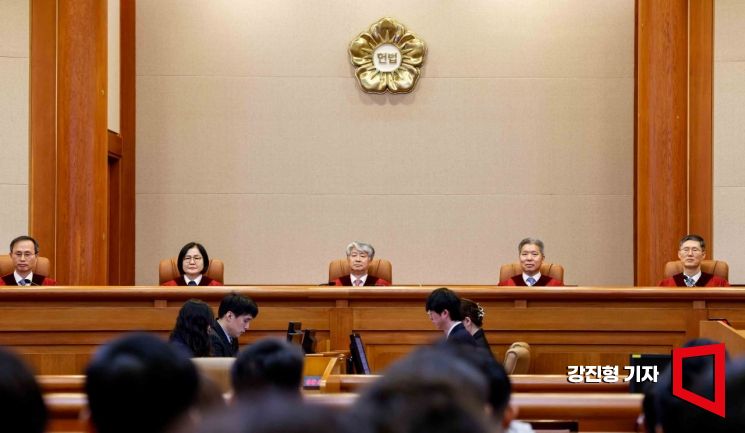
Through its ruling, the Court stated, "Article 328, Paragraph 1 of the Criminal Act is not in conformity with the Constitution," and "courts, other state agencies, and local governments must suspend the application of this legal provision until the legislature amends it by December 31, 2025."
The Court explained, "The provision under review prevents criminal victims from requesting judges to exercise appropriate penal authority," and "it clearly exceeds legislative discretion, is markedly unreasonable or unfair, and infringes on the criminal victim's right to testify during judicial proceedings."
The Court consolidated several constitutional complaints filed by complainants who had accused relatives of embezzlement or fraud but were met with non-prosecution decisions by prosecutors or non-referral by police due to the exemption clause in the Criminal Act’s kinship exemption provision. Among the complainants was a person with a level 3 intellectual disability who had accused his uncle of embezzlement and quasi-fraud but was subject to non-prosecution because the accused was a cohabiting relative.
Article 328 (Crimes and Complaints Among Relatives) Paragraph 1 of the Criminal Act states, "Crimes under Article 323 (Obstruction of Exercise of Rights) committed between direct lineal relatives, spouses, cohabiting relatives, cohabiting family members, or their spouses shall be exempt from punishment." Paragraph 2 of the same article provides, "When crimes under Article 323 are committed between relatives other than those specified in Paragraph 1, prosecution can only be initiated upon complaint."
This provision, which exempts punishment for property crimes committed between close relatives and requires a complaint for prosecution in other kinship cases, is called 'Chinsok Sangdorye' (kinship exemption). It is a special rule concerning the punishment and prosecution conditions of property crimes among relatives.
The Criminal Act stipulates this kinship exemption provision in the chapter on obstruction of exercise of rights and applies it mutatis mutandis to other property crimes such as theft, fraud, and extortion. However, it does not apply to robbery and property damage crimes, as there are no mutatis mutandis provisions for these.
Considering that Article 328 of the Criminal Act, although regulating obstruction of exercise of rights, is applied to other property crimes through mutatis mutandis provisions, the Court took Article 328 itself as the subject of review rather than separately judging each mutatis mutandis provision.
The Court first acknowledged, "The necessity of special rules regarding criminal prosecution or punishment for property crimes at a tolerable level occurring among family members who share economic interests or have emotional closeness is understandable."
However, the Court found problematic that the current kinship exemption provision unconditionally exempts punishment simply based on kinship relations such as direct lineal relatives or spouses.
The Court pointed out, "Since the characteristics of kinship relations over a broad range are difficult to generalize, unconditionally exempting punishment may, in some cases, unilaterally sacrifice the rights of family members who are criminal victims, resulting in outcomes contrary to the original intent of the system."
It further stated that it is difficult to consider recovery of damages and forgiveness within the family through kinship exemption for crimes such as embezzlement under the Specific Economic Crimes Act involving amounts exceeding 5 billion KRW, extortion accompanied by assault or threats, or special theft crimes involving weapons.
The Court also noted concerns that applying this provision unconditionally to vulnerable members within the family or kinship society, such as persons with disabilities or minors, may result in economic exploitation being tolerated.
The Court stated, "The provision under review mandates judges to uniformly issue exemption rulings without considering these circumstances, resulting in most cases not being prosecuted," and "criminal victims lose the opportunity to participate in judicial proceedings."
However, the Court emphasized that how to amend the kinship exemption provision requires the legislature to "thoroughly seek social consensus and devise measures," ordering the suspension of its application and urging the National Assembly to amend the law as soon as possible.
The kinship exemption provision in the Criminal Act was introduced in 1953 alongside the enactment of the Criminal Act, with the intent to minimize state intervention by respecting family-internal decisions regarding property crimes among close relatives who often manage and use property jointly.
However, with social changes, evolving perceptions of kinship, and increasing property crimes among relatives, criticism has been raised that the provision should be revised or abolished to reflect reality. Recently, it was brought into the spotlight due to the embezzlement case involving broadcaster Park Suhong’s older brother.
Meanwhile, the Court upheld the constitutionality of Article 328, Paragraph 2 of the Criminal Act, which requires a complaint to initiate prosecution for property crimes committed by relatives other than direct lineal descendants, spouses, cohabiting relatives, or cohabiting family members.
The Court judged that since this provision allows the exercise of state penal authority according to the victim's will, the victim's right to testify in judicial proceedings is not problematic, nor does it violate the principle of equality.
© The Asia Business Daily(www.asiae.co.kr). All rights reserved.
![Clutching a Stolen Dior Bag, Saying "I Hate Being Poor but Real"... The Grotesque Con of a "Human Knockoff" [Slate]](https://cwcontent.asiae.co.kr/asiaresize/183/2026021902243444107_1771435474.jpg)
















