NH Nonghyup and Hana Bank System Construction Service Underway
KDB and IBK Also Selecting Vendors
Government and Ruling Party Raise Calls for Abolition
Ruling Democratic Party Maintains Support
Following the policy banks, commercial banks have begun building systems related to the financial investment income tax. While the government and the ruling party advocate for the abolition of the financial investment income tax, the Democratic Party of Korea, which holds the majority in the National Assembly, maintains its stance to implement the tax as planned, hastening the introduction of the system.
According to the financial sector on the 28th, NH Nonghyup Bank and Hana Bank are selecting consulting and development firms for the withholding tax system related to the financial investment income tax. The financial investment income tax is a comprehensive tax levied on income generated from stocks, bonds, funds, derivatives, and other financial products. If an investor earns more than 50 million KRW from domestic listed stocks or 2.5 million KRW from overseas stocks, unlisted stocks, bonds, or derivatives, 22% of the income is taxed. If the income exceeds 300 million KRW, 27.5% of the income is taxed.
The financial investment income tax is designed so that financial institutions paying out income or profits withhold part of the tax. The withheld tax amounts are aggregated by investor and paid to the National Tax Service, allowing investors to receive refunds later. Since banks also handle financial investment products such as funds, they need to develop related systems to comply with the financial investment income tax regulations.
Policy banks are also busy developing systems. KDB Industrial Bank is recruiting system development consulting firms. IBK Industrial Bank is selecting consulting agencies to respond to the introduction of the financial investment income tax. They are looking for firms to comprehensively manage not only the withholding tax system but also regulatory amendments. As a result of the bidding, KDB Industrial Bank’s bid was canceled due to a single bid, while Samjong Accounting Corporation and Bohyun Accounting Corporation participated in the IBK Industrial Bank consulting bid.
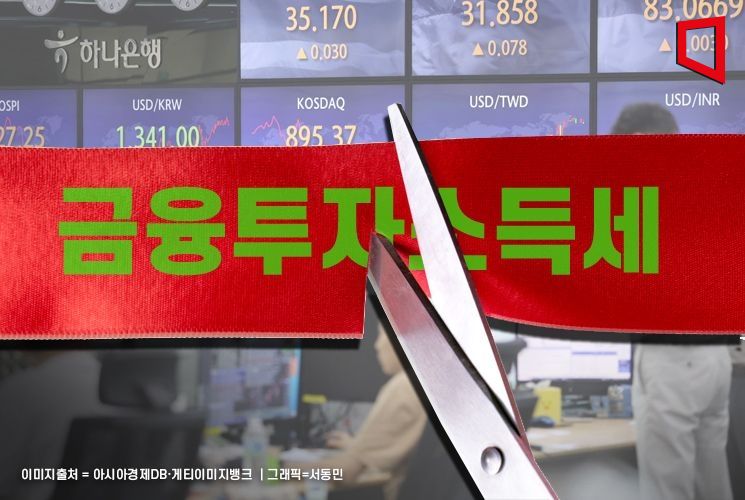
This movement is because the implementation of the financial investment income tax is imminent. The tax, announced as part of the financial tax reform plan during the Moon Jae-in administration in 2020, was set to be implemented following the passage of the amended Income Tax Act last year. However, the Yoon Suk-yeol administration announced a two-year postponement of the tax’s introduction in 2022, delaying implementation until 2025 through the passage of the Income Tax Act. Banks had been preparing related systems ahead of the planned 2023 introduction.
KDB Industrial Bank and IBK Industrial Bank halted system development in 2022 due to the postponement of the tax implementation. Meanwhile, Kookmin Bank and Shinhan Bank selected minimum development contractors or began developing withholding tax systems in August of the same year. However, in January this year, President Yoon Suk-yeol’s declaration to abolish the financial investment income tax reignited the debate over its introduction.
There is a clear difference in stance between the government and ruling party and the opposition regarding the financial investment income tax. The People Power Party officially proposed a package bill on the 12th that includes the abolition of the tax. The government is also responding positively. On the 26th, Prime Minister Han Duck-soo stated, “If the stock market and equity market enter a panic due to the financial investment income tax, all 14 million investors will suffer. I believe abolishing it is the right thing to do.”
The Democratic Party of Korea, which holds the majority in the National Assembly, is close to the position that the financial investment income tax should be implemented as originally planned. In April, Jin Seong-jun, the Democratic Party’s Policy Committee Chair, said, “Whether the financial investment income tax is postponed or abolished, it means not collecting taxes from the wealthy,” adding, “We will never tolerate tax policies that worsen fiscal soundness through tax cuts for the rich and only increase income inequality.”
© The Asia Business Daily(www.asiae.co.kr). All rights reserved.
![Clutching a Stolen Dior Bag, Saying "I Hate Being Poor but Real"... The Grotesque Con of a "Human Knockoff" [Slate]](https://cwcontent.asiae.co.kr/asiaresize/183/2026021902243444107_1771435474.jpg)
















