KCCI and Geographical Society 'Era of 1000 Special Zones' Session
Urging Passage of Land Use Act... Improving Living Conditions to Secure Workforce
There have been calls to increase inheritance tax and capital gains tax benefits to preserve the purpose of the Opportunity Development Zone system introduced by the Yoon Suk-yeol administration, which aims for regional balanced development.
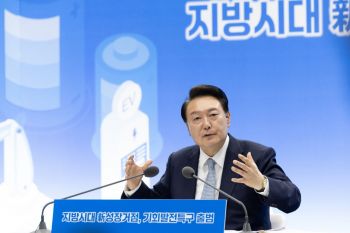 President Yoon Suk-yeol is speaking at the 9th Local Era Committee meeting and Opportunity Development Zone investment agreement ceremony held on the 20th at the Secondary Battery Integrated Management Center in Blue Valley Industrial Complex, Pohang-si, Gyeongbuk.
 [Photo by Yonhap News]
On the 27th, Lee Seo-hee, head of the Regional Economic Analysis Center at the Korea Institute of Local Administration, made this claim during a special session titled "The Era of 1,000 Special Zones in Korea," jointly hosted by the Korea Chamber of Commerce and Industry and the Korean Geographical Society at Seoul National University. According to the Korea Institute of Local Administration, as of August 2022, there were 909 special zones in Korea. Including about 20 additional designated zones, 31 education development special zones piloted last February, and the Opportunity Development Zones currently under review, the total number of special zones in Korea is expected to approach 1,000 by the end of the year.
Earlier, on the 20th, the Presidential Commission on the Local Era announced that it had approved the designation of eight areas?Gyeongbuk, Jeonnam, Jeonbuk, Daegu, Daejeon, Gyeongnam, Busan, and Jeju?as the first Opportunity Development Zones. The Opportunity Development Zone system allows local governments to autonomously design and operate large-scale investment attraction projects in their regions, while the central government supports them with tax and regulatory exemptions.
Lee Seo-hee stated, "The basic concept of the Opportunity Development Zones included bold and innovative tax, regulatory, and other support measures such as local-led bottom-up initiatives and reductions in capital gains tax, corporate tax, income tax, and inheritance tax. However, the current plan excludes inheritance and capital gains tax benefits, which diminishes its distinctiveness. We need to increase linked support with regional revitalization investment funds and further expand special exemptions in regulations, taxes, and subsidies to foster businesses."
There were also opinions urging the National Assembly to expedite the passage of the Regional Balanced Investment Promotion Special Act. Once enacted, the law is expected to activate financial and tax support for local investments, local businesses, and Opportunity Development Zones, as well as regulatory exemptions within special zones, thereby enhancing the trickle-down effects in underdeveloped regional zones. Cho Sung-hwan, head of the Regional Economy Team at the Korea Chamber of Commerce and Industry, argued, "The 22nd National Assembly must hasten the passage of the Local Investment Promotion Special Act."
Regarding Economic Free Zones (Gyeongja-guyeok), there were suggestions to increase foreign investment performance. Hong Jin-gi, director of the Regional Industry Location Research Institute, said, "Economic Free Zones, which have a high proportion of industrial complexes, show lower foreign investment performance compared to domestic investment, creating a gap with the law’s original purpose. When newly designating Economic Free Zones, requirements should be strengthened to include complex developments that accommodate various functions such as shopping and culture, and procedures for expanding or changing existing zones should be shortened."
Advice was also given to enhance the effectiveness of Regional Specialized Development Zones and Regulatory Free Zones. Kim Sang-shin, a research fellow at the Korea Institute of Small and Medium Enterprises and Startups, said, "Currently, 181 Regional Specialized Development Zones are designated nationwide. The purpose of these zones should be classified by company and industry, and the 'menu-style regulatory exemptions' should be reorganized to improve effectiveness. For Regulatory Free Zones, regulations that lead to new technologies and corporate achievements should be identified."
Kang Seok-gu, head of the Research Headquarters at the Korea Chamber of Commerce and Industry, emphasized, "With nearly 1,000 special zones existing, future operation of the special zone system should shift focus from a government-centered approach to one centered on the actual demand of companies, the real users."
© The Asia Business Daily(www.asiae.co.kr). All rights reserved.
![Clutching a Stolen Dior Bag, Saying "I Hate Being Poor but Real"... The Grotesque Con of a "Human Knockoff" [Slate]](https://cwcontent.asiae.co.kr/asiaresize/183/2026021902243444107_1771435474.jpg)
















