Ministry of Education Announces 'Yubo Integration Implementation Plan'
Integration of Kindergartens and Daycare Centers, Unified 'Application Site'
Guarantee of 12-Hour Care for Infants and Toddlers, Improvement of Teacher-to-Child Ratio
Plans to Address Teacher Treatment Disparities
The Ministry of Education, the department responsible for early childhood education and care, announced detailed implementation plans ahead of the launch of the Yubo Integration, a key policy of the Yoon Seok-yeol administration, scheduled for next year. Starting from the end of this year, pilot schools will be operated in about 100 institutions through the integration of kindergartens and daycare centers, with plans to realize free childcare for children aged 3 to 5 from next year. However, the ministry did not provide specific answers regarding detailed plans such as budget utilization, teacher recruitment, and designation of pilot institutions, stating that these will be finalized by the end of this year.
 Lee Ju-ho, Deputy Prime Minister for Social Affairs and Minister of Education, is announcing measures to normalize medical school education on the 14th at the Government Seoul Office in Jongno, Seoul. Photo by Jo Yong-jun jun21@
On the 27th, Lee Ju-ho, Deputy Prime Minister for Social Affairs and Minister of Education, held a briefing at the Government Complex Seoul and announced the 'Yubo Integration Implementation Plan.' Deputy Prime Minister Lee stated, "A foundation has been established to provide high-quality early childhood education and care services from the early stages of life under one umbrella, the Ministry of Education," and added, "The government will actively support the co-growth of daycare centers and kindergartens."
The Yoon administration set the promotion of Yubo Integration as a national agenda when it took office in 2022. Since then, the Ministry of Education announced the promotion plan in January last year and launched the Yubo Integration Promotion Team to prepare for the process. In December last year, the Government Organization Act was amended to sequentially transfer early childhood care duties from the Ministry of Health and Welfare and local governments to the Ministry of Education and metropolitan and provincial offices of education.
Kindergartens and Daycare Centers to Become 'Integrated Early Childhood Institutions'
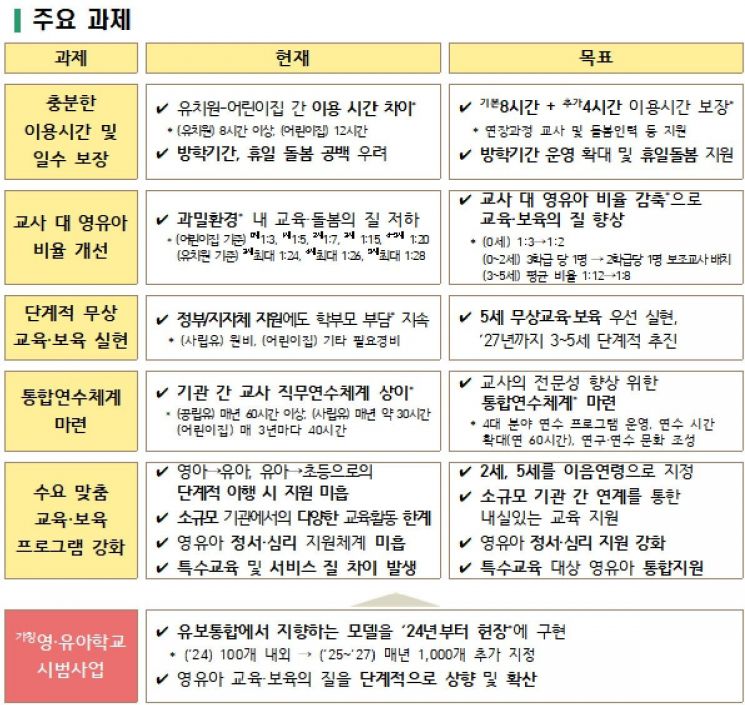
According to the revised law, the integration of kindergartens and daycare centers into unified institutions will be promoted. Once integrated, the admission methods and teacher recruitment processes of the two institutions will be unified. The Ministry of Education plans to establish a new admission method through a public discussion process. The admission application window will be unified as the 'Yubo Integration Application Site (tentative name).'
The currently separate '0-2 years childcare curriculum' and '3-5 years education curriculum' will be integrated into a '0-5 years early childhood education curriculum.' The Ministry of Education and the National Education Commission will prepare this plan by 2027.
The teacher qualifications for integrated institutions are being considered in two ways: a single qualification of 'Early Childhood Teacher (0-5 years)' or two separate qualifications of 'Infant Teacher (0-2 years)' and 'Preschool Teacher (3-5 years).' Additionally, the training system will be reorganized to ensure teachers have professional expertise as early childhood educators. New teachers will be trained through a bachelor's degree program, and current teachers will be able to obtain integrated teacher qualifications through special teacher training courses or new admissions to universities (graduate schools). Existing childcare and kindergarten teacher qualifications will still be recognized after the reorganization.
The treatment of private kindergarten teachers will continue to improve. Concerns have been raised about potential disparities in treatment between childcare teachers and private kindergarten teachers during the Yubo Integration process. The Ministry of Education plans to devise measures to narrow the gap in salary and working conditions. Support for substitute teachers will also be expanded to reduce workload burdens.
Realizing Free Early Childhood Care by 2027

The Ministry of Education will designate about 100 institutions from the second half of this year to operate pilot early childhood schools. The number of pilot institutions is planned to expand to 3,100 by 2027.
In particular, starting with 5-year-olds next year, free education and care for children aged 3 to 5 will be gradually realized by 2027. Currently, free childcare is only provided for children aged 0 to 2.
Additionally, all children who wish to use the service will be guaranteed 12 hours of daily care. To this end, 8 hours of basic operating time and 4 hours of morning and evening care will be provided. To meet the diverse care needs of dual-income parents and self-employed individuals, the operation of public kindergartens during vacations will be expanded, and hub institutions providing care on Saturdays and holidays will be piloted from next year.
The teacher-to-child ratio will be improved to enhance the quality of care and education. For 0-year-old classes, the goal is to improve from 1:3 to 1:2, and for 3-5-year-old classes, from 1:12 to 1:8. Teacher training hours will be gradually increased from 13 hours per year to 60 hours per year, and customized training will be provided to enhance professional competencies.
To ensure children receive educational support tailored to their age characteristics, ages 2 and 5 will be designated as transitional ages. Age 2 will focus on play-centered education and experiences, strengthening connections with the 3-5-year-old Nuri Curriculum. Age 5 will receive focused support to improve early literacy and basic competencies through strengthened links between preschool and elementary education curricula.
Emotional and psychological support for young children will also be strengthened. Children with disabilities in daycare centers will be designated as special education recipients, and itinerant education and special education services will be gradually expanded. The plan includes establishing 80 special classes in kindergartens and 80 specialized or integrated daycare centers for children with disabilities annually.
'Will Yubo Integration Start This Year?'

However, the Ministry of Education could not provide answers regarding the financial scale or timeline for promoting Yubo Integration or detailed plans for implementation by the end of this year.
In particular, no concrete financial plans have been established. In response to related questions, Deputy Prime Minister Lee said, "The budget has not yet been concretized because the budget negotiation process is still ongoing," and added, "We will do our best to realize what we have announced today through future budget negotiations and finalization processes."
Regarding the scale and plans for teacher recruitment, the Ministry of Education stated, "We have only presented target figures for now," and "We are continuing to consult with related agencies about specific numbers and the budget involved."
When asked about when the integrated teacher qualification plan would be finalized, the ministry replied, "We plan to finalize it by the end of the year after gathering opinions."
Regarding the timing for full application of integrated institutions, the ministry explained, "It will take time to establish the teacher training system, for students to enroll, obtain qualifications as teachers, and enter the field. Assuming the integrated law is enacted in 2025, the integrated name can be used as early as 2026, and most standards will likely be applied then."
© The Asia Business Daily(www.asiae.co.kr). All rights reserved.
![Clutching a Stolen Dior Bag, Saying "I Hate Being Poor but Real"... The Grotesque Con of a "Human Knockoff" [Slate]](https://cwcontent.asiae.co.kr/asiaresize/183/2026021902243444107_1771435474.jpg)













