Four Policy Proposals Including 'Coverage Expansion for Diagnostic Device Use' and 'Authorization for Vaccination Procedures'
The Association of Korean Medicine Doctors (AKMD) proposes a policy to the government allowing Korean medicine doctors to fill the primary healthcare gap during doctors' strikes.
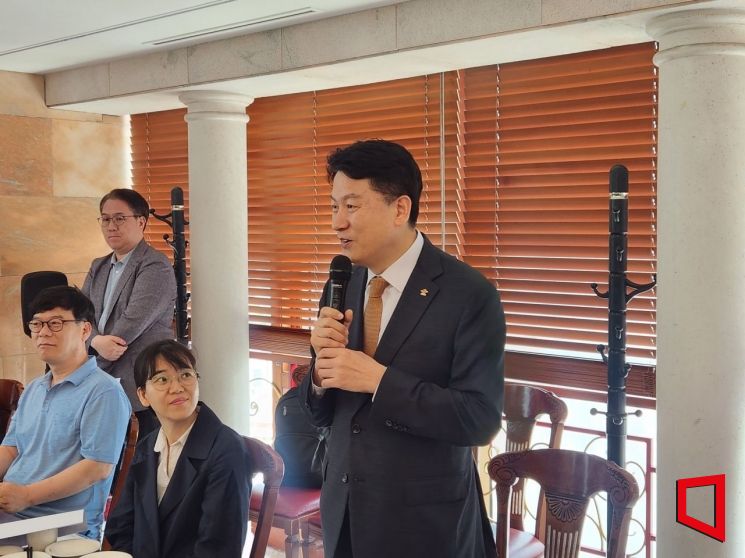 Yoon Seong-chan, President of the Korean Medicine Association, is speaking at a press conference held at a Chinese restaurant in Yeongdeungpo-gu, Seoul, at 12 PM on the 27th. Photo by Choi Tae-won peaceful1@
On the 27th at 12:10 PM, the AKMD held a press conference at a Chinese restaurant in Yeongdeungpo-gu, Seoul, announcing this proposal. Yoon Seong-chan, president of the AKMD, stated, "During the collective suspension of work by the Korean Medical Association on the 18th, over 50% of clinics in some regions closed," adding, "There is a need to prepare for potential primary healthcare gaps that can occur at any time," explaining the purpose of the policy proposal.
He continued, "Among the frequently occurring medical conditions in Western medicine, such as back pain, vasomotor and allergic rhinitis, gastritis, and duodenitis, these are also common conditions treated in Korean medicine outpatient clinics," and added, "Major diseases expected to cause primary healthcare gaps due to doctors' strikes can be managed through treatment at Korean medicine clinics."
The AKMD proposed a total of four policies. The first is "Expanding the role of Korean medicine public health doctors (gongbo-ui) in medically underserved areas." President Yoon said, "The number of Korean medicine public health doctors has steadily been maintained from 1,026 in 2015 to 1,057 in 2023, but the number of Western medicine public health doctors decreased by 36%, from 2,239 in 2015 to 1,434 in 2023," adding, "The shortage of Western medicine public health doctors is infringing on the health rights of residents in towns and villages and causing inconvenience."
He further argued that Korean medicine public health doctors need the authority to prescribe medications and other clinical rights equivalent to those of health care public officials during their service period. Health care public officials are government employees, typically nurses or midwives, who after completing 1,008 hours of training, can prescribe 90 types of medications for conditions such as colds, digestive disorders, dementia, and headaches. Especially in medically underserved areas, during severe medical crises like collective work stoppages, it is proposed that Korean medicine public health doctors receive four weeks of job training before deployment, and if not in a severe stage, receive job training equivalent to that of health care public officials before deployment.
They also advocated for the inclusion of Korean medicine doctors' use of diagnostic devices in health insurance coverage. President Yoon said, "Korean medicine doctors can use blood and urine analyzers, ultrasound diagnostic devices, and in vitro diagnostic kits, but these are not covered by health insurance," adding, "It is inconsistent that the same medical procedures are reimbursed in some places but not in others."
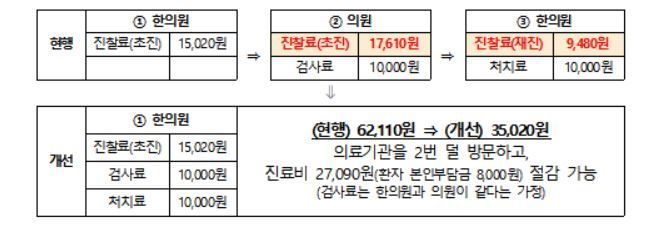 Examples of damages caused by restrictions on X-ray use by Korean medicine doctors. [Image source=Korean Medicine Doctors Association]
There was also a proposal to permit the use of diagnostic X-ray devices. Under current law, Korean medicine doctors are not allowed to use X-rays in treatment. President Yoon explained, "The shortcomings of the system shift the burden onto the public," adding, "With the diagnostic scope granted to Korean medicine doctors, it is difficult to accurately diagnose whether an injury is a sprain or a fracture, forcing patients who visit Korean medicine clinics to go to Western clinics for diagnosis and then return to the Korean medicine clinic." He further explained, "Patients suffer physical inconvenience from double visits and economic burdens from duplicate medical expenses."
Finally, they argued that the professions authorized to perform vaccinations should be expanded to include Korean medicine doctors, nurses, and pharmacists. President Yoon said, "Currently, vaccinations are monopolized by doctors, and social confusion has been caused by actions of certain groups, such as the Korean Medical Association's refusal to participate in the elderly influenza vaccination program in 2015 and refusal to administer COVID-19 vaccinations in 2021," adding, "In most countries like the United States and Europe, vaccinations are administered not only by doctors but also by various professionals such as nurses."
He added, "In the United States, pharmacists began administering vaccines following doctors' requests, and in China, traditional Chinese medicine doctors, who are similar to Korean medicine doctors, are authorized to perform vaccinations."
© The Asia Business Daily(www.asiae.co.kr). All rights reserved.


















