Prolonged Concurrent Weakness of Won and Yen
Interest in Whether Korean and Japanese Forex Authorities Will Maintain Won at 1400 and Yen at 160
Market Intervention Expected if Won-Dollar Exchange Rate Approaches 1400 Won
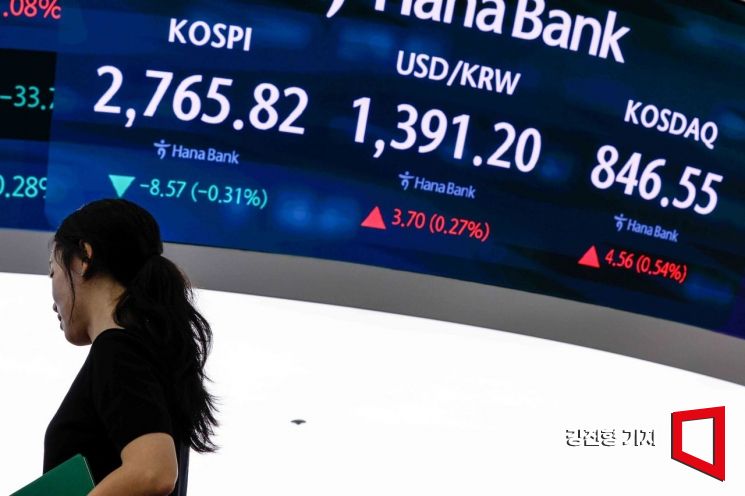 On the 26th, dealers are working in the dealing room of Hana Bank in Jung-gu, Seoul. Photo by Jinhyung Kang aymsdream@
The simultaneous weakening of the Korean won and Japanese yen has been prolonged. Although the governments of South Korea and Japan have once again engaged in verbal interventions to prevent the depreciation of their currencies, the prolonged high interest rate policy in the United States and political uncertainties in Europe have combined to create expectations that the simultaneous weakening of the won and yen will continue for the time being.
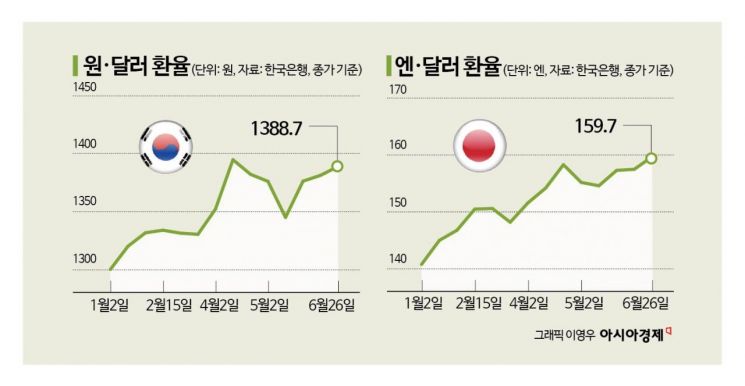
On the 27th, the won-dollar exchange rate opened at 1,394.4 won, up 5.7 won from the previous trading day in the Seoul foreign exchange market. This is the highest level in about 1 year and 8 months since November 7, 2022, based on the opening price.
The won-dollar exchange rate has exceeded the 1,300 won level on a monthly average basis for 11 consecutive months from August last year to this month. This is the first time that the exchange rate has remained above the 1,300 won level for such a long period. In April, the rate even surpassed 1,400 won during the day. At that time, the rapid rise in the exchange rate prompted intervention by the foreign exchange authorities, and the rate subsequently fell to the mid-1,300 won range but has recently resumed an upward trend.
Prolonged U.S. High Interest Rate Policy and European Political Instability... Exchange Rates Soar
The reason the won-dollar exchange rate is soaring is due to the strength of the dollar. The expected timing for the U.S. Federal Reserve to cut interest rates has been pushed back, and the prolonged high interest rate policy has sustained the strength of the dollar as a safe-haven currency. The dollar index, which reflects the value of the dollar against six major currencies on the ICE Futures U.S. exchange, was 106.07 the previous day, close to the annual high of 106.26 recorded on April 16.
Recently, the dollar's strength has intensified due to overlapping political uncertainties in Europe. As far-right parties have shown signs of gaining ground in France and the European Parliament, concerns have arisen about the weakening of the European Union's (EU) political and economic solidarity, leading to a weaker euro and a stronger dollar. Central banks of major European countries such as Switzerland and the United Kingdom have also moved to cut benchmark interest rates ahead of the U.S., which has contributed to the dollar's strength.
Oh Hyun-hee, a researcher at Hana Financial Management Research Institute, explained, "Following the June European Parliament elections, the rise of far-right forces and growing concerns over fiscal soundness due to the far-right party's potential governance in France have impacted the foreign exchange market."
As the dollar's strength continues, the value of Japan's yen has also sharply declined. The yen-dollar exchange rate surpassed 160 yen during the day in the Tokyo foreign exchange market. This is the first time in about two months since April 29 that the yen-dollar rate has exceeded 160 yen.
The Nihon Keizai Shimbun analyzed that hawkish remarks from U.S. Federal Reserve officials have spread expectations that the timing of interest rate cuts will be delayed, prompting moves to sell yen and buy dollars. On the 25th, Fed Governor Michelle Bowman said it was not yet time to begin cutting rates and that the possibility of raising rates should remain open if inflation does not ease, fueling the dollar's strength.
Another notable feature in recent years in the global foreign exchange market is the synchronized movement of the won and yen. The Bank of Korea analyzed in its financial stability report released the previous day that the won and yen have shown a high correlation in recent years, highlighted by their export competition relationship with Japan. When the yen weakens first, the won tends to follow suit.
Ryu Jin-yi, an economist at SK Securities, analyzed, "One of the strong factors pushing up the won-dollar exchange rate recently is the weakness of the yen and yuan. In particular, the Bank of Japan's decision to keep its benchmark interest rate unchanged this month and not to specify concrete plans for reducing long-term government bond purchases caused the yen to sharply weaken, which also affected the won."
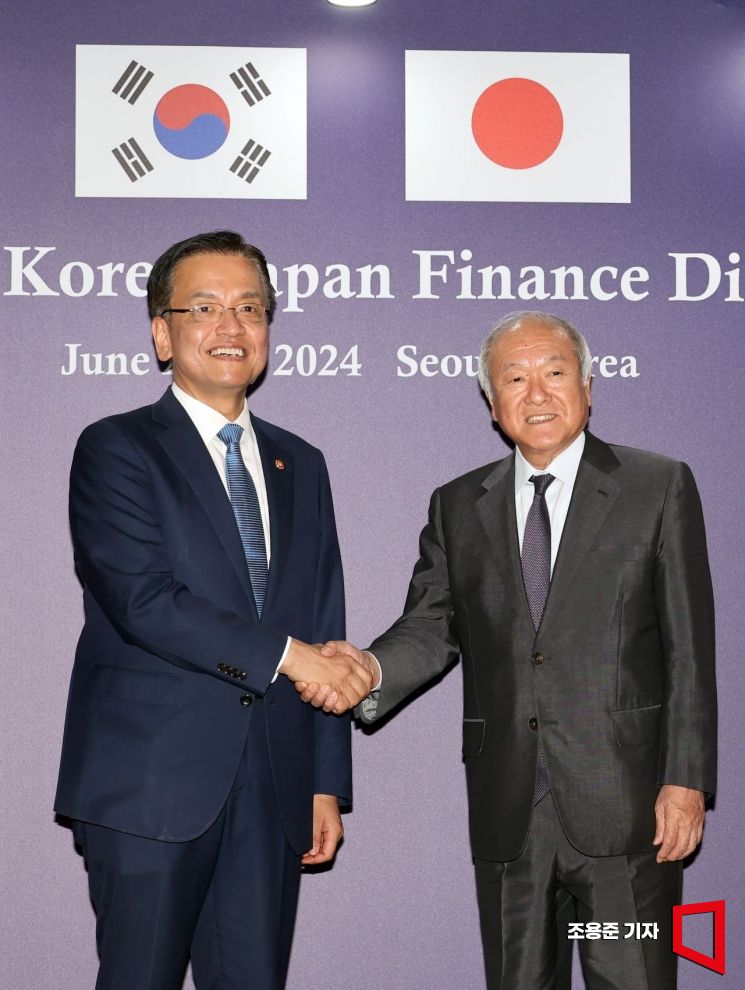 Choi Sang-mok, Deputy Prime Minister and Minister of Economy and Finance, is shaking hands with Suzuki Shunichi, Japanese Minister of Finance, at the 9th Korea-Japan Finance Ministers' Meeting held on the 25th at the Government Seoul Office in Jongno-gu, Seoul. This Korea-Japan Finance Ministers' Meeting was held domestically for the first time in eight years. Photo by Jo Yong-jun jun21@
Foreign Exchange Authorities' Strong Intervention Will Likely Make 1,400 Won the Last Line of Defense
As the simultaneous weakening of the two countries' currencies worsens, the foreign exchange authorities of South Korea and Japan have strengthened their willingness to jointly respond to the depreciation of their currencies. On the afternoon of the 25th, Choi Sang-mok, Deputy Prime Minister and Minister of Economy and Finance of South Korea, and Suzuki Shunichi, Japan's Minister of Finance, held a Korea-Japan finance ministers' meeting at the Seoul Government Complex, sharing concerns about excessive currency depreciation and pledging to take appropriate measures. They had previously expressed a joint stance to respond to currency depreciation in Washington D.C. in April, and within two months, they again showed strong intentions for market intervention through verbal intervention in the foreign exchange market.
As a result, the market is paying attention to whether the foreign exchange authorities of both countries can maintain the first line of defense for exchange rates: the won-dollar rate at 1,400 won and the yen-dollar rate at 160 yen.
Experts expect that the government’s strong intervention will defend the 1,400 won level in the short term. If the won-dollar exchange rate rises again near 1,400 won, the government is highly likely to intervene in the market immediately. The Ministry of Economy and Finance and the Bank of Korea, among other foreign exchange authorities, had already signaled active responses by increasing the foreign exchange swap limit with the National Pension Service from $35 billion to $50 billion on the 21st.
Lee Jung-hoon, an economist at Eugene Investment & Securities, said, "As the won-dollar exchange rate rises again near the record high of 1,400 won, it is difficult to rule out entering the 1,400 won range. However, unlike in the past, considering the steady trade surplus and caution regarding strategic foreign exchange hedging by foreign exchange authorities and the National Pension Service, the 1,400 won level will likely serve as the first line of defense."
However, due to external conditions, there is also a possibility that the won-dollar exchange rate will break through the 1,400 won level again in the mid to long term. Kwon Ah-min, a researcher at NH Investment & Securities, said, "The increase in the foreign exchange swap limit with the National Pension Service by the foreign exchange authorities will likely prevent the immediate entry into the 1,400 won range. However, considering the mid to long-term dollar strength, international oil price trends, and pressure from yuan weakness, the possibility of breaking through 1,400 won within the year remains valid."
Park Sang-hyun, a senior advisor at Hi Investment & Securities, said, "The current dollar strength is due to the weakness of the yen and euro. If the yen and euro weaken further, entering the 1,400 won range for the won-dollar exchange rate cannot be ruled out, and there is a possibility of increased financial market volatility due to temporary exchange rate instability."
Since the Bank of Japan is hesitant to implement additional tightening measures, the yen's weakness is expected to continue for the time being. Park also analyzed, "Despite verbal intervention warnings from the Japanese government, expectations for yen weakness have not diminished. Without direct intervention by the Japanese government in the foreign exchange market, settling the yen-dollar exchange rate in the 160 yen range cannot be ruled out."
© The Asia Business Daily(www.asiae.co.kr). All rights reserved.

![Clutching a Stolen Dior Bag, Saying "I Hate Being Poor but Real"... The Grotesque Con of a "Human Knockoff" [Slate]](https://cwcontent.asiae.co.kr/asiaresize/183/2026021902243444107_1771435474.jpg)
















