Bank of Korea New York Office Major IB Forecast Summary
First Interest Rate Cut Expected by September
Growth Rate 2.4% and Inflation Rate 2.8% Projected for This Year
Six out of ten major Wall Street investment banks (IBs) in the United States expect the Federal Reserve (Fed) to cut interest rates more than twice this year. The most likely timing for the rate cuts was September. Most IBs forecast that the U.S. economy will grow at a low 2% range this year, realizing a no-landing scenario, and that the pace of inflation slowdown will decelerate.
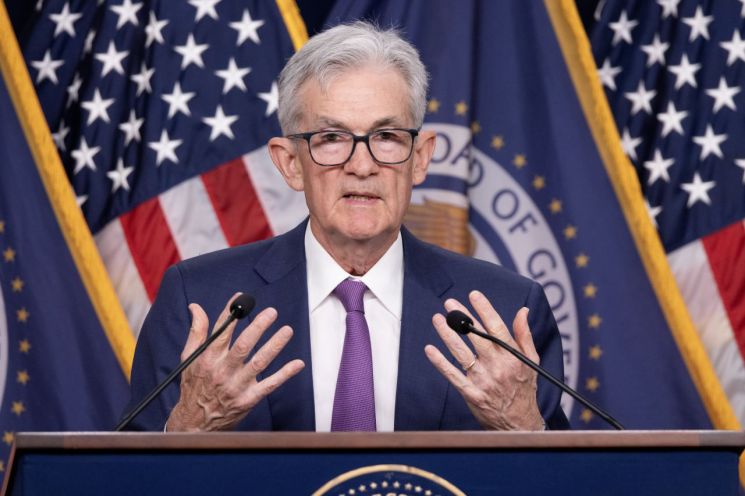
According to the "U.S. Economic Outlook and Key Issues for the Second Half of 2024" released on the 26th (local time) by the Bank of Korea's New York office, among ten Wall Street investment banks, Goldman Sachs, Nomura Securities, Wells Fargo, and TD Securities expect the Fed to cut the benchmark interest rate, currently at 5.25-5.5%, twice by 0.25 percentage points each this year. Citibank and Morgan Stanley expect three rate cuts within the year, lowering the benchmark rate by a total of 0.75 percentage points.
Barclays, Bank of America (BoA), JP Morgan, and Deutsche Bank, four other banks, forecast that the number of rate cuts this year will be limited to one, matching the Fed's expectations. Earlier this month, the Fed reduced its forecast for the number of rate cuts this year from three to one in the dot plot released at the Federal Open Market Committee (FOMC) meeting.
Accordingly, the average forecast for the policy rate cut among the ten IBs decreased from 130 basis points (bp) (1bp = 0.01 percentage points) at the end of 2023 to 45bp as of June this year. The difference in the expected policy rate cut between the Fed and the IBs narrowed from 65bp at the end of last year to about 20bp currently.
Regarding the timing of the Fed's rate cut initiation, seven out of the ten IBs selected a date before the end of September. The last FOMC meeting before the U.S. presidential election in November is scheduled for September.
The Bank of Korea's New York office analyzed, "Major IBs either forecast the policy rate cut this year to be the same as the Fed's or expect one or two more cuts. Compared to the forecast at the end of last year, the gap in policy rate cut expectations between the Fed and IBs has narrowed, and the differences among IBs' forecasts have also decreased."
The differences in forecasts among IBs regarding the magnitude of rate cuts this year stemmed from differing views on inflation and the labor market. IBs expecting two or more rate cuts this year believed that if the number of job openings decreases from the current level, the unemployment rate is likely to rise. They also diagnosed that the current labor market is not as strong as corporate survey results suggest, citing a decline in economic participation rates from household surveys. Conversely, IBs expecting only one rate cut anticipated that the slowdown in the rise of housing costs and supercore inflation (service prices excluding housing) would delay the reduction in overall inflation rates.
Regarding the U.S. economic outlook for the second half of the year, it was forecasted that growth would slow due to the cumulative effects of monetary tightening, but the possibility of a recession is low. As of the 20th, the median growth forecast for the U.S. economy this year among 77 IBs was 2.4%. The growth forecast for next year was 1.8%. IBs evaluated that the U.S. economy has achieved solid growth, reducing recession concerns to pre-pandemic levels. However, Citibank projected a sharp economic slowdown due to the cumulative effects of high-intensity tightening, revising its year-end GDP growth forecast to -0.9%.
Inflation forecasts were slightly revised upward compared to the end of last year. As of the 20th, the median forecast for core Personal Consumption Expenditures (PCE) inflation among 56 IBs was 2.8% for this year and 2.3% for 2025, matching the Fed's forecasts (2.8% and 2.3%, respectively).
The Bank of Korea's New York office stated, "In the second half of this year, the U.S. economy is expected to experience somewhat slower growth due to the cumulative effects of monetary tightening, particularly constraining the consumer growth that has driven the U.S. economy. Prices are expected to gradually slow their rise as goods prices decline and service sector inflation also decelerates."
© The Asia Business Daily(www.asiae.co.kr). All rights reserved.

















