China's 'Chang'e 6' Returns to Earth After Collecting Lunar Soil Samples
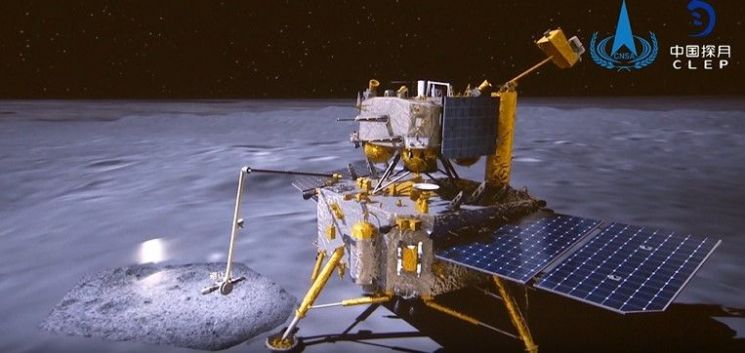
China has become the first in human history to secure soil samples from the far side of the moon. The United States, a powerhouse in space exploration, is feeling the pressure.
On the 25th (local time), the American daily The Wall Street Journal (WSJ) reported that China's lunar probe 'Chang'e 6' completed its mission of collecting soil and rock samples from the far side of the moon and returned to Earth on the same day. This marks a step forward for China amid ongoing delays in the U.S. Artemis program, which aims to send a manned spacecraft to the moon in cooperation with the private sector.
The U.S. and China have also planned to build bases on the far side of the moon. WSJ analyzed that the U.S. is particularly concerned about China achieving this goal first. NASA Administrator Bill Nelson expressed at a congressional hearing in April, "We are worried about a situation where China reaches the moon first and suddenly says, 'Now this is our land, so step aside.'"
Administrator Nelson voiced concerns about China potentially territorializing the moon in the future. According to WSJ, when Chinese President Xi Jinping visited the White House in 2015, he promised not to militarize the South China Sea. However, China soon constructed airfields and missile hangars on artificial islands, effectively occupying the area.
Since the area suitable for building bases on the lunar far side, particularly the south pole, is limited, the U.S. cannot help but worry about China establishing a base there first.
WSJ explained that a metaphor used by a scientist from the Chinese Academy of Sciences in 2017 to describe China's lunar ambitions has intensified competition between the U.S. and China. The scientist said, "Space is like the sea," and "The moon is the Diaoyu Islands (釣魚島) among them, and Mars is Huangyan Island (黃岩島)." The Diaoyu Islands is the Chinese name for the Senkaku Islands, which are disputed between Japan and China. Huangyan Island refers to Scarborough Shoal in the Spratly Islands, which is contested by the Philippines.
WSJ also analyzed that the lack of clear space treaties regarding the construction of bases on the lunar south pole could become a source of future disputes. Currently, the United Nations 'Outer Space Treaty,' ratified by over 100 countries and effective since 1967, is in force. This treaty does not recognize any nation's sovereignty claims over the moon or other celestial bodies. There are no regulations to coordinate if two countries build lunar bases in the same location.
To supplement this treaty and boost momentum for lunar exploration, the U.S. proposed the Artemis Accords in 2020 and began gathering participating countries. China criticized this as a U.S. play for space hegemony. Subsequently, China did not join the accords and instead formed separate partnerships with ten countries, including Russia, Pakistan, and South Africa.
However, WSJ pointed out that establishing a foothold on the lunar south pole may not be smooth due to various technical challenges.
© The Asia Business Daily(www.asiae.co.kr). All rights reserved.

![Clutching a Stolen Dior Bag, Saying "I Hate Being Poor but Real"... The Grotesque Con of a "Human Knockoff" [Slate]](https://cwcontent.asiae.co.kr/asiaresize/183/2026021902243444107_1771435474.jpg)















