Government to Prepare Supplementary Measures for Removing Public Institution Status from Government-Funded Research Institutes
Promoting Integration by Removing Physical Barriers, Not Merging Research Institutes
Granting Autonomy Including Allowing Special Recruitment of Eminent Scholars
Evaluation Cycle Adjusted from 3 Years to 2 Years
From now on, members of government-funded research institutes in the science and technology field (hereinafter referred to as research institutes) will be able to freely visit the cafeterias or meeting rooms of other institutions at any time. A knowledge portal enabling interaction among research institute members regardless of their affiliated institutions will also be established. Each research institute will be able to specially hire distinguished scholars without open recruitment to innovate research outcomes, and operational autonomy regarding personnel expenses will be significantly relaxed. However, for accountability management evaluation, the institutional evaluation cycle, currently every three years, will be shortened to two years.
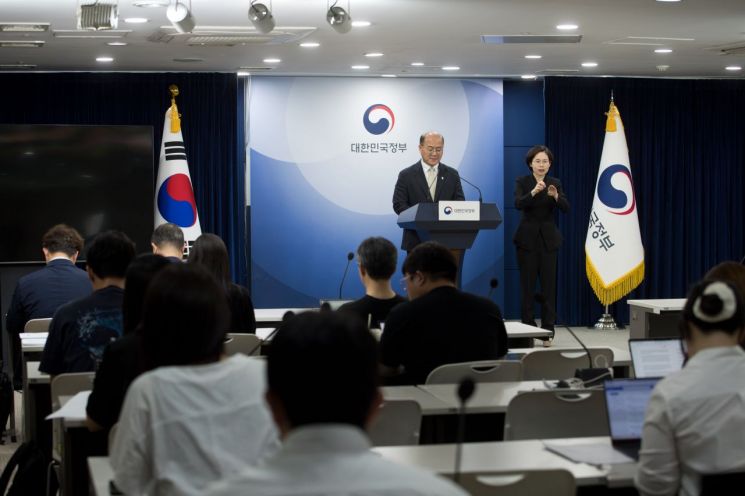 Lee Chang-yoon, 1st Vice Minister of the Ministry of Science and ICT, is giving a briefing on the "Measures to Promote the Dynamism of the R&D Ecosystem and Activation of Knowledge Fluidity in Science and Technology Research Institutes" on the 26th at the Government Seoul Office in Jongno-gu, Seoul. [Image source=Yonhap News]
On the 26th, the Ministry of Science and ICT held the 61st Steering Committee meeting of the National Science and Technology Advisory Council (hereinafter referred to as the ‘Steering Committee’) and announced that it had deliberated and approved the 'Plan to Promote Dynamism in the Research and Development Ecosystem and Activation of Knowledge Fluidity in Science and Technology Government-Funded Research Institutes (Draft).' The plan applies to the National Research Council of Science & Technology (NST) and its 23 affiliated research institutes. The Korea Aerospace Research Institute and the Korea Astronomy and Space Science Institute, which have moved under the Aerospace Administration, are excluded.
This plan was promoted as a result of the removal of public institution status from government-funded research institutes in the science and technology field, which have played a significant role in the development of Korean science and technology. Since President Yoon Suk-yeol accepted the science and technology community’s recommendation to revoke the public institution designation of research institutes, a catalyst was needed to induce changes in these institutes.
The direction of change excludes physical integration among research institutes but aims to remove physical barriers, grant autonomy to support cooperation for securing advanced technologies, and simultaneously strengthen supervision.
First, to promote joint research among research institutes, measures such as introducing joint access cards, removing boundary walls, establishing an integrated (tentatively named) knowledge portal, and holding regular researcher meetings will be attempted. This is a plan to enhance the dynamism of R&D through free exchange and cooperation among research institute members regardless of their affiliated institutions.
To dramatically enhance the research capabilities of research institutes, operational autonomy will also be significantly increased. Under minimal requirements, institutes will be able to manage their own staffing and simplify the hiring procedures for fixed-term employees to quickly fill necessary personnel. Income from technology fees can be used for personnel expenses, and special non-open recruitment will be allowed to hire key talents such as distinguished scholars. The upper limit for external lecture fees for research institute researchers will also be raised to a level equivalent to university professors.
The accountability management system will be strengthened, and from 2026, evaluations will be conducted every two years. This measure unifies the current institutional operation evaluation every three years and the research project evaluation every six years. The Ministry of Science and ICT explained that to minimize the burden on research institutes, the collection of quantitative performance data will be automated, and excellent institutions based on inspection results will be exempted from the next inspection, thereby reducing the burden.
Until now, NST has remained a simple management organization, but going forward, it will normalize its policy functions, assign support and nurturing roles, and improve the expertise of its personnel. A plan to improve these functions will be separately prepared by the end of this year.
To establish an open cooperative system among research institutes, the 'National Science and Technology Laboratory (NSTL)' system will be introduced. NSTL will consist of research departments from multiple institutions cooperating to achieve the same mission, and the specific composition will be decided through inter-institutional consultations.
Minister Lee Jong-ho of the Ministry of Science and ICT said, "We are determined to push forward with this as the last chance to transform the R&D ecosystem into a leading model and to elevate our research institutes to the world’s top level." He added, "We will continuously communicate during the implementation process and build consensus on the ground as we proceed."
© The Asia Business Daily(www.asiae.co.kr). All rights reserved.
![Clutching a Stolen Dior Bag, Saying "I Hate Being Poor but Real"... The Grotesque Con of a "Human Knockoff" [Slate]](https://cwcontent.asiae.co.kr/asiaresize/183/2026021902243444107_1771435474.jpg)











