Hankyung Association Conducts Minimum Wage Awareness Survey with 500 Self-Employed Workers
More than half of self-employed individuals believe that next year's minimum wage should be cut or at least maintained at this year's level, according to a survey. This year's minimum wage is 9,860 KRW per hour.
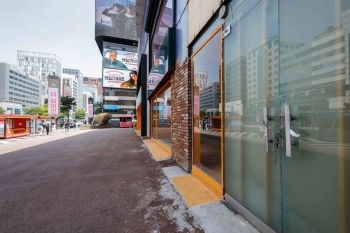 On the 5th, it was found that one out of five self-employed restaurant business owners in Seoul closed their businesses last year, with Gangnam-gu (2,798 locations) having the highest number of closed stores. The first floor of a large shopping street near Gangnam Station in Seoul is empty due to closures. Photo by Kang Jin-hyung aymsdream@
The Korea Economic Association (KEA) announced the results of this minimum wage perception survey among self-employed individuals on the 26th. The survey was conducted over a week from the 21st to the 27th of last month, targeting 500 self-employed people nationwide.
The survey results showed that 54.4% of respondents answered that next year's minimum wage should be frozen (43.4%) or lowered (11%).
Many respondents said that even if the wage is raised, the increase should be limited. Regarding the appropriate level of minimum wage increase, the highest response rates were for 1% or more but less than 3% (17.2%), 3% or more but less than 6% (13.4%), and 6% or more but less than 9% (8.2%), excluding freeze or reduction.
By industry, the proportion of those who said next year's minimum wage should be cut or maintained was highest in the accommodation and food service sector (67.3%), followed by wholesale and retail trade (54.7%), real estate (54.5%), and manufacturing (53.2%).
Forty-eight percent of self-employed respondents said that this year's minimum wage is already a significant burden on their business. By industry, the proportions were manufacturing (62.5%), accommodation and food service (61.3%), wholesale and retail trade (47.8%), and real estate (45.5%).
When asked about the impact of next year's minimum wage increase on employment, 48% of self-employed individuals responded that they currently have no capacity to hire. By industry, the rates were manufacturing (59.4%), finance, construction, and others (57.1%), real estate (54.5%), and arts, sports, and service industries (51.9%).
When the minimum wage is increased by less than 3%, 9.8% of respondents said they would consider giving up employment or laying off staff; this rose to 11.4% when the increase was between 3% and less than 6%.
In response to the question, "At what minimum wage increase would you raise sales prices?" 37.8% said they already plan to raise sales prices at the current level. By industry, the proportions were real estate (45.5%), transportation and warehousing (42.9%), others (42.9%), wholesale and retail trade (39.4%), and arts, sports, and leisure services (38.5%).
KEA analyzed, "With continuous increases in costs such as raw materials and rent, the operational cost burden from minimum wage hikes may lead to higher sales prices, which could stimulate inflation as a side effect."
Regarding the average monthly income of self-employed individuals, 25.4% of respondents were found to earn less than the minimum wage based on a 40-hour workweek (monthly 2,060,740 KRW). This was followed by 23.8% earning between 2.5 million and less than 3 million KRW, 16% earning between 3.5 million and less than 4 million KRW, and 15.2% earning between the minimum wage level and less than 2.5 million KRW.
Regarding the "minimum wage increase rate at which business closure is considered," 34.2% of self-employed individuals said they have already reached their limit. If the minimum wage increases by less than 3%, 6.6% said they would consider closure; if it increases by 3% to less than 6%, 7.2% said they would consider closure.
Regarding urgent improvements to the current minimum wage system, respondents cited differentiated minimum wage application by industry and region (30.6%), limits on increase rates considering economic conditions (23.2%), and supplementing minimum wage determination criteria such as employer payment capacity (18%).
Lee Sang-ho, head of KEA's Economic and Industrial Headquarters, said, "Increasing the minimum wage will increase labor costs and deepen management difficulties. To determine the minimum wage rationally, the employer's payment capacity should be prioritized, and discussions on differentiated application by industry and region need to be concretized."
© The Asia Business Daily(www.asiae.co.kr). All rights reserved.

















