A chatbot system capable of predicting the properties and performing inverse design of metal-organic frameworks, tasks that conventional language models could not accomplish, has been developed domestically.
KAIST announced on the 26th that Professor Ji-Han Kim's research team from the Department of Bio and Chemical Engineering developed a chatbot system (ChatMOF, hereafter ChatMOF) that utilizes large language models (LLMs) to predict the characteristics of Metal-Organic Frameworks (MOFs) and automatically generate new materials.
The research team developed ChatMOF based on the limitation that, although artificial intelligence has recently advanced dramatically, the complexity of materials and the lack of specialized training data for each material still hinder the full realization of LLMs' potential in materials science.
ChatMOF was developed by combining traditional machine learning models with LLMs in the materials field, and the research team explained that it has the potential to reduce the gap for beginners in computational and machine learning tools.
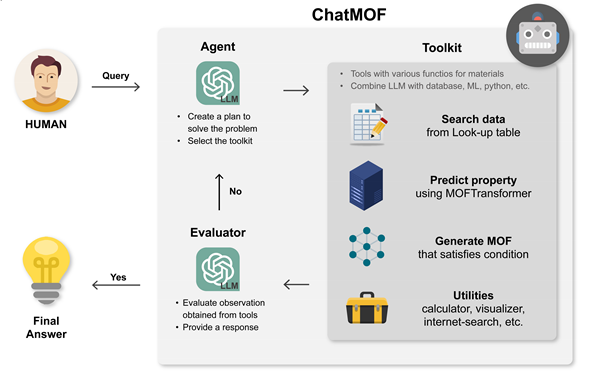 Overview of the Operation of a Chatbot System for Prediction and Inverse Design of Metal-Organic Frameworks Using Large Language Models. Provided by KAIST
First, ChatMOF formulates a problem-solving plan using LLMs in response to users' questions about metal-organic frameworks (MOFs) and selects appropriate tools necessary for the plan.
Then, based on the results obtained from the tools, it determines whether the results can answer the user's question. If it can provide a final answer, it responds to the user; if not, it re-establishes the problem-solving plan.
The tools used in this process mainly include a 'search tool' that retrieves data from tables, a 'prediction tool' that predicts properties using machine learning, and a 'generation tool' that performs inverse design of materials with desired properties. Additionally, various utilities such as calculators and unit converters can be used as tools.
ChatMOF demonstrated success rates of 96.9% and 95.7% in search and prediction tasks, respectively. The research team emphasized that achieving 87.5% accuracy in the complex structure generation task (inverse design) is particularly noteworthy. These results suggest that ChatMOF can be effectively utilized to manage demanding tasks in the future.
Above all, ChatMOF not only provides detailed and accurate information about materials desired by users in the materials field but also enables easy use of machine learning and various computational chemistry tools that are difficult for non-experts to use, thereby narrowing the gap between experts and non-experts. This is expected to contribute to accelerating materials development by enabling rapid and accurate creation and research of new materials.
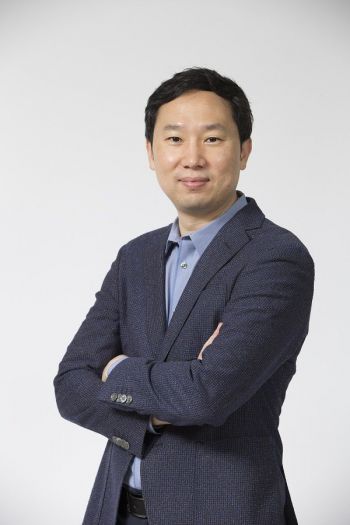
Professor Ji-Han Kim stated, “The technology developed by our research team is an important advancement toward achieving high autonomy of artificial intelligence in the field of materials science,” adding, “With systematic improvements in model capacity and data sharing on online platforms, ChatMOF’s performance can be further optimized, which could trigger progress in the field of metal-organic framework research.”
Meanwhile, the results of this study, in which PhD candidate Young-Hoon Kang from KAIST’s Department of Bio and Chemical Engineering participated as the first author, were published on the 3rd in the international journal Nature Communications.
© The Asia Business Daily(www.asiae.co.kr). All rights reserved.
![Clutching a Stolen Dior Bag, Saying "I Hate Being Poor but Real"... The Grotesque Con of a "Human Knockoff" [Slate]](https://cwcontent.asiae.co.kr/asiaresize/183/2026021902243444107_1771435474.jpg)












