The government announced that it will prepare a plan for the supply and demand forecast of medical personnel and the establishment of an adjustment system regarding the medical school quota from the 2025 academic year onward by September.
The Ministry of Health and Welfare stated this on the 25th during a briefing by the Central Disaster and Safety Countermeasures Headquarters (CDSCH) amid the doctors' collective action.
In response to a question about whether negotiations on the 2026 academic year quota are possible, the Ministry replied, "On the 20th of this month, the Special Committee on Medical Reform discussed the basic direction of the supply and demand forecast and adjustment discussion body, and after discussions within the special committee by September, a concrete plan will be announced."
At that time, Roh Yeon-hong, the chairman of the Medical Reform Special Committee, said, "The 2025 academic year medical school quota has already been allocated by university, and university admission implementation plans have been issued, so it will be difficult to apply the method discussed that day to next year's quota," adding, "The timing of applying the new method may vary depending on the progress of discussions."
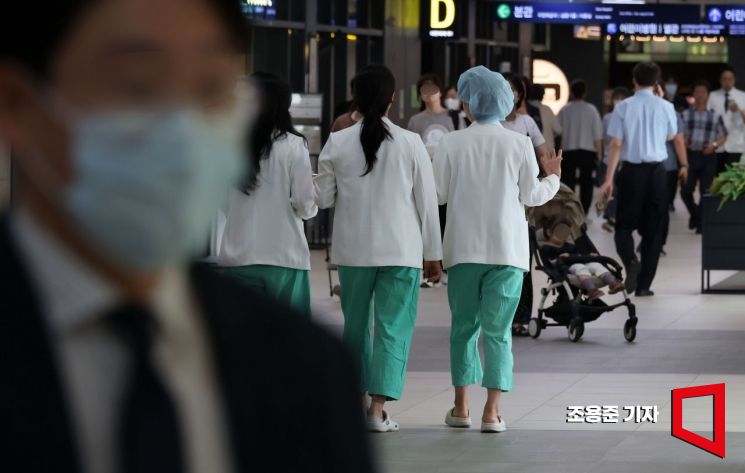 On the 24th, Seoul National University Hospital, which had entered an indefinite strike starting from the 17th, resumed normal medical services. Medical staff are seen moving for consultations at Seoul National University Hospital in Jongno-gu, Seoul. Photo by Jo Yongjun jun21@
The government expressed a welcoming stance regarding the formation of special committees by doctors' organizations and decided to actively engage in dialogue.
Kwon Byung-ki, the Ministry of Health and Welfare's Essential Medical Support Officer, said, "We are communicating with the medical community frequently," and added, "In particular, we welcome the Korean Medical Association (KMA) for unifying communication channels and expressing willingness to dialogue through the 'Special Committee for Proper Medical Care' (Olteukwi)."
The KMA formed the Olteukwi with a three-person co-chair system consisting of medical school professors, residents, and representatives of city and provincial medical associations, and held its first meeting on the 22nd. The Olteukwi plans to hold a second meeting on the 29th to discuss future protest methods such as work stoppages.
The government urged residents to return promptly, stating that their demands are being implemented.
The government's plan to implement residents' demands announced that day includes four main points: establishing an organization for scientific doctor supply and demand forecasting, expanding the hiring of specialists at training hospitals, presenting specific legal measures for unavoidable medical accidents, and improving the poor training environment for residents.
The residents' organization has a total of seven demands, including those announced by the government that day, as well as △ complete cancellation of the medical school quota increase plan and essential medical policy package △ full withdrawal of unfair orders directed at residents △ complete abolition of work commencement orders.
© The Asia Business Daily(www.asiae.co.kr). All rights reserved.

















