The issue of whether foreign workers employed at the secondary battery manufacturer 'Arisel' in Hwaseong, Gyeonggi Province, where a large fire occurred, were subject to 'illegal dispatch' has emerged as a new matter to be clarified. Dispatching is prohibited in direct production processes in manufacturing, but suspicions have been raised that the dispatching company issued work instructions.
On the afternoon of the 25th, Arisel CEO Park Soon-kwan issued a public apology, stating that all the foreign workers who died in the fire were 'contracted personnel,' but also mentioned that work instructions were given by the 'dispatching company.' In doing so, CEO Park inadvertently raised suspicions about the illegal dispatch of foreign workers.
In response, CEO Park avoided a direct answer, saying, "I will sincerely cooperate with the investigation and provide answers later."
According to the current 'Act on the Protection of Dispatched Workers, etc.' (Dispatch Act), dispatching is allowed only for 32 specific tasks and is prohibited for most other tasks. A representative example of prohibited dispatch work is 'direct production process work in manufacturing.'
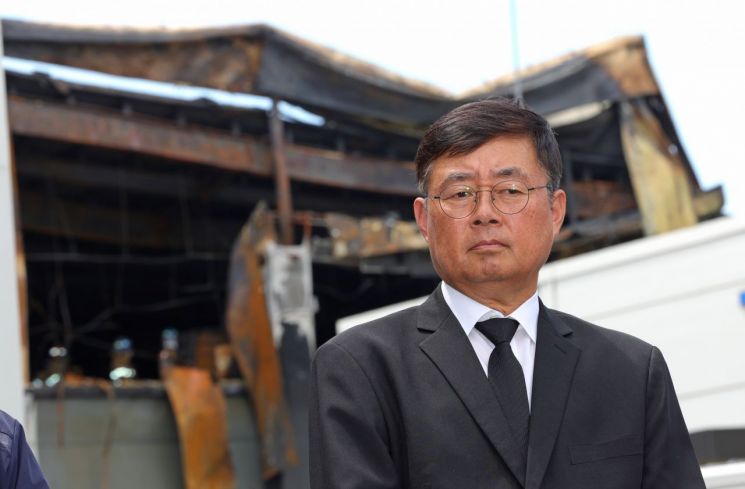 Park Soon-kwan, CEO of Esconec, listening to reporters' questions
(Hwaseong=Yonhap News) Reporter Hong Ki-won = On the afternoon of the 25th, at Arisel, a lithium battery factory in Seosin-myeon, Hwaseong City, Park Soon-kwan, CEO of Esconec, read an official apology regarding the accident that caused 23 deaths and then answered reporters' questions.
On the morning of the 24th at 10:31 a.m., a fire broke out at Arisel, a primary battery company located in Jeongok-ri, Seosin-myeon, Hwaseong City, resulting in numerous casualties. 2024.6.25 [Joint Coverage]
xanadu@yna.co.kr
(End)
<Copyright (c) Yonhap News, unauthorized reproduction and redistribution, AI training and use prohibited>
It is known that the space where the fire occurred the previous day was used for inspection and packaging of lithium battery finished products supplied to the military. In 2017, the Constitutional Court ruled that direct production process work refers to 'core tasks that form the foundation of manufacturing,' including 'completing products and inspecting and packaging them.'
However, the consensus is that the statement by CEO Park alone cannot confirm whether 'illegal dispatch' occurred. This is because, especially in small-scale workplaces, dispatch and subcontracting are often mixed regardless of legal definitions.
The key to distinguishing between dispatch and subcontracting is who gave the instructions and orders to the workers. The Ministry of Employment and Labor stated that since Arisel is not a 'workplace subject to the Employment Permit System,' it is necessary to verify whether illegal dispatch occurred or if a legitimate subcontracting contract was established.
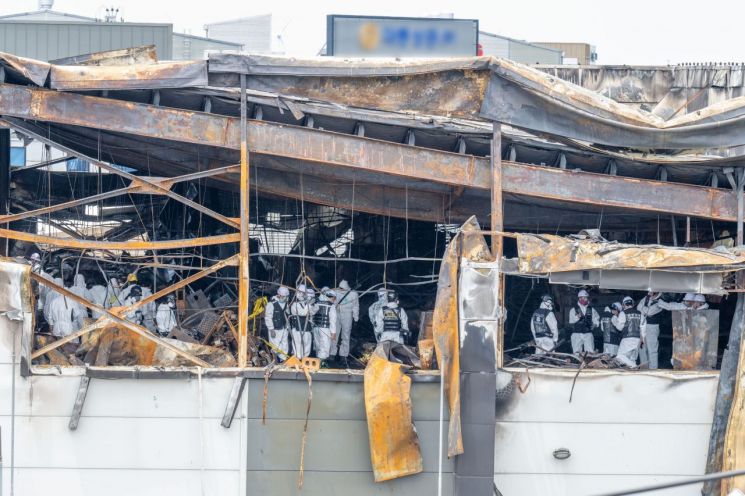 Find the Cause of the Fire
(Hwaseong=Yonhap News) Reporter Hong Gi-won = On the 25th, at the lithium battery factory fire site in Seosin-myeon, Hwaseong-si, Gyeonggi-do, police, fire department, National Forensic Service, Korea Institute of Civil Engineering and Building Technology, Ministry of Employment and Labor, and Korea Occupational Safety and Health Agency officials are conducting a joint inspection to find the cause of the fire.
On the morning of the 24th at 10:31 a.m., a fire broke out at Arisel, a primary battery company located in Jeongok-ri, Seosin-myeon, Hwaseong-si, resulting in multiple casualties. 2024.6.25 [Joint Coverage]
xanadu@yna.co.kr
(End)
<Copyright (c) Yonhap News, unauthorized reproduction, redistribution, AI training and use prohibited>
© The Asia Business Daily(www.asiae.co.kr). All rights reserved.
![Clutching a Stolen Dior Bag, Saying "I Hate Being Poor but Real"... The Grotesque Con of a "Human Knockoff" [Slate]](https://cwcontent.asiae.co.kr/asiaresize/183/2026021902243444107_1771435474.jpg)

















