The Supreme Court has ruled that a former partner company employee who used a waterproof adhesive manufacturing method for touchscreens and circuit boards of Samsung Electronics' Galaxy series phones, developed while working at Samsung, to produce prototypes at a new company after changing jobs, should be punished for using and disclosing trade secrets.
According to the legal community on the 25th, the Supreme Court's 3rd Division (Presiding Justice Oh Seok-jun) overturned the lower court's ruling that acquitted Jeong Mo on the charges of violating the Unfair Competition Prevention Act (acquisition, use, and disclosure of trade secrets), except for the 'acquisition' part of the trade secrets, and remanded the case to the Daejeon District Court. The court also overturned and remanded the acquittal of two company officials, Jo Mo and Lim Mo, who were indicted alongside Jeong.
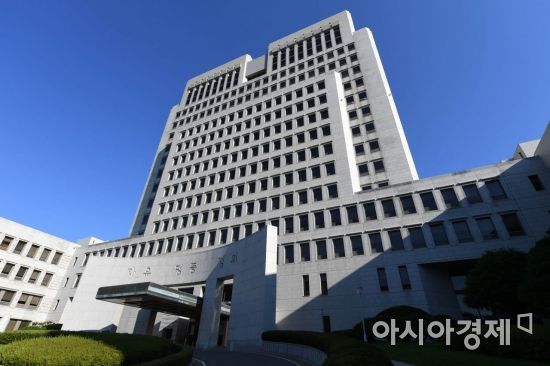
The court stated, "The lower court's judgment, which acquitted defendant Jeong of the use and disclosure of trade secrets under the Unfair Competition Prevention Act and acquitted the other defendants, misinterpreted the legal principles regarding intent under Article 18, Paragraph 2 of the Unfair Competition Prevention Act, specifically concerning 'obtaining unfair benefits or causing damage to the trade secret holder,' and failed to conduct necessary investigations, which affected the judgment," as the reason for overturning and remanding.
Article 18 (Penalties), Paragraph 2 of the Unfair Competition Prevention Act stipulates that acts committed with the purpose of obtaining unfair benefits or causing damage to the trade secret holder, such as ▲ acquiring, using, or disclosing trade secrets to third parties ▲ unauthorized leakage of trade secrets outside designated locations ▲ retaining trade secrets despite demands for deletion or return from the trade secret holder (Item 1), are punishable by imprisonment of up to 10 years or a fine of up to 500 million won.
Additionally, even without a specific purpose, acts of acquiring trade secrets through theft, deception, intimidation, or other unfair means (Item 2), and acts of acquiring or using trade secrets knowing that Items 1 or 2 were involved (Item 3), are punishable by the same penalties.
From January 2015 to August 1, 2016, Jeong worked as a production staff member at Company A, a secondary subcontractor of Samsung Electronics, and took photos eight times of raw material weighing sheets and manufacturing instructions containing the manufacturing methods of waterproof adhesive NC-71(C) for touchscreens and circuit boards of the Galaxy series phones independently developed and produced by Company A and supplied to Samsung Electronics.
The documents Jeong photographed contained specific details such as the names of individual raw materials for each product, quantities and ratios of input materials, manufacturing process instructions, and precautions, which had never been disclosed to the public through publications or other means.
In August 2015, Company A posted on the internal bulletin boards of each factory a notice titled 'Company Instructions, Technical Security' stating, "Production prescriptions are high-grade confidential security materials; copying or photographing is prohibited, and they must be returned immediately to the person responsible after use. The person responsible must store high-grade technical materials in a locked separate cabinet." Employees of Company A, including Jeong, submitted confidentiality agreements in January of the following year pledging not to provide or disclose confidential information to third parties.
However, Jeong used these manufacturing methods to produce prototypes at two companies he sequentially joined, and those companies introduced the prototypes made by Jeong to clients as products equivalent to NC-71(C) and others produced by Company A.
The prosecution indicted Jeong and two company officials who instructed Jeong, hired as an experienced worker, to produce products similar to those of Company A, on charges of violating the Unfair Competition Prevention Act.
The first trial court found all defendants guilty, sentencing Jeong to one year in prison with a three-year probation and the other officials to six months in prison with a three-year probation. Under the joint penalty provision, the two corporations Jeong joined were each fined 10 million won.
However, the second trial court reversed the decision, acquitting all. It reasoned that it was difficult to see that Jeong recognized the manufacturing method as a trade secret and acquired it, and that the other company officials learned and used the manufacturing method by chance without improper intent.
The Supreme Court's judgment differed. It first clarified that the technology was a trade secret of Company A, stating, "Considerable costs were invested in development, and competitive advantages can be gained through its use."
It judged that even if Jeong had no improper intent when photographing and storing the manufacturing method, he would have known after resignation that he should not use or disclose it improperly.
Regarding the two other company officials, the court noted, "There is a high possibility that they tacitly recognized that using or acquiring the manufacturing method without the victim company's permission was not allowed," and pointed out, "There is a strong possibility that they acquired and used the manufacturing methods in this case with the intent to obtain unfair benefits or cause damage to the victim company."
The court cited previous Supreme Court precedents, stating, "The use of trade secrets includes not only producing products by simply copying the trade secret technology but also cases where referring to another's trade secrets reduces trial and error or omits necessary experiments, thereby saving time and costs in product development."
The court pointed out, "The lower court should have examined whether each manufacturing method in this case constituted a trade secret of the victim company, whether defendant Jeong recognized and used or disclosed the manufacturing methods when sequentially changing jobs, and whether defendants Jo and Lim recognized these as trade secrets when acquiring and using them, to determine if they acted with intent to violate Article 18, Paragraph 2 of the Unfair Competition Prevention Act to obtain unfair benefits or cause damage to the victim company."
However, the court found no problem with the lower court's acquittal of Jeong on the charge of acquiring trade secrets, citing Supreme Court precedents that "an employee of the trade secret holder who recognizes and can use the trade secret is already considered to have acquired the trade secret, so the mere unauthorized removal of the trade secret outside the company does not constitute acquisition of trade secrets, although it may constitute breach of trust."
© The Asia Business Daily(www.asiae.co.kr). All rights reserved.
![Clutching a Stolen Dior Bag, Saying "I Hate Being Poor but Real"... The Grotesque Con of a "Human Knockoff" [Slate]](https://cwcontent.asiae.co.kr/asiaresize/183/2026021902243444107_1771435474.jpg)
















