Bank of Korea Announces '2020 Employment Table'
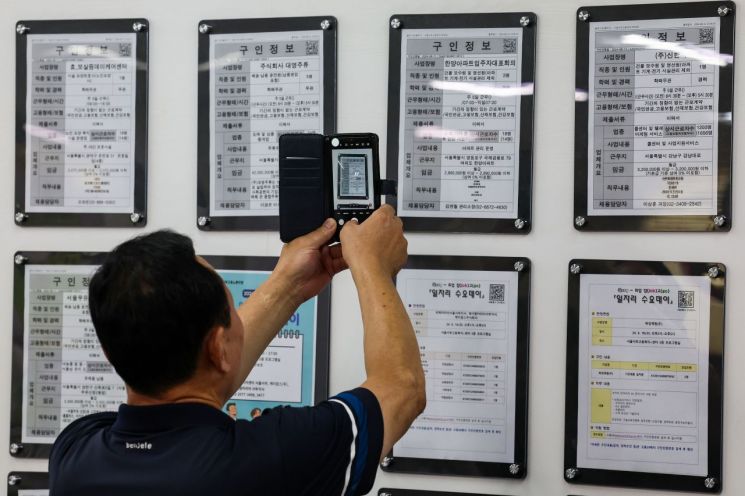
As labor productivity continues to improve due to automation of production facilities, the number of employees required to produce 1 billion KRW worth of output is decreasing.
According to the "2020 Employment Table Results" released by the Bank of Korea on the 25th, the employment coefficient, which indicates the number of employees needed to produce 1 billion KRW of output, was 5.4 persons, down 1.1 persons from 6.5 in 2015.
The employment table is an annex to the 2020 benchmark input-output table, which is compiled every five years. It is used as basic data for analyzing labor ripple effects and establishing manpower supply and demand plans.
The employment coefficient has an inverse correlation with labor productivity. Therefore, the higher the labor productivity, the lower the employment coefficient. Generally, as labor productivity improves due to automation of production facilities and workforce reductions occur through corporate restructuring, the employment coefficient shows a downward trend.
This decline in the employment coefficient was led by the service sector. The employment coefficient in services fell across all sectors, including consumer services, wholesale and retail, and transportation, dropping from 10.2 in 2015 to 7.7 in 2020. This is attributed to an increase in service output (from 1,722 trillion KRW to 2,246 trillion KRW) while the number of employees decreased (from 17.64 million to 17.37 million).
The employment coefficient for wage workers, which indicates the number of wage employees required to produce 1 billion KRW of output, was 4 persons, down 0.8 persons from 4.8 in 2015.
Employment Induction Coefficient Falls to 9.7, Down from 2015... Employment Creation Capacity Weakens
South Korea's economic employment creation capacity is weakening. The employment induction coefficient, which represents the number of employees directly and indirectly induced when final demand for a specific product reaches 1 billion KRW, was 9.7 persons, down 2 persons from 2015.
The decline in the employment induction coefficient was led by the service and manufacturing sectors. The employment induction coefficient in services, centered on consumer services, wholesale and retail, and transportation, decreased from 15 in 2015 to 11.5. In manufacturing, the employment induction coefficient, focused on manufacturing processing, industrial equipment repair, and consumer goods products, fell from 7.3 to 6.3.
As of 2020, the total number of employed persons in South Korea (based on full-time equivalent) was 24.44 million, a 1.6% decrease compared to 2015. By employment type, the proportion of wage workers, mainly regular employees, increased to 74.4%, while self-employed and unpaid family workers accounted for 25.6%. The gender ratio remained the same as before, with males at 61% and females at 39%.
By sector, the share of manufacturing workers declined, while the service sector saw a slight increase. Manufacturing, centered on consumer goods such as textiles and leather products, accounted for 15.1%. Meanwhile, the service sector, influenced bidirectionally by COVID-19, saw increases in health and social welfare services but decreases in wholesale, retail, and brokerage services, accounting for 71.1%.
By employment type, the share of regular employees increased. The proportion of regular employees rose from 51.9% in 2015 to 58.2%. This was due to an overall increase in the share of regular employees except in some sectors such as electricity, gas, water supply, and waste management. In particular, the share of regular employees expanded in wholesale, retail, brokerage services, and real estate services.
© The Asia Business Daily(www.asiae.co.kr). All rights reserved.

















