"The Fire on a Lithium Battery Cannot Be Extinguished"
Amid a large-scale fire casualty at the Arisel factory, a primary battery manufacturer in Hwaseong-si, Gyeonggi Province, experts have diagnosed that toxic gases generated by burning lithium likely caused the employees' bodies to stiffen, making evacuation more difficult.
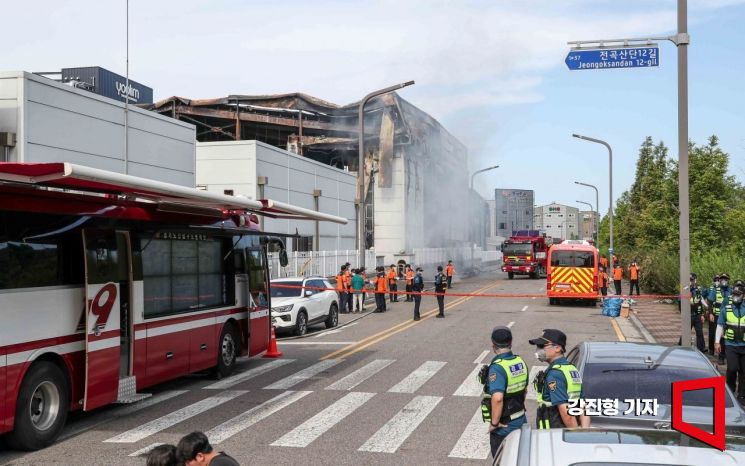 On the 25th, firefighters are busily moving at the scene of a fire at a primary battery manufacturing factory in Hwaseong-si, Gyeonggi Province. Photo by Jinhyung Kang aymsdream@
Professor Gong Ha-seong of the Department of Fire and Disaster Prevention at Woosuk University appeared on CBS Radio's 'Kim Hyun-jung's News Show' on the 25th and said, "Even if they tried to evacuate, inhaling toxic gases would have made their bodies immobile, making evacuation difficult," adding, "Compared to wood, lithium batteries produce hundreds of times more toxic gases. Representative substances include hydrofluoric acid, benzene, acrolein, and toluene."
He continued, "Most of these substances have a tremendous impact on the respiratory system, can cause heart attacks, and benzene can cause anesthesia-like symptoms. Even if they tried to evacuate, their bodies would not move, which is why I sadly think they might have been unable to escape."
Regarding the fire originating from finished lithium batteries, Professor Gong speculated that strong impact or manufacturing defects were the causes. He explained, "The battery has positive and negative poles and a separator. If the separator is damaged, high heat is generated, which can easily lead to an explosion." He added, "Also, when lithium meets water, hydrogen gas, which is flammable, is produced. While this alone does not cause an explosion, if there is even a small spark caused by friction from packaging or other factors, it can also lead to a fire."
According to the fire authorities, the second floor where most of the deceased were found measures 1,185㎡ (350 pyeong), and the fire spread there in just 15 seconds. Professor Gong said, "This is called a thermal runaway phenomenon, where a battery next to one that explodes due to high heat receives that heat, causing the same explosion to occur in a chain reaction." He also added that the 'tatak tatak' sound witnesses reported hearing at the fire scene was the sound of batteries bursting.
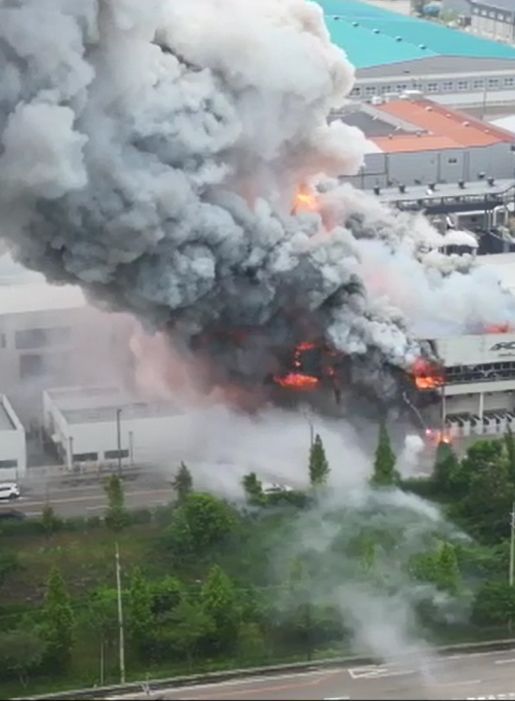 On the morning of the 24th, smoke and flames rose from a fire at a lithium battery manufacturing factory in Seosin-myeon, Hwaseong-si, Gyeonggi Province. Photo by Yonhap News Agency, reader.
Regarding workers' initial attempts to extinguish the fire with fire extinguishers, which failed, he said, "You cannot put out a fire on lithium batteries. Also, when lithium meets water, hydrogen gas is continuously produced. Since combustible materials are continuously generated, the fire inevitably spreads."
Furthermore, Professor Gong emphasized the need for caution as toxic substances may have spread near the fire site. He said, "According to the U.S. Agency for Toxic Substances and Disease Registry, if a fire occurs in lithium batteries, it is dangerous within a radius of at least 800 meters, so evacuation beyond that is recommended. If you live near the factory where the fire occurred, it is important to keep windows tightly closed and operate ventilation fans or air purifiers to cleanse the indoor air."
© The Asia Business Daily(www.asiae.co.kr). All rights reserved.
![Clutching a Stolen Dior Bag, Saying "I Hate Being Poor but Real"... The Grotesque Con of a "Human Knockoff" [Slate]](https://cwcontent.asiae.co.kr/asiaresize/183/2026021902243444107_1771435474.jpg)

















