Passage of Four Bills Including the Gender Equality in Employment Act at the Cabinet Meeting
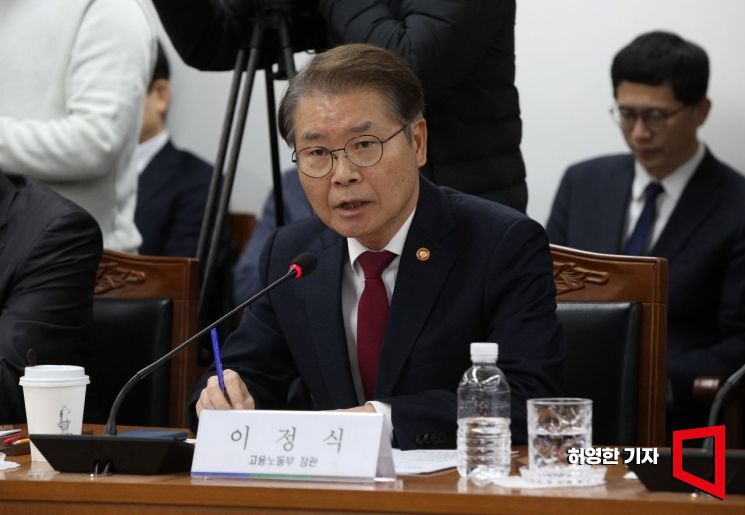 On the 6th, during the 13th plenary session of the Economic, Social and Labor Council held at the Gyeongsanowi meeting room in Jongno-gu, Seoul, Lee Jeong-sik, Minister of Employment and Labor, is speaking. Photo by Heo Young-han younghan@
The eligible age for applying for reduced working hours during childcare will be expanded from under 8 years old to under 12 years old. The support period for spousal paternity leave pay will also be extended from 5 days to 10 days.
The Ministry of Employment and Labor announced on the 25th that four bills, including the "Act on Gender Equality in Employment and Work-Family Balance" (hereinafter referred to as the Gender Equality Employment Act), were reviewed and approved at the Cabinet meeting held on the same day.
The so-called "Maternity Protection Three Acts," including the Gender Equality Employment Act, Employment Insurance Act, and Labor Standards Act, which were discarded due to expiration during the 21st National Assembly, have been re-promoted.
The bills include provisions to increase the number of times spousal paternity leave can be split from once to three times, extend the support period for spousal paternity leave pay from 5 days to 10 days, and raise the eligible age for applying for reduced working hours during childcare from under 8 years old or under 2nd grade in elementary school to under 12 years old or under 6th grade in elementary school.
Additionally, to protect the health of pregnant women and fetuses from the risk of premature birth, the period for reducing working hours by 2 hours per day will be expanded from within 12 weeks of pregnancy or after 36 weeks to within 12 weeks of pregnancy or after 32 weeks. The annual duration of infertility treatment leave will also be increased from 3 days to 6 days, and a new system will be established to provide pay for 2 days of paid leave to workers belonging to priority support companies.
On the same day, the partial amendment bill of the "National Lifelong Vocational Competency Development Act" also passed the Cabinet meeting. This bill includes provisions allowing companies to have discretion over individual training courses within a certain scope and receive training cost support if their vocational competency development plans are pre-approved.
Furthermore, the admission qualification requirements for advanced degree major courses at technical colleges have been revised so that applicants can be admitted as long as they meet both academic and career requirements, regardless of the order of these qualifications.
© The Asia Business Daily(www.asiae.co.kr). All rights reserved.

















