Last Month's Card Loan Balance Hits 40 Trillion Won, a Record High
'Quick Cash Window' Insurance Policy Loans at 70 Trillion for Third Consecutive Quarter
"Early Withdrawal of Savings and Deposits Expected to Increase"
#A (57), who runs an art academy in Suseong-gu, Daegu, recently took out a total of 100 million KRW in card loans and 5 million KRW in insurance policy loans. Although he had already secured a loan from a commercial bank using his apartment as collateral, ongoing sales slumps forced him to resort to card and insurance loans as well. A said, “With the low birthrate causing a decline in the school-age population and the recession hitting, I am running a deficit of 3 to 4 million KRW per month.”
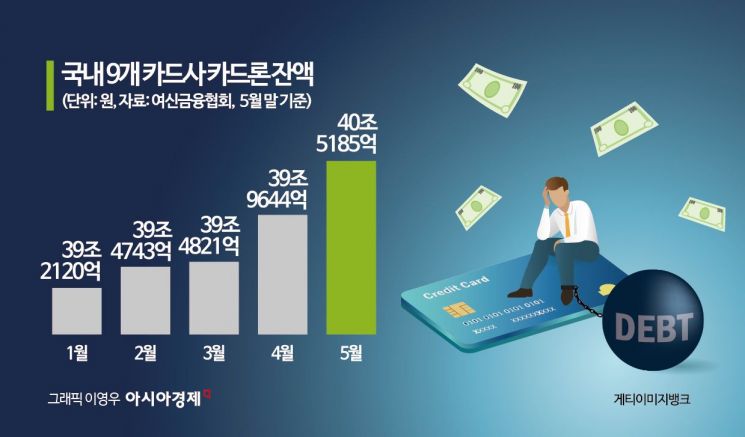
Low-income earners suffering from prolonged high inflation and high interest rates are flocking to recession-type loans. The outstanding balance of card loans has surpassed 40 trillion KRW for the first time ever, while insurance policy loans remain at an all-time high level of around 70 trillion KRW.
According to the Credit Finance Association on the 25th, the outstanding balance of card loans from nine domestic card companies (Samsung, Shinhan, KB Kookmin, Lotte, Hana, Hyundai, BC, NH Nonghyup, and Woori) stood at 40.5186 trillion KRW as of the end of last month. This is an increase of 554.2 billion KRW compared to the previous record in April (39.9644 trillion KRW). Compared to May last year (37.7684 trillion KRW), the balance surged by 2.7052 trillion KRW in one year.
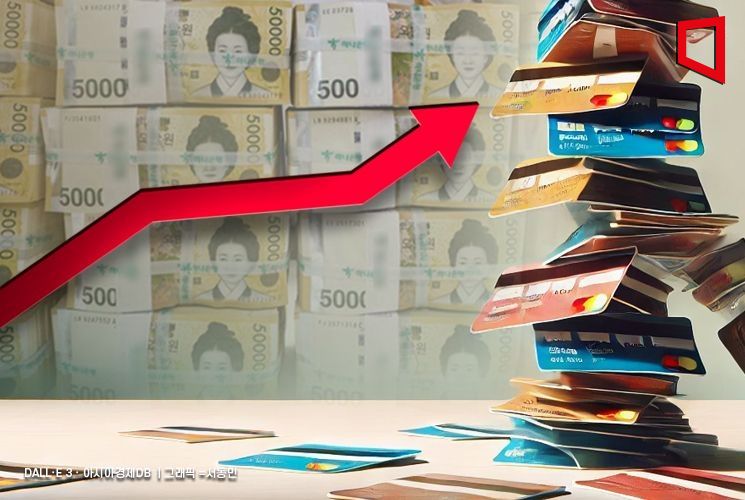
Card loans are a typical example of recession-type loans and thus have a high risk of default. Since there is no separate loan screening, anyone with a card can easily use them, but the average loan interest rate reaches 14-15% per annum. As a result, the scale of “rolling over” card loans?taking out new card loans to repay existing ones?has approached 2 trillion KRW. The balance of refinancing loans used for rolling over stood at 1.9105 trillion KRW as of the end of last month, up 45.6% year-on-year.
The outstanding balance of insurance policy loans, also considered recession-type loans, is rising sharply. According to the Financial Supervisory Service, the outstanding balance of insurance policy loans by insurance companies was 70.1 trillion KRW as of the end of the first quarter this year. This is an increase of 1.9 trillion KRW compared to the same period last year and has maintained the highest-ever level of around 70 trillion KRW for three consecutive quarters. Insurance policy loans are products where borrowers use future receivables as collateral to borrow money, allowing them to borrow 79-95% of the surrender value without canceling their insurance policies. Since there is no screening process such as credit rating checks, these loans are mainly used by people with low credit scores who find it difficult to obtain bank loans.
Many people end up canceling or unable to maintain their insurance contracts altogether. According to the Life Insurance Association, the total amount of insurance cancellation and lapse refunds paid by 22 domestic life insurance companies in the first quarter of this year reached 12.4178 trillion KRW. Although this is lower than the same period last year (14.4082 trillion KRW), it has increased significantly compared to 2022 (9.1328 trillion KRW). Cancellation refunds are the money returned when a policyholder requests contract cancellation, and lapse refunds are returned when a contract is terminated due to non-payment of premiums for a certain period.
The increase in recession-type loans is due to commercial banks and savings banks raising their lending thresholds. The credit scores for household loans based on new loan amounts in April at the five major banks (KB Kookmin, Shinhan, Hana, Woori, NH Nonghyup) and internet banks (Kakao, K, Toss Bank) ranged from 928 to 952 points. Generally, a credit score in grade 3 (832-890 points) is classified as high credit, but even these borrowers have found it difficult to get loans from commercial banks. The outstanding loan balance in the savings bank sector fell to 100 trillion KRW in April, the lowest in 28 months, interpreted as a downsizing due to the deterioration of real estate project financing (PF).
A financial industry official explained, “Recession-type loans have increased due to other financial institutions such as savings banks reducing their lending amid the worsening economy,” adding, “It seems that borrowers have flocked to card companies and insurance companies where loans are still possible before turning to illegal private loans.”
Kang Sung-jin, a professor of economics at Korea University, said, “The economic burden caused by the recession, such as insufficient loans previously taken out, has increased loan demand,” and added, “If this continues, there will likely be more cases of early termination of deposits and savings accounts before maturity.”
© The Asia Business Daily(www.asiae.co.kr). All rights reserved.


















