[K Artisan Era④] 'Banggu Buchae' Danseon (團扇) Master Bang Hwaseon, Seonjang
Jeollabuk-do Intangible Cultural Property No. 10 (Taegukseon)
A Lifelong Dedication to Jeonju Fans Spanning Two Generations
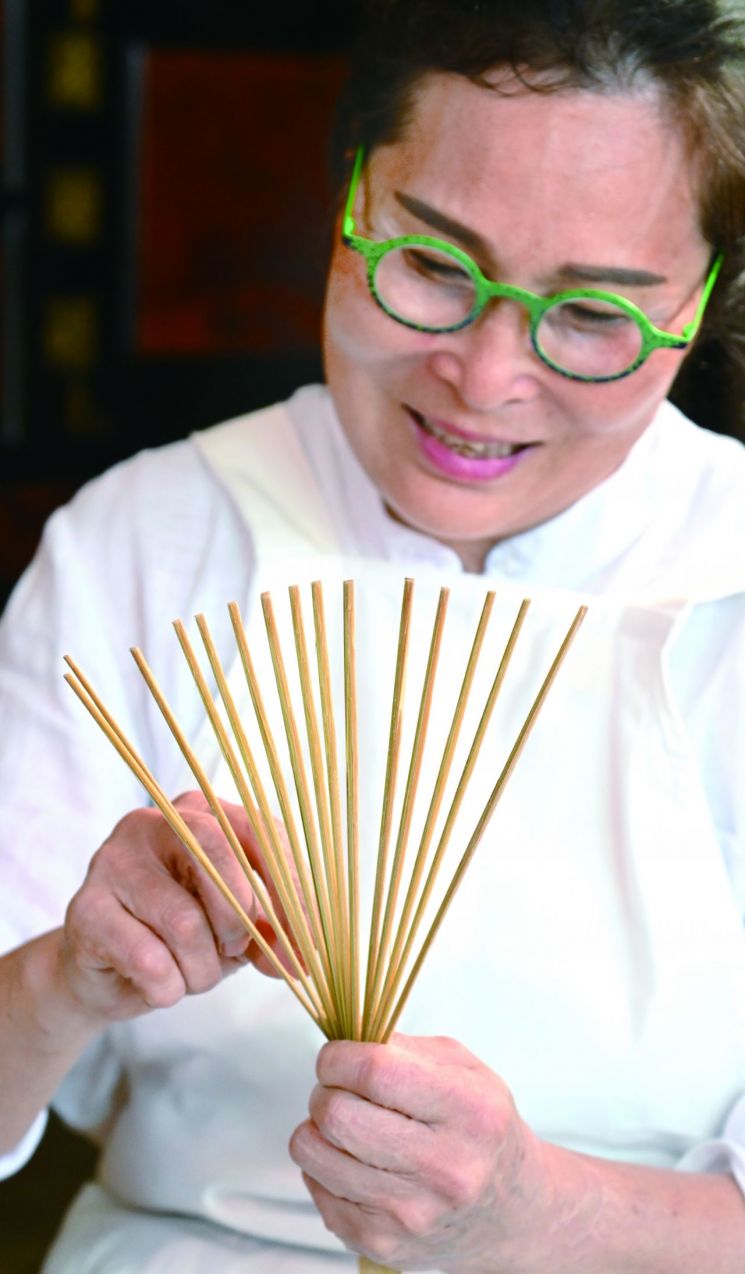 Bangsaseon Seonjajang, who evenly trims thinly sliced bamboo fan ribs. The process of cutting and trimming king bamboo, which has grown for over two years and is harvested in winter, into uniform 1mm thick slices is completed entirely by hand, not by machine.
 [Photo by Banghwasun Fan Craft Research Studio]
"Tak- Tak- Tak- Tak-"
The sound of striking wood, like hitting a moktak (wooden percussion instrument), echoes throughout the building. On the first floor workshop of the Jeonju Korean Sound Culture Hall International Conference Room, the busy hands of artisan Bang Hwa-seon, a fan maker (Seonja-jang, a craftsman with the skill of making fans, Jeollabuk-do Intangible Cultural Property No. 10), move swiftly alongside her apprentices seated on a mat. They are in the midst of making fan ribs by standing thick bamboo on a stone plate and evenly splitting it with a knife. The bamboo used is king bamboo grown for over two years, harvested in winter, and cut by hand into a uniform thickness of 1mm rather than by machine.
"The thin fan ribs spread out from the center of the handle, resembling a round shape, which is why it is called 'Banggu-bucha'?'banggu' being a pure Korean word meaning round. It is also said to represent the morning sun awakening all things in heaven and earth. This single fan (Danjeon), made by attaching silk or paper to the ribs, has ribs that spread upward and gather at the handle, so the upper part of the ribs is thin while the part where the handle is inserted must be strong. Look, the thickness of the ribs varies slightly from top to bottom, right?"
Our ancestors believed that a single fan could create wind to chase away the heat and survive the summer. In an era where electric fans and air conditioners are used more than fans, Bang Hwa-seon still believes in the power of the 'pure breeze' created by hand-made fans. This belief has been the driving force behind her dedication to fan making for over half a century.
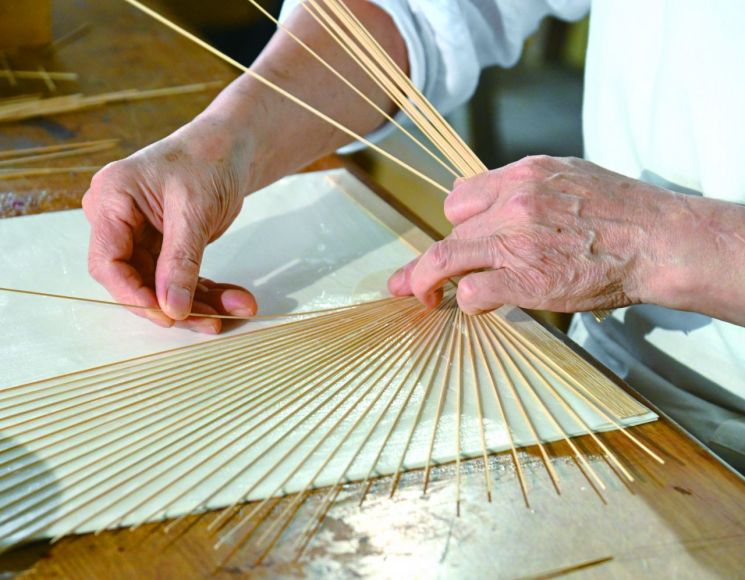 Banghwa-seon Seonjajang is a master of Dansun, which refers to a round-shaped fan made by attaching fan ribs onto paper or silk.
 [Photo by Banghwa-seon Fan Craft Research Studio]
Fans are broadly classified into folding fans ('Jeopseon') and single fans with handles ('Danjeon'). During the Joseon Dynasty, scholars considered it proper to carry a folding fan called 'Hapjukseon' before going out, as a sign of completing their formal attire. Single fans were enjoyed by both men and women and were categorized into representative types such as Taegukseon, Gongjakseon (Peacock fan), Daeryunseon, Seonnyeoseon (Fairy fan), and Pacho-seon, depending on shape and use.
Among them, the Taegukseon is a special fan for artisan Bang. "I learned about fans as if I was born in my mother's womb surrounded by them. Our family had over 160 fan makers." His father was the late Bang Chun-geun, a master of Korea and Jeonbuk Intangible Cultural Property No. 10, renowned as a master of Taegukseon among Banggu fans. His father assigned fan making as daily homework to his children, and Bang Hwa-seon, the eldest daughter among two sons and three daughters, showed the most talent in fan making from a young age by skillfully arranging the fan ribs.
In Jeonju, where Bang Hwa-seon was born and raised, there was a Seonja-cheong (fan-making office) since the Joseon Dynasty that produced fans for the royal court. Jeonju fans were considered the best nationwide, worthy of being presented to the king on the Dano Festival. They were masterpieces born from high-quality hanji paper, sturdy and straight bamboo, and the artistic sensibility of local artisans.
The late master Bang Chun-geun's household, famous as single fan artisans in Jeonju, was always busy making fans regardless of the season. Bang Hwa-seon naturally learned the fan-making skills in such an environment.
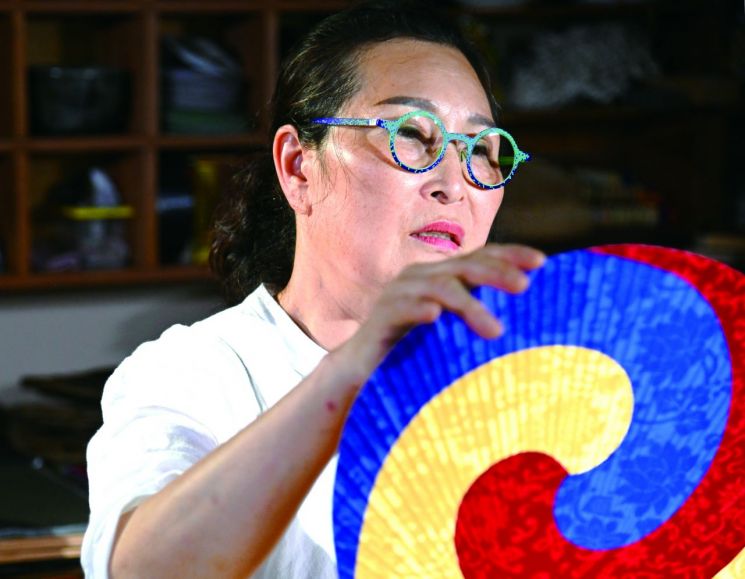 Taegukseon is a special fan to Seon Jajang Bang Hwa-seon. His father was the late Bang Chun-geun, a master craftsman of Korea and Jeonbuk intangible cultural asset No. 1, who was especially known as a Taegukseon master among Banggu fans. As the eldest of two sons and three daughters, he is the only sibling to inherit the family business and continues to make fans.
 [Photo by Bang Hwa-seon Fan Craft Research Studio]
However, in the 1970s when she was a middle school student, as electric fans became common in every household, fan orders sharply declined. After the Saemaul Movement ended and industrial complexes were established in Jeonju, fan makers all moved to factories. Although the family’s fortunes declined rapidly, master Bang Chun-geun did not give up fan making. Among the five siblings, only Bang Hwa-seon stayed by her father's side. "I had the responsibility as the eldest daughter to help my father, but I think I was more driven by the thought that fan making was what I loved most and was best at. I never considered another path. My parents told me to study, but I couldn't suddenly give up fans."
Unlike her father who insisted on tradition, Bang Hwa-seon always pondered her own fans. At age 23, she first stepped out from her father's shadow and introduced a Taeguk fan clock and a fan-made night lamp. At that time, Bang Chun-geun was furious. "He was very angry, saying I was ruining tradition. But I thought differently. I believed that as times change, fans should reflect that flow. Fans made in the past, present, and future cannot be the same. We need to incorporate contemporary sensibilities and try various new uses. If we stay only in tradition, there is no progress."
Her fans embody originality while carrying an old-fashioned beauty. This is the result of countless experiments, having made almost every kind of fan over half a century. Special fans such as 'Onseon,' made by looking at the full moon and wishing for a bountiful harvest; 'Hani-seon,' inspired by the beautiful breeze swirling; 'Saewoo-seon' (Shrimp fan) and 'Myeolchi-seon' (Anchovy fan), created before the inaugural exhibition in Tongyeong, Gyeongnam, inspired by local specialties. These are unique fans found only in her works.
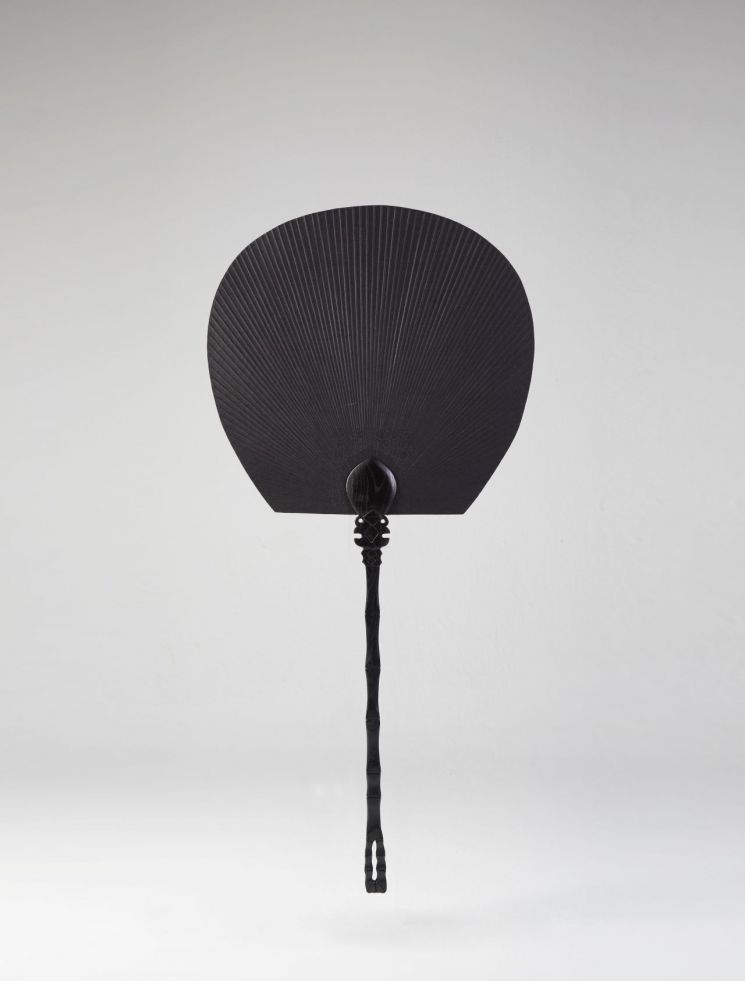 The lacquered Daewonseon fan, created by Banghwasun Seonjajang and exhibited at the 2019 Milan Design Week, is a large fan measuring 46cm in width and 98cm in length. It was highly praised for beautifully highlighting the contrast between black and white.
 [Photo by Korea Craft & Design Foundation]
A few years ago, Bang participated in a European invitational exhibition with craft artists and was deeply moved when she saw a Taeguk fan treasured like a treasure in a restaurant in Spain. "Foreigners admire our fans, saying they are truly beautiful. At the European exhibition, other artists soon put their works on sale. I didn’t want traditional culture to be sold cheaply, so I insisted on full price. In the end, I returned without selling a single piece. But I have no regrets because I preserved its value."
Foreigners, seeing other works on sale, naturally expected the fans to be discounted and waited leisurely. When the exhibition ended without a sale, urgent inquiries came from local cultural centers and organizers wanting to buy. After some searching, those who contacted Bang after her return to Korea purchased all the fans at full price.
Jung Gu-ho, a director noted for modern Korean dance, happened to see Bang’s workshop and fans during a visit to Jeonju Korean Sound Culture Hall in 2018 while directing a production. He entrusted her with making fairy fans as props for the performance. "There was already a prepared prop, but after seeing my fans, he changed his mind. As a director and designer, he had clear standards for the design he wanted. Since the fans were for a performance, I enjoyed working on them. Through this connection, Director Jung also oversaw an exhibition at Milan Design Week where I submitted a lacquered Daewon fan. The exhibition, themed 'Monologue of Ink Painting,' displayed craft works by 23 artists arranged like a Chaekgado (traditional Korean painting of books and objects). I chose lacquer work to express the gradations of ink painting, and visitors showed great interest in the subtle colors."
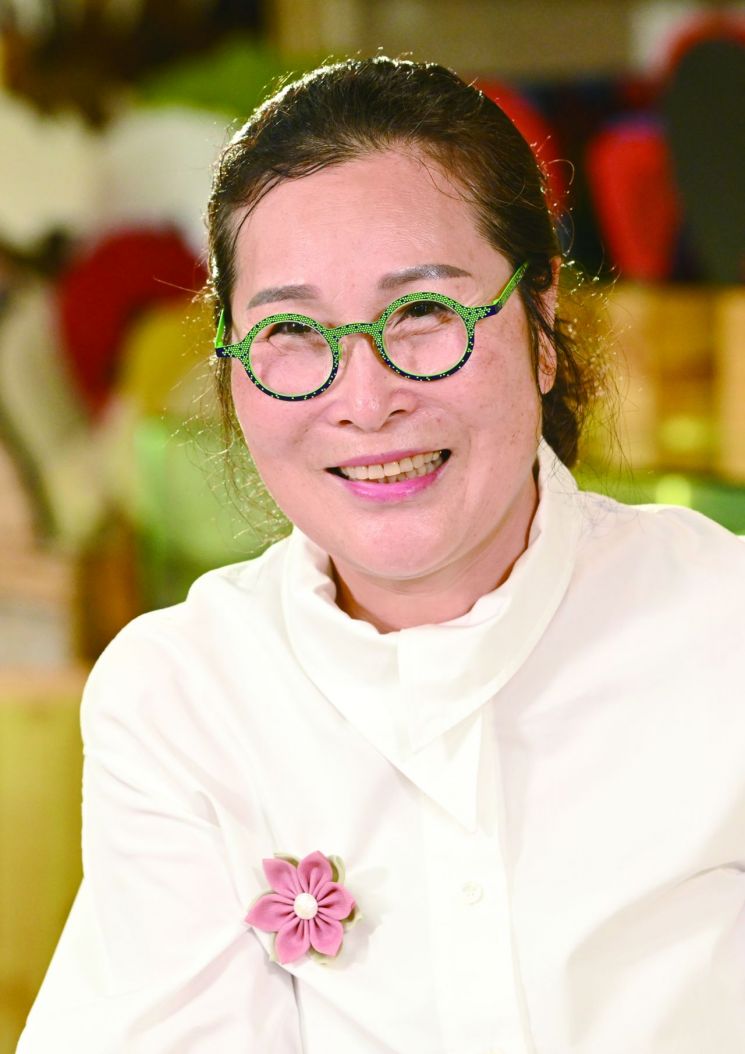 Even after making fans for over half a century, Bang Hwa-seon says that making fans is still the most exciting and enjoyable work for him. He expressed his desire to share this "joy" with many people and plans to continue offering various hands-on activities and artisan classes in the future.
 [Photo by Bang Hwa-seon Fan Craft Studio]
Bang, who immersed herself in lacquer work for a while, showed the fans she made and said, "No matter how carefully you oil the hanji paper with oil coating, if it gets wet, the fan becomes unusable. That’s the limitation of hanji fans. But lacquer can overcome that limit. The long handle of a fan excavated from the Dahori site in Changwon, Gyeongnam, dating back to the Samhan period, survived for a long time thanks to lacquer."
Bang Hwa-seon says the moment she arrives at the workshop is the most exciting and enjoyable. Like a fan that has endured underground for many years, she hopes fans will be loved by many people for a long time to come. "When I find good materials, I get excited thinking about what kind of fan to make. Even if something unpleasant happens, coming to the workshop calms my mind. I want to share this joy with many people, so I conduct classes such as experiential learning and artisan schools whenever I can. Today, I dream of creating a gentle breeze like that."
© The Asia Business Daily(www.asiae.co.kr). All rights reserved.



















